A tote's second life is worth more than its first.
We buy used IBC totes, wash them back to spec, re-mark them, haul them where they are needed next — and only grind them up when the container has genuinely nothing left to give. 418,400 containers kept in service and counting.
Start with one form. It covers everything we do.
Buying, selling, washing, hauling, leasing or recycling — one request line, read by a person in York, PA. Written reply inside one business day.
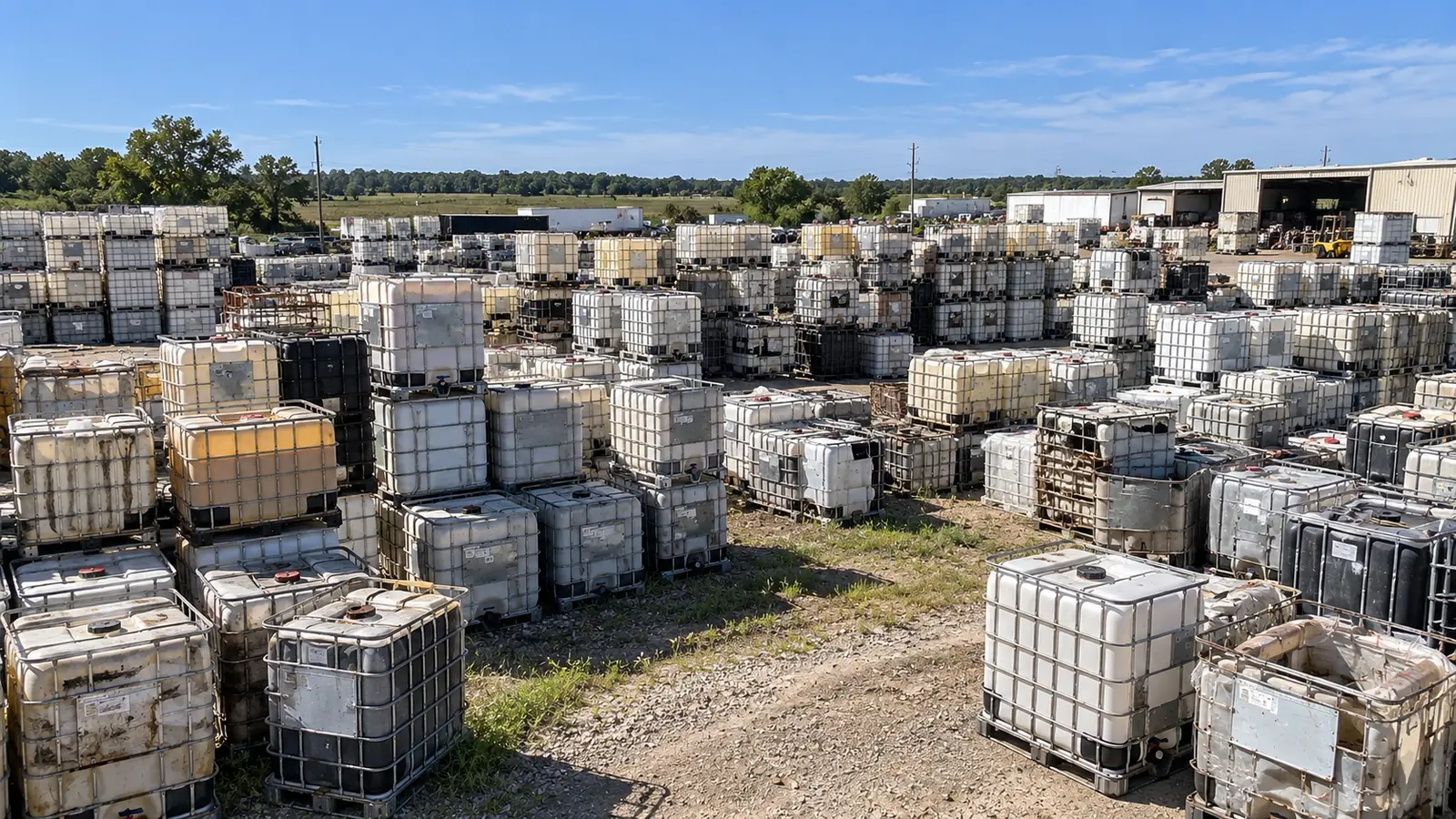
Roughly 2,900 containers on the ground at any time.
Every one of them arrived with a signed declaration, crossed a certified scale, and was graded in writing before anybody saw a price. This is what 418,400 recovered containers looks like from the middle of it.
We do not sell containers.
We keep them circulating.
A 275-gallon tote has roughly seven honest service lives in it. Most of them are thrown away after one. Our yard exists to close that gap.
Each stage below is a real station at 310 Emig Rd — not a diagram. Average turnaround from inbound gate to shippable, graded tote is 72 hours.
Recover
We pay for empties at breweries, co-ops, plating shops, print houses and chemical blenders — and we clear whole yards in a day. Nothing leaves your site without a weight ticket and a prior-contents record.
Sort & grade
Every inbound tote is sniffed, lit from behind, and read off its UN plate. Edible-prior stock is quarantined separately from industrial. Cages are checked for twist, pallets for rot and delamination.
Wash or rebottle
Three-stage rinse for benign residues; hot caustic clean-in-place with a 360° rotating lance for the stubborn ones. When a bottle will not come back to spec, we keep the cage and pallet and fit a new bottle instead of scrapping the lot.
Test, re-mark, redeploy
Leak test at pressure, new valve and gaskets, new lid, then a fresh UN 31HA1 mark with our reconditioner code and date. Graded A, B or C, photographed, listed, loaded.
Recycle — last, not first
Bottles that fail twice are granulated into HDPE regrind; cages and pallets go to steel and timber recovery. Last year that route accounted for only 2.6% of everything we took in.
Environmental claims should come with arithmetic.
Eight ways to buy a bulk container
Graded honestly, photographed before it ships, and priced by condition — not by optimism.
Reconditioned
Original bottle, washed and pressure-tested, new valve and gaskets, fresh UN mark. Grades A through C.
OpenVirgin contactRebottled
New blow-moulded HDPE bottle in a reused cage and pallet. Food-grade contact surface at a fraction of new-tote cost.
OpenNew / first-use
When a specification, an auditor or a customer genuinely requires virgin everything. We will say so when that is the case.
OpenFood-grade
Edible-prior-service only, washed on a dedicated line, prior contents documented in writing.
OpenStainless IBCs
304 and 316L vessels for solvents, flavourings and anything that would craze poly. Decades of service, not years.
OpenAccessories & parts
Valves, butterfly and ball; camlocks, S60x6 adapters, lids, gaskets, cages, pallets and dust caps.
OpenFun oneUpcycled builds
Rain-harvest kits, aquaponics beds, wash stations, fire-suppression tanks and bar tops. Built in-house from Grade C stock.
OpenCompare everything
The full catalogue with dimensions, grades, prior-service rules and price bands side by side.
OpenOur stock, photographed where it stands
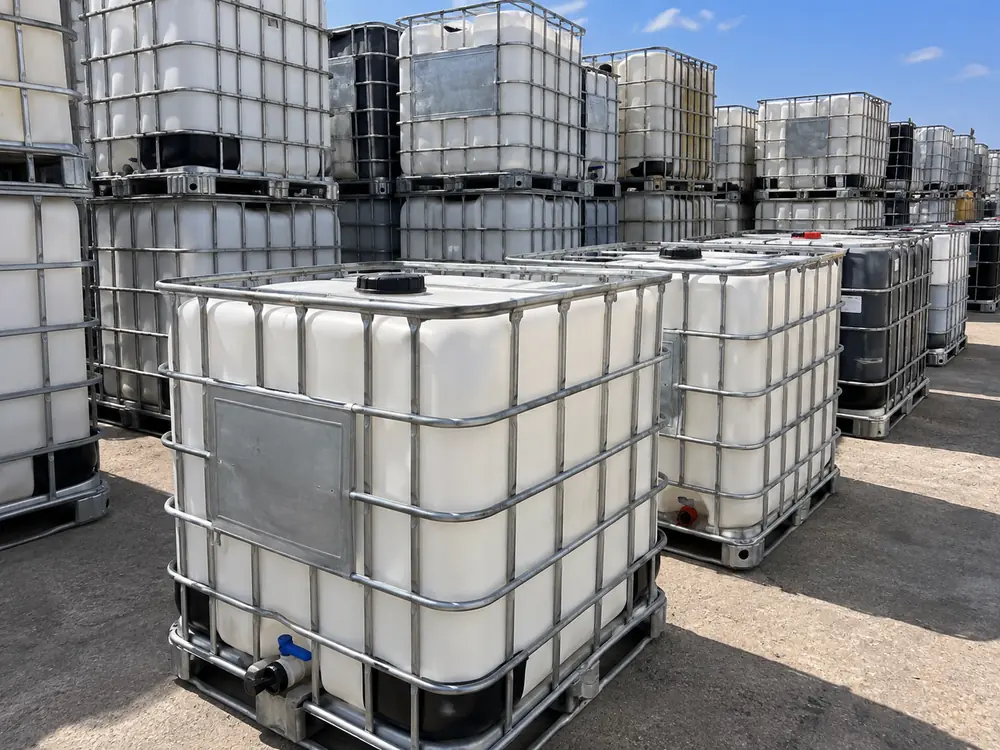
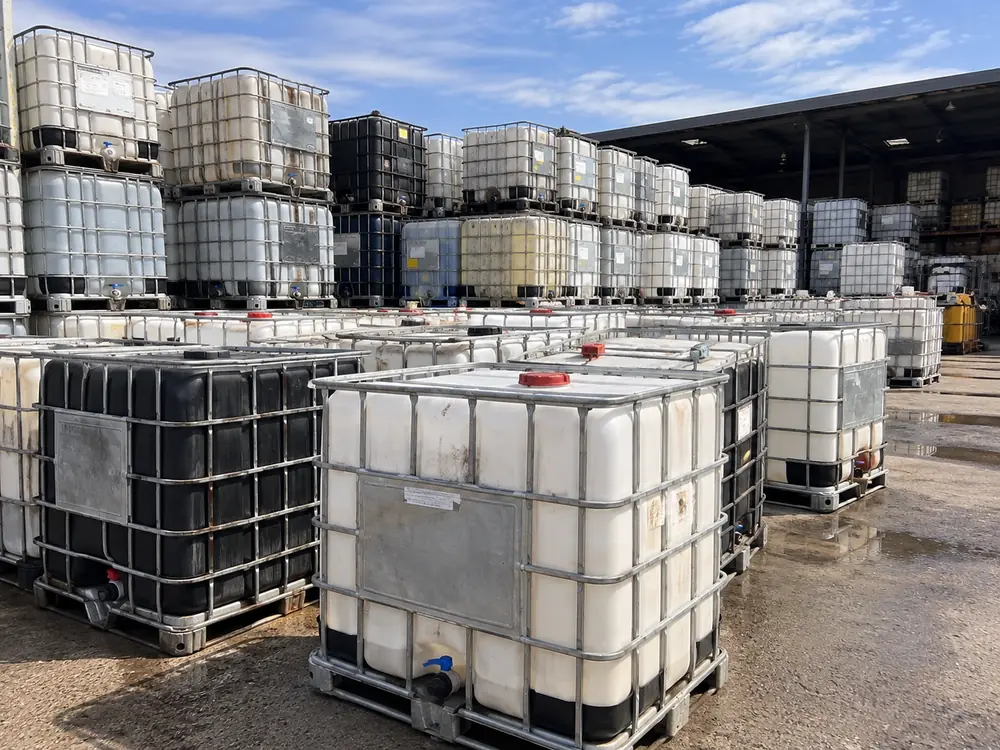
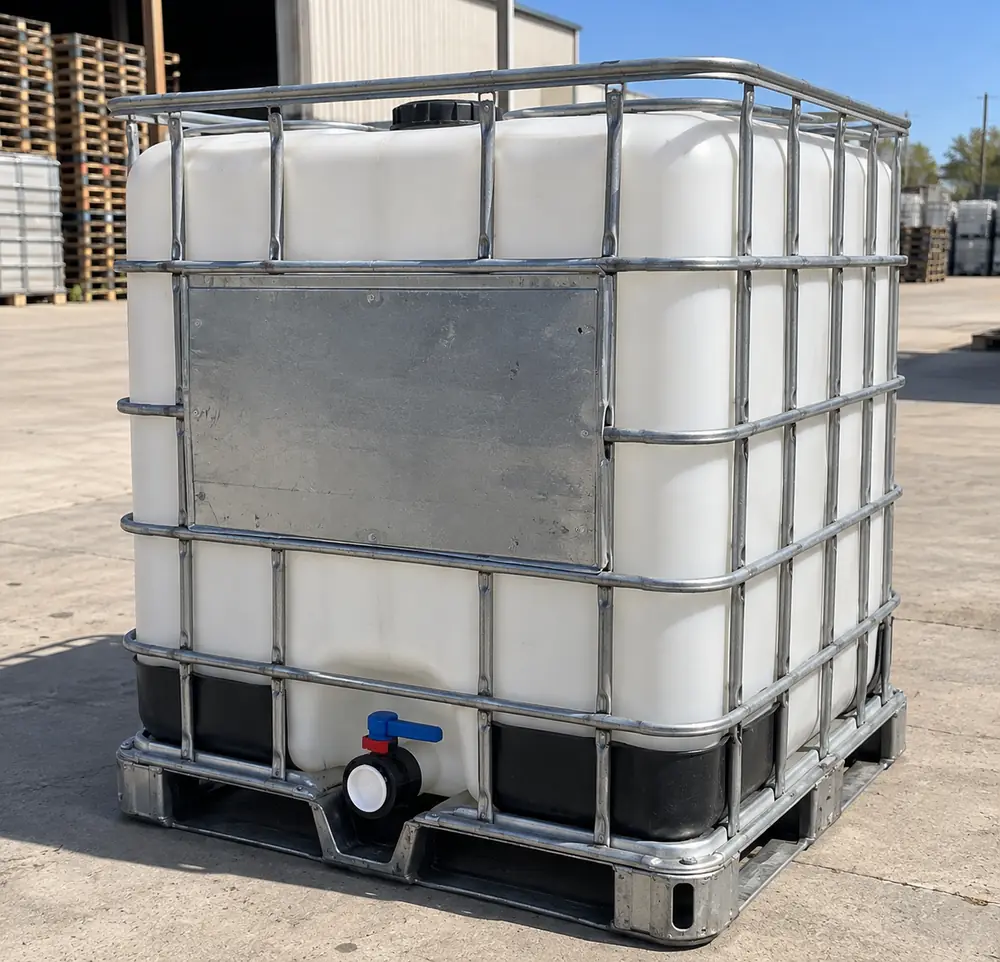
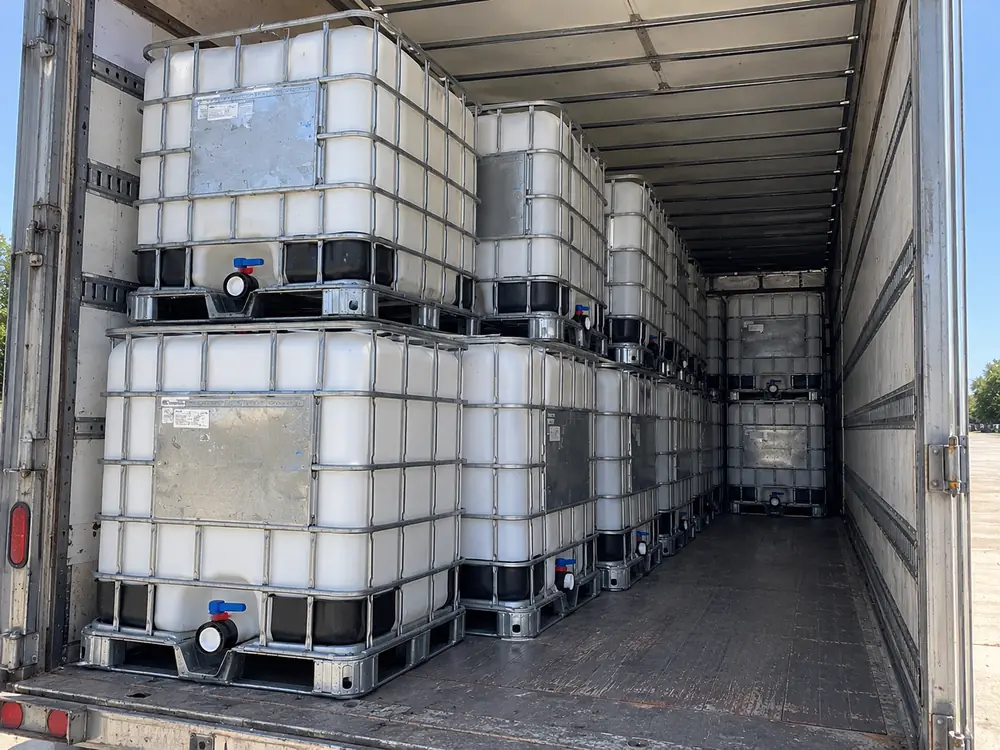
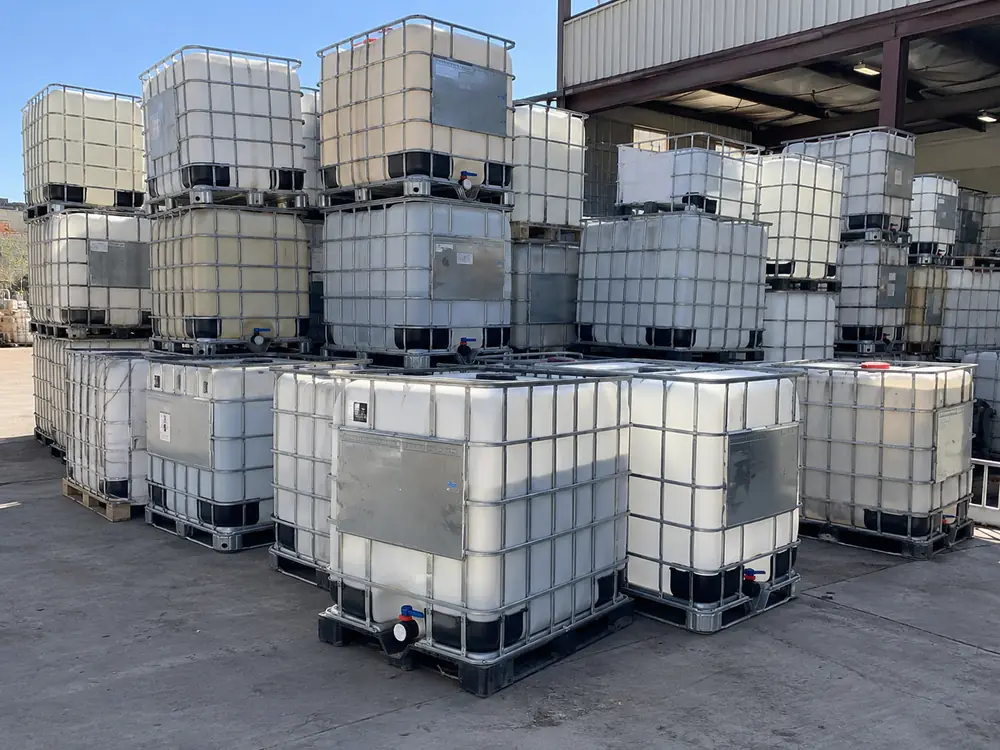
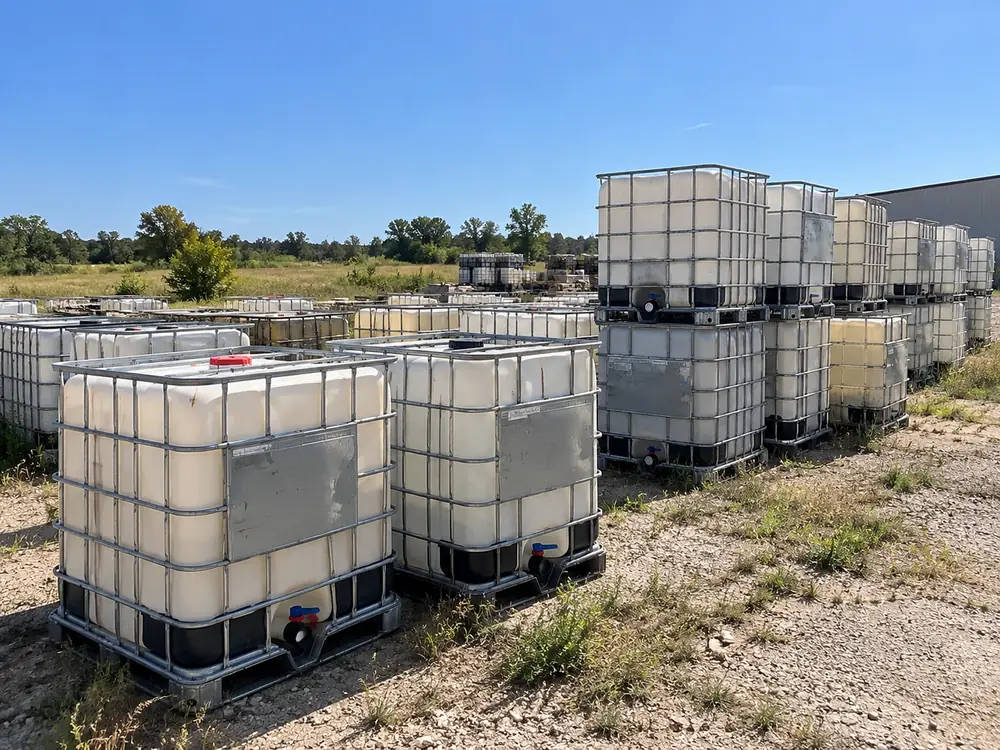
No stock imagery anywhere on this site. These are our containers, in our yard, and the units you are quoted are photographed on the rack before they ship.
One reconditioned tote beats one recycled tote. Every time.
Recycling a container destroys the most valuable thing about it: its shape. Washing it keeps 100% of the embodied energy that went into forming the bottle, welding the cage and building the pallet.
A new 275-gallon composite IBC carries roughly 118 lb of virgin HDPE, 62 lb of galvanised steel and a pallet. Producing that resin and steel from scratch is where almost all of the container's lifetime carbon sits — not in using it, and not in washing it.
Washing the same tote takes about 31 gallons of water on our closed-loop line, of which we reclaim and re-use the bulk through a three-stage settling and filtration train. Grinding it into regrind instead means re-melting, re-pelletising and re-moulding — energy you simply do not have to spend if the vessel still holds liquid.
That is the whole thesis of this company, and it is why recycling is our last service, not our first.
| Route | Embodied CO₂e | Water | Virgin resin |
|---|---|---|---|
| New composite IBC | ≈ 410 lb | ≈ 290 gal | 118 lb |
| Rebottled | ≈ 182 lb | ≈ 120 gal | 47 lb |
| Reconditioned | ≈ 34 lb | ≈ 31 gal | 0 lb |
Figures are our own yard measurements combined with published HDPE and galvanised steel factors. Method and sources are set out in full on The Carbon Math of Reuse.
Six things we do, all of them with a tote in hand
We buy your used totes
Written offers, freight included, weight tickets and prior-contents records on collection.
OpenReconditioning & washing
Triple-rinse through hot caustic CIP, leak test, re-valve, re-mark. Your totes or ours.
OpenNationwide transport
Flatbed and van freight across the lower 48, with backhaul pricing when the lane allows.
OpenRecycling & regrind
Documented end-of-life with diversion certificates for your environmental reporting.
OpenLeasing & pooling
Rent a float of graded totes for a season or a campaign and hand them back.
OpenSite cleanouts
Mixed, stacked, weathered yards cleared in a day — including the ones nobody else wants.
OpenTote Studio: build your exact spec, then send it to the yard.
Pick a capacity, a grade, a valve thread, a lid and a pallet. The drawing updates as you go, the spec sheet writes itself, and the request form arrives at our desk already filled in. No login, no JavaScript framework gymnastics — it works with scripts switched off.
The size chart people actually bookmark
Nominal capacity, real capacity, footprint, tare, gross, stack rating, valve thread and UN marking — in one table, with the awkward exceptions noted rather than hidden.
| Format | Capacity | L × W × H | Tare | Gross |
|---|---|---|---|---|
| 275 gal composite | 275 gal / 1,041 L | 48 × 40 × 46" | 137 lb | 2,590 lb |
| 275 gal tall | 275 gal / 1,041 L | 48 × 40 × 53" | 141 lb | 2,600 lb |
| 330 gal composite | 330 gal / 1,249 L | 48 × 40 × 53" | 165 lb | 3,100 lb |
| 350 gal composite | 350 gal / 1,325 L | 48 × 40 × 58" | 172 lb | 3,250 lb |
| 550 gal composite | 550 gal / 2,082 L | 48 × 48 × 72" | 251 lb | 5,050 lb |
The parts of the job that happen off the wash line
Industries
Agriculture & growers
Liquid fertiliser, crop protection, irrigation buffer tanks, maple sap, honey.
OpenFood & beverage
Syrups, brines, concentrates, spent grain slurry, cider and wine transfer.
OpenChemical & industrial
Surfactants, coolants, plating chemistry, de-icer, adhesives, waste streams.
OpenAll industries we serveField guides
How to clean an IBC tote
The method we use, the chemicals we use, and the four residues we refuse.
Open14-point buying checklist
What to look at before money changes hands, in inspection order.
OpenRainwater harvesting build
Turn a Grade C tote into a 275-gallon catchment that survives a Pennsylvania winter.
OpenOpen the guide libraryQuestions we get every week
If yours is not here, the FAQ page has sixty-six more — or just ask on the form.
What is the difference between a reconditioned and a rebottled IBC tote?
A reconditioned tote keeps its original bottle: we empty it, triple-rinse or caustic-wash it, pressure-test the fittings, replace the valve and gaskets, re-cage it where needed and re-mark it. A rebottled tote keeps the steel cage and pallet but receives a brand-new blow-moulded HDPE bottle, so the contact surface is virgin plastic at roughly 55–65% of new-tote cost. Rebottling is how you get a food-grade contact surface without buying a whole new asset.
Do you buy used totes, and how much do you pay?
Yes — buying empties is half of our business. Price depends on what was in them, whether the bottle is clear or cloudy, cage condition, valve type and how many you have on one site. Clean, label-free, previously-edible totes in lots of 20+ fetch the most. Send the quantity, the last product and a photo through the request form and you will have a written offer, including freight, inside one business day.
Are used IBC totes safe for drinking water or food?
Only if the prior service was food-grade and the tote has been washed and certified for it. We keep edible-prior-service totes in a separate quarantine row, wash them on a dedicated food line and document the prior contents. We will never sell you an industrial-prior tote for potable use, and we will tell you plainly when rebottling is the honest answer.
Do you deliver, and how far?
We run flatbed and dry-van freight to the lower 48. Full truckloads move 40–45 totes at a time; LTL and partial loads are quoted per lane. The Mid-Atlantic, Northeast and Ohio Valley are our dedicated lanes and often ship within 48 hours of order.
What happens to a tote that cannot be reused again?
It is dismantled, not landfilled. The HDPE bottle is cut, washed and granulated into regrind; the galvanised cage and the steel or composite pallet go to a scrap partner; valves and lids are harvested for reuse. We document the destruction and issue a diversion certificate if your environmental reporting needs one.
Why does the site not list a phone number?
Deliberately. Every quote, grade call and freight booking we make goes in writing, by email, so there is a record both sides can point at later. It eliminates the "but you said on the phone" problem that plagues used-container trading. Use the request form or email us directly and you will get a same-business-day reply.
Got empties sitting out back?
They are an asset, not a disposal problem. Tell us how many and what was in them.
Everything we know, on one page
Most container sites make you email for the numbers. Ours are published: twelve formats, a hundred named prior products, twenty-one seal compatibilities, twenty-five freight lanes and eighteen regulations. Nothing below is behind a form.
Every container we handle, dimension by dimension
Nominal versus usable capacity, footprint, tare on a steel base, gross filled with water, outlet size, stack rating and how often we actually have it.
| Format | Nominal | Usable | L × W × H | Tare (steel base) | Gross, water | Outlet | Stack filled | Availability |
|---|---|---|---|---|---|---|---|---|
| 275 gal standard | 275 gal / 1,041 L | 265 gal | 48 × 40 × 46" | 137 lb | 2,347 lb | 2" S60x6 | 2 high | Ex-stock |
| 275 gal tall | 275 gal / 1,041 L | 264 gal | 48 × 40 × 53" | 141 lb | 2,342 lb | 2" S60x6 | 2 high | Regular |
| 330 gal standard | 330 gal / 1,249 L | 320 gal | 48 × 40 × 53" | 165 lb | 2,834 lb | 2" S60x6 | 2 high | Ex-stock |
| 350 gal | 350 gal / 1,325 L | 338 gal | 48 × 40 × 58" | 172 lb | 2,991 lb | 2" or 3" | 2 high | Occasional |
| 400 gal | 400 gal / 1,514 L | 386 gal | 48 × 46 × 60" | 198 lb | 3,417 lb | 3" buttress | 1 high | Order |
| 550 gal | 550 gal / 2,082 L | 532 gal | 48 × 48 × 72" | 251 lb | 4,688 lb | 3" buttress | 1 high | Occasional |
| 120 gal mini | 120 gal / 454 L | 115 gal | 32 × 32 × 36" | 71 lb | 1,030 lb | 2" S60x6 | 2 high | Occasional |
| 180 gal | 180 gal / 681 L | 174 gal | 40 × 40 × 42" | 98 lb | 1,549 lb | 2" S60x6 | 2 high | Order |
| Stainless 265 gal | 265 gal / 1,003 L | 258 gal | 48 × 40 × 50" | 285 lb | 2,436 lb | 2" tri-clamp | 2 high | Occasional |
| Stainless 330 gal | 330 gal / 1,249 L | 322 gal | 48 × 40 × 56" | 330 lb | 3,015 lb | 2" tri-clamp | 2 high | Occasional |
| Stainless 400 gal | 400 gal / 1,514 L | 390 gal | 48 × 46 × 62" | 385 lb | 3,637 lb | 3" tri-clamp | 1 high | Order |
| Stainless 500 gal | 500 gal / 1,893 L | 488 gal | 48 × 48 × 68" | 430 lb | 4,600 lb | 3" tri-clamp | 1 high | Order |
Gross figures assume water at 8.34 lb/gal and usable rather than nominal capacity — the honest basis for equipment planning. For a denser product, multiply by specific gravity; the table further down does it for you. Full size chart.
Twelve situations and the service that fits
Find the sentence that sounds like your week. Each one links to the page that answers it.
| If this is your situation | The service | Turnaround |
|---|---|---|
| We have empties and no plan | Buy-back | 1 week, Mid-Atlantic |
| We need washed totes by Friday | Reconditioned stock | Ex-stock |
| Our own fleet comes back dirty | Contract reconditioning | 72 hrs per batch |
| We need 80 food-grade for 11 weeks | Lease pool | 1–2 weeks |
| Corporate wants end-of-life evidence | Documented recycling | 2 weeks + certificate |
| The plant is closing this month | Site cleanout | 1 day on site |
| 40 totes to Columbus, nobody will quote | Transport | 1–2 days transit |
| We do not know what these totes are | Free grading from photos | Same day, by email |
| We need a virgin contact surface | Rebottling | 3–7 days |
| Solvents are destroying our poly totes | Stainless IBCs | 1–3 weeks |
| A tote is leaking at the valve | Parts | Next business day |
| We want a rain tank, not a container | Upcycled builds | 1–3 weeks |
What each grade commits us to
These are contractual definitions printed on the back of every invoice, not adjectives. The inspector assigns the grade and nobody in sales can overturn it.
| Grade A | Grade B | Grade C | Cage / pallet only | |
|---|---|---|---|---|
| Bottle clarity | Clear / near-clear | Haze & staining permitted | Ghosting permitted | n/a |
| Prior service | Documented edible, signed at source | Industrial, declared | Industrial, declared | Any declared |
| Wash programme | Food line, recorded | Programme to residue, recorded | Ambient rinse | Cage rinse only |
| Hydrostatic test | 100% of units | Sampled | Sampled | n/a |
| New valve & gaskets | Yes, FDA-compliant | Yes | Sound or new | n/a |
| New lid | Yes | Yes | Sound or new | n/a |
| Re-marked | Yes | Yes | Where the plate survives | No |
| Stackable when filled | 2 high | 2 high | No | n/a |
| 30-day leak warranty | Yes | Yes | No — watertight at loading | No warranty |
| Food / potable | Yes, with records | No | No | n/a |
| Cost vs new | ≈ 35–45% | ≈ 25–32% | ≈ 18–24% | ≈ 5–10% |
| Lead time | Ex-stock to 5 days | Ex-stock | Ex-stock | Ex-stock |
| Loop score (lives left) | 5–6 | 4–5 | 2–3 | 3–4 bottles |
Match the liquid to the container before anything else
Three tables that answer most of what customers email us about: what your prior product does to a bottle, which wash programme it needs, and which seal will survive it.
Prior-product list — all 110 named products, with programme, achievable grade and food eligibility
This is the list our inbound inspector works from. Published in full because a buyer who can see it can pre-screen their own stock, and because a reconditioner who will not tell you what a residue does to a bottle is guessing.
| Prior product | Family | SG | Programme | Best grade | Food? | Seal | What to watch |
|---|---|---|---|---|---|---|---|
| Apple juice concentrate (70 Bx) | Food & beverage | 1.35 | PF | A | Yes | FDA EPDM | Best inbound stock we see; sugars rinse clean |
| Orange juice concentrate | Food & beverage | 1.33 | PF | A | Yes | FDA Viton | Citrus oil fraction can scent the bottle |
| Grape juice concentrate | Food & beverage | 1.34 | PF | A | Yes | FDA EPDM | Watch for tartrate scale at the outlet |
| Liquid sugar / sucrose syrup | Food & beverage | 1.33 | PF | A | Yes | FDA EPDM | Hot rinse only, no caustic needed |
| High-fructose corn syrup | Food & beverage | 1.38 | PF | A | Yes | FDA EPDM | Viscous; 3" outlet helps decanting |
| Molasses | Food & beverage | 1.42 | PF | A | Yes | FDA EPDM | Heated rinse; heavy heel |
| Honey | Food & beverage | 1.42 | PF | A | Yes | FDA EPDM | Crystallises; heater jacket recommended |
| Maple sap | Food & beverage | 1.02 | PF | A | Yes | FDA EPDM | Benign but sugars feed biofilm fast |
| Maple syrup | Food & beverage | 1.33 | PF | A | Yes | FDA EPDM | Hot rinse; inspect lid seat |
| Apple cider | Food & beverage | 1.05 | PF | A | Yes | FDA EPDM | Vented lid essential — ferments |
| Wine / must | Food & beverage | 1.08 | PF | A | Yes | FDA EPDM | Tartrate scale; usually leased |
| Beer / wort | Food & beverage | 1.05 | PF | A | Yes | FDA EPDM | Stainless preferred for repeat service |
| Brine (pickling liquor) | Food & beverage | 1.20 | PF | A | Yes | FDA Viton | Check cage for chloride attack |
| Vinegar, 10% | Food & beverage | 1.01 | PF | A | Yes | FDA EPDM | Easy; acid-resistant seal needed |
| Soy sauce | Food & beverage | 1.20 | PF | A | Yes | FDA Viton | Salt plus colour; monitor ghosting |
| Edible soybean oil | Food & beverage | 0.92 | P2 | A | Yes | FDA Viton | 140°F minimum or fat re-deposits |
| Edible canola oil | Food & beverage | 0.91 | P2 | A | Yes | FDA Viton | As above |
| Olive oil | Food & beverage | 0.92 | P2 | A | Yes | FDA Viton | Polyphenols can tint the wall |
| Glycerine, USP | Food & beverage | 1.26 | PF | A | Yes | FDA EPDM | Often effectively first-use stock |
| Propylene glycol, food grade | Food & beverage | 1.04 | PF | A | Yes | FDA EPDM | Frequently single-product filler stock |
| Liquid egg | Food & beverage | 1.04 | PF | A | Case by case | FDA EPDM | Protein film needs verification |
| Milk / dairy intermediate | Food & beverage | 1.03 | PF | A | Case by case | FDA EPDM | Allergen changeover record required |
| Whey concentrate | Food & beverage | 1.06 | PF | A | Case by case | FDA EPDM | Protein scale; hot detergent |
| Tomato paste | Food & beverage | 1.10 | PF | A | Yes | FDA Viton | Acidic; stains but rinses |
| Fruit purée | Food & beverage | 1.12 | PF | A | Yes | FDA EPDM | Pulp load; coarse settling matters |
| Flavour concentrate / essence | Food & beverage | 0.95 | Refused | Rebottle | No | PTFE | Permeates HDPE permanently — use stainless |
| Citrus terpene oil | Food & beverage | 0.84 | Refused | Recycle | Never | PTFE | One batch ends a poly bottle's usefulness |
| Spent grain slurry | Food & beverage | 1.05 | P2 | B | No | EPDM | By-product duty; 3" outlet strongly advised |
| Yeast slurry | Food & beverage | 1.08 | P2 | B | Case by case | EPDM | Vent — active fermentation |
| UAN 32 liquid nitrogen | Agricultural | 1.32 | P1 | B | Never | EPDM | Rinses readily; dense — check ratings |
| UAN 28 | Agricultural | 1.28 | P1 | B | Never | EPDM | As above |
| Liquid starter 10-34-0 | Agricultural | 1.38 | P1 | B | Never | EPDM | Polyphosphate scale at the outlet |
| Ammonium thiosulphate | Agricultural | 1.33 | P1 | B | Never | EPDM | Sulphur odour persists faintly |
| Potassium thiosulphate | Agricultural | 1.47 | P1 | B | Never | EPDM | Very dense; 275 format only |
| Calcium nitrate solution | Agricultural | 1.43 | P1 | B | Never | EPDM | Crystallises when cold |
| Humic / fulvic acid | Agricultural | 1.10 | P2 | B | Never | EPDM | Dark staining, usually washes out |
| Fish hydrolysate fertiliser | Agricultural | 1.12 | P3 | C | Never | Viton | Odour frequently permanent |
| Foliar micronutrient blend | Agricultural | 1.25 | P1 | B | Never | EPDM | Metal salts can tint the wall |
| Glyphosate concentrate | Agricultural | 1.17 | P3 | C | Never | Viton | Labelled rinse programme governs |
| 2,4-D amine concentrate | Agricultural | 1.19 | Refused | Per label | Never | Viton | Label prescribes rinse-and-destroy |
| Crop oil adjuvant | Agricultural | 0.88 | P3 | C | Never | Viton | Attacks EPDM; permeates slowly |
| Surfactant adjuvant (NIS) | Agricultural | 1.03 | P1 | B | Never | EPDM | Foams heavily on transfer |
| Molluscicide suspension | Agricultural | 1.22 | Refused | Per label | Never | Viton | Refused — labelled destruction |
| Livestock drinking water | Water & inert | 1.00 | P1 | A | Yes | EPDM | Effectively first-use |
| Irrigation water | Water & inert | 1.00 | P1 | A | Yes | EPDM | May carry silt; coarse settling |
| Sodium hydroxide 50% | Industrial chemistry | 1.52 | P1 | B | Never | EPDM | 3,497 lb filled — check every rating |
| Sodium hydroxide 25% | Industrial chemistry | 1.27 | P1 | B | Never | EPDM | Easy wash; dilute and drain |
| Potassium hydroxide 45% | Industrial chemistry | 1.46 | P1 | B | Never | EPDM | As NaOH; dense |
| Sulphuric acid 93% | Industrial chemistry | 1.83 | Refused | Dedicated | Never | PTFE | 4,182 lb filled; dedicated service only |
| Sulphuric acid 35% | Industrial chemistry | 1.26 | P1 | C | Never | PTFE | Fume attack on cage galvanising |
| Hydrochloric acid 31% | Industrial chemistry | 1.16 | P1 | C | Never | PTFE | Cage usually the limiting factor |
| Phosphoric acid 75% | Industrial chemistry | 1.58 | P1 | B | Never | PTFE | Dense; viscous at low temperature |
| Nitric acid 42% | Industrial chemistry | 1.26 | Refused | Dedicated | Never | PTFE | Oxidiser — embrittles HDPE |
| Hydrogen peroxide 35% | Industrial chemistry | 1.13 | P1 | B | Case by case | PTFE | Vent; absolutely no contaminants |
| Sodium hypochlorite 12% | Industrial chemistry | 1.21 | P1 | B | Never | EPDM | Degasses; vent and shield from UV |
| Ferric chloride 40% | Industrial chemistry | 1.42 | P2 | C | Never | Viton | Heavy orange staining is permanent |
| Aluminium sulphate | Industrial chemistry | 1.33 | P1 | B | Never | EPDM | Scale at the outlet boss |
| Polyaluminium chloride | Industrial chemistry | 1.35 | P1 | B | Never | EPDM | Gels if allowed to dry out |
| Propylene glycol coolant | Industrial chemistry | 1.04 | P1 | B | Never | EPDM | Ideal duty; nothing to watch |
| Ethylene glycol | Industrial chemistry | 1.11 | P1 | B | Never | EPDM | Toxic — never re-grade for potable |
| Calcium chloride brine 32% | Industrial chemistry | 1.38 | P1 | B | Never | Viton | Chloride attack on lower cage |
| Magnesium chloride de-icer | Industrial chemistry | 1.32 | P1 | B | Never | Viton | As above; rinse frames each spring |
| Potassium acetate de-icer | Industrial chemistry | 1.28 | P1 | B | Never | EPDM | Benign; airport runway chemistry |
| Urea solution (DEF) | Industrial chemistry | 1.09 | P1 | B | Never | EPDM | Purity-critical next fill; usually dedicated |
| Nickel plating solution | Industrial chemistry | 1.25 | Refused | Recycle | Never | Viton | Metal-bearing; never re-used |
| Chromic acid solution | Refused | 1.30 | Refused | Refused | Never | PTFE | Not accepted at the gate |
| Cyanide plating bath | Refused | 1.15 | Refused | Refused | Never | PTFE | Acutely hazardous — licensed facility only |
| Phosphate conversion coating | Industrial chemistry | 1.22 | P2 | C | Never | Viton | Scale and staining |
| Amine corrosion inhibitor | Industrial chemistry | 0.98 | P2 | B | Never | Viton | Fish-like odour can persist |
| Sodium silicate | Industrial chemistry | 1.39 | P3 | C | Never | EPDM | Sets hard if dried; wash promptly |
| Polymer flocculant emulsion | Industrial chemistry | 1.02 | P3 | C | Never | EPDM | Extremely slippery; gels with water |
| Sodium bisulphite | Industrial chemistry | 1.33 | P1 | B | Never | EPDM | Sulphur odour; vent |
| Antifoam silicone emulsion | Industrial chemistry | 1.00 | P3 | C | Never | Viton | Film is very hard to remove |
| Latex paint, white | Coatings & inks | 1.30 | P3 | C | Never | EPDM | Heavy ghosting; often rebottle |
| Latex paint, tinted | Coatings & inks | 1.32 | P3 | C | Never | EPDM | Pigment ghosting permanent |
| Water-based pigment dispersion | Coatings & inks | 1.25 | P3 | C | Never | EPDM | Strong colour transfer into the wall |
| Flexographic ink | Coatings & inks | 1.08 | P3 | Rebottle | Never | Viton | Resin binder plasticises the surface |
| UV-curable coating | Coatings & inks | 1.10 | Refused | Recycle | Never | PTFE | Cures in the bottle; not washable |
| Acrylic adhesive emulsion | Coatings & inks | 1.08 | P3 | Rebottle | Never | EPDM | Caustic at 180°F, often still ghosts |
| PVA wood adhesive | Coatings & inks | 1.09 | P3 | C | Never | EPDM | Wash before it skins over |
| Polyurethane resin, 2-part | Coatings & inks | 1.12 | Refused | Recycle | Never | PTFE | Cross-linked; nothing shifts it |
| Asphalt emulsion | Coatings & inks | 1.01 | P3 | C | Never | Viton | Hot caustic plus long dwell |
| Concrete release agent | Coatings & inks | 0.89 | P2 | C | Never | Viton | Oily film; 140°F detergent |
| Mineral oil, hydraulic | Oils & fuels | 0.88 | P3 | B | Never | Viton | Permeation; faint odour often remains |
| Cutting fluid, soluble | Oils & fuels | 0.92 | P3 | B | Never | Viton | Bacterial odour is the real problem |
| Gear oil | Oils & fuels | 0.90 | P3 | C | Never | Viton | Heavy film; two cycles common |
| Used motor oil | Refused | 0.89 | Refused | Recycle | Never | Viton | Waste stream — not accepted for reuse |
| Diesel fuel | Oils & fuels | 0.85 | Refused | Recycle | Never | Viton | Permanent odour; bottle compromised |
| Kerosene | Oils & fuels | 0.81 | Refused | Recycle | Never | Viton | As diesel |
| Biodiesel B100 | Oils & fuels | 0.88 | P3 | C | Never | Viton | Solvency attacks some HDPE grades |
| Vegetable-based lubricant | Oils & fuels | 0.92 | P2 | B | Never | Viton | Oxidises to a varnish if left |
| Anionic surfactant concentrate | Cleaning & sanitation | 1.05 | P1 | B | Never | EPDM | It is soap — rinses, but foams |
| Non-ionic surfactant | Cleaning & sanitation | 1.03 | P1 | B | Never | EPDM | Easy wash |
| Alkaline degreaser | Cleaning & sanitation | 1.10 | P1 | B | Never | EPDM | Compatible with our own loop |
| Acid descaler | Cleaning & sanitation | 1.14 | P1 | B | Never | PTFE | Segregate heel from caustic tanks |
| Quaternary ammonium sanitiser | Cleaning & sanitation | 1.01 | P1 | B | Case by case | EPDM | Residual actives need verification |
| Peracetic acid sanitiser | Cleaning & sanitation | 1.12 | P1 | B | Case by case | PTFE | Oxidiser; vent and shield |
| Hand sanitiser (ethanol 70%) | Cleaning & sanitation | 0.87 | P1 | B | Case by case | Viton | Alcohol flashes off; little residue |
| Laundry detergent, liquid | Cleaning & sanitation | 1.06 | P1 | B | Never | EPDM | Optical brighteners can tint |
| Car wash soap concentrate | Cleaning & sanitation | 1.04 | P1 | B | Never | EPDM | Very common inbound stock |
| Floor finish / wax emulsion | Cleaning & sanitation | 1.02 | P3 | C | Never | EPDM | Films hard; wash before it dries |
| Potable water | Water & inert | 1.00 | P1 | A | Yes | FDA EPDM | Frequently first-use stock |
| Deionised water | Water & inert | 1.00 | P1 | A | Yes | FDA EPDM | Best-value first-use source |
| Distilled water | Water & inert | 1.00 | P1 | A | Yes | FDA EPDM | As above |
| Glycerine, technical | Water & inert | 1.26 | P1 | B | No | EPDM | Technical grade is not food grade |
| Saline solution, industrial | Water & inert | 1.07 | P1 | B | Never | Viton | Chloride; inspect cage |
| Unknown or mixed residue | Refused | — | Refused | Refused | Never | — | Safety assessment, not a grading question |
| RCRA P-listed residue | Refused | — | Refused | Refused | Never | — | Licensed treatment facility only |
| Radiological material | Refused | — | Refused | Refused | Never | — | No testing, no discussion |
| Pesticide, labelled destruction | Refused | — | Refused | Refused | Never | — | Service life ended by regulation |
Wash programmes — temperature, chemistry, cycle time and relative cost
Your residue sets the price, not your unit count. A ninety-second ambient rinse and a nine-minute caustic clean-in-place differ by roughly four and a half times in bay time, chemistry and energy.
| Code | Programme | Temperature | Chemistry | Cycle | Relative cost | Suits |
|---|---|---|---|---|---|---|
| P1 | Ambient flood rinse | Ambient | Process water, occasional mild alkaline | 90 sec | 1.0× | Water-miscible residues |
| P2 | Hot detergent | 140°F | Alkaline detergent 1.5–2.5% | 3 min | 2.2× | Oils, fats, filming products |
| P3 | Caustic clean-in-place | 160–180°F | NaOH 2–4% + surfactant | 6–9 min | 4.5× | Pigments, latex, resins, heavy concentrates |
| PF | Food line (Bay 1) | 140°F | Alkaline detergent 2% + 100% hydrostatic | 3 min + test | 3.1× | Documented edible prior service |
| Refused | Not accepted | — | — | — | — | Unknown, acute, labelled-destruction, radiological |
Seal compatibility — 21 media against EPDM, Viton, silicone and PTFE
The gasket and valve seat are the parts that fail first and the parts nobody specifies. EPDM into aromatics or fats does not fail on day one — it swells quietly and lets go six weeks later, overnight, onto concrete.
| Medium | EPDM | Viton (FKM) | Silicone | PTFE | We would fit |
|---|---|---|---|---|---|
| Water, potable & process | Excellent | Excellent | Excellent | Excellent | EPDM |
| Dilute acids (<10%) | Good | Excellent | Fair | Excellent | EPDM |
| Concentrated acids | Poor | Good | Poor | Excellent | PTFE |
| Caustic soda, alkalis | Excellent | Fair | Fair | Excellent | EPDM |
| Liquid fertiliser, UAN | Excellent | Good | Fair | Excellent | EPDM |
| Glycols, coolants, de-icer | Excellent | Good | Good | Excellent | EPDM |
| Surfactants, detergents | Excellent | Good | Good | Excellent | EPDM |
| Edible oils, fats | Poor | Excellent | Poor | Excellent | Viton |
| Mineral oils | Poor | Excellent | Poor | Excellent | Viton |
| Aromatic solvents | Poor | Excellent | Poor | Excellent | Viton |
| Chlorinated solvents | Poor | Good | Poor | Excellent | Viton / PTFE |
| Ketones (acetone, MEK) | Fair | Poor | Poor | Excellent | PTFE |
| Alcohols | Good | Good | Good | Excellent | EPDM |
| Fuels, diesel, kerosene | Poor | Excellent | Poor | Excellent | Viton |
| Juice & syrup concentrate | Excellent | Excellent | Excellent | Excellent | FDA EPDM |
| Brine, pickling liquor | Good | Excellent | Fair | Excellent | Viton |
| Hot fill 140–180°F | Fair | Excellent | Excellent | Excellent | Viton / silicone |
| Hydrogen peroxide (dilute) | Good | Fair | Fair | Excellent | EPDM / PTFE |
| Sodium hypochlorite | Good | Good | Fair | Excellent | EPDM |
| Steam / CIP chemistry | Excellent | Fair | Good | Excellent | EPDM |
| Outdoor weathering & ozone | Excellent | Good | Excellent | Excellent | EPDM |
Specific gravity and filled weight — the number that bends rack beams
Filled weight = tare + (usable gallons × 8.34 lb × specific gravity). A 275-gallon tote of 50% caustic weighs 3,497 lb against 2,347 lb for water, and nothing about the container warns you.
| Product | SG | 275 gal filled | 330 gal filled | 550 gal filled |
|---|---|---|---|---|
| Acetone | 0.79 | 1,883 lb | 2,273 lb | 3,756 lb |
| Ethanol | 0.79 | 1,883 lb | 2,273 lb | 3,756 lb |
| Kerosene | 0.81 | 1,927 lb | 2,327 lb | 3,845 lb |
| Citrus terpene oil | 0.84 | 1,993 lb | 2,407 lb | 3,978 lb |
| Diesel fuel | 0.85 | 2,016 lb | 2,433 lb | 4,022 lb |
| Mineral oil, hydraulic | 0.88 | 2,082 lb | 2,514 lb | 4,155 lb |
| Biodiesel B100 | 0.88 | 2,082 lb | 2,514 lb | 4,155 lb |
| Concrete release agent | 0.89 | 2,104 lb | 2,540 lb | 4,200 lb |
| Gear oil | 0.90 | 2,126 lb | 2,567 lb | 4,244 lb |
| Canola oil | 0.91 | 2,148 lb | 2,594 lb | 4,289 lb |
| Soybean / olive oil | 0.92 | 2,170 lb | 2,620 lb | 4,333 lb |
| Flavour concentrate | 0.95 | 2,237 lb | 2,700 lb | 4,466 lb |
| Amine corrosion inhibitor | 0.98 | 2,303 lb | 2,780 lb | 4,599 lb |
| Water | 1.00 | 2,347 lb | 2,834 lb | 4,688 lb |
| Antifoam emulsion | 1.00 | 2,347 lb | 2,834 lb | 4,688 lb |
| Quaternary sanitiser | 1.01 | 2,369 lb | 2,860 lb | 4,732 lb |
| Asphalt emulsion | 1.01 | 2,369 lb | 2,860 lb | 4,732 lb |
| Maple sap | 1.02 | 2,391 lb | 2,887 lb | 4,777 lb |
| Non-ionic surfactant | 1.03 | 2,413 lb | 2,914 lb | 4,821 lb |
| Milk / dairy intermediate | 1.03 | 2,413 lb | 2,914 lb | 4,821 lb |
| Car wash soap concentrate | 1.04 | 2,436 lb | 2,941 lb | 4,865 lb |
| Propylene glycol | 1.04 | 2,436 lb | 2,941 lb | 4,865 lb |
| Anionic surfactant | 1.05 | 2,458 lb | 2,967 lb | 4,910 lb |
| Apple cider | 1.05 | 2,458 lb | 2,967 lb | 4,910 lb |
| Spent grain slurry | 1.05 | 2,458 lb | 2,967 lb | 4,910 lb |
| Laundry detergent | 1.06 | 2,480 lb | 2,994 lb | 4,954 lb |
| Flexographic ink | 1.08 | 2,524 lb | 3,047 lb | 5,043 lb |
| Wine / must | 1.08 | 2,524 lb | 3,047 lb | 5,043 lb |
| Acrylic adhesive emulsion | 1.08 | 2,524 lb | 3,047 lb | 5,043 lb |
| Urea solution (DEF) | 1.09 | 2,546 lb | 3,074 lb | 5,087 lb |
| Alkaline degreaser | 1.10 | 2,568 lb | 3,101 lb | 5,132 lb |
| Humic acid | 1.10 | 2,568 lb | 3,101 lb | 5,132 lb |
| Tomato paste | 1.10 | 2,568 lb | 3,101 lb | 5,132 lb |
| Ethylene glycol | 1.11 | 2,590 lb | 3,127 lb | 5,176 lb |
| Peracetic acid sanitiser | 1.12 | 2,612 lb | 3,154 lb | 5,220 lb |
| Fruit purée | 1.12 | 2,612 lb | 3,154 lb | 5,220 lb |
| Hydrogen peroxide 35% | 1.13 | 2,634 lb | 3,181 lb | 5,265 lb |
| Acid descaler | 1.14 | 2,657 lb | 3,207 lb | 5,309 lb |
| Hydrochloric acid 31% | 1.16 | 2,701 lb | 3,261 lb | 5,398 lb |
| Glyphosate concentrate | 1.17 | 2,723 lb | 3,287 lb | 5,442 lb |
| Brine 23% / soy sauce | 1.20 | 2,789 lb | 3,368 lb | 5,575 lb |
| Sodium hypochlorite 12% | 1.21 | 2,811 lb | 3,394 lb | 5,620 lb |
| Phosphate coating | 1.22 | 2,833 lb | 3,421 lb | 5,664 lb |
| Pigment dispersion | 1.25 | 2,900 lb | 3,501 lb | 5,797 lb |
| Nickel plating solution | 1.25 | 2,900 lb | 3,501 lb | 5,797 lb |
| Foliar micronutrient | 1.25 | 2,900 lb | 3,501 lb | 5,797 lb |
| Glycerine | 1.26 | 2,922 lb | 3,528 lb | 5,841 lb |
| Sulphuric acid 35% | 1.26 | 2,922 lb | 3,528 lb | 5,841 lb |
| Sodium hydroxide 25% | 1.27 | 2,944 lb | 3,554 lb | 5,886 lb |
| UAN 28 | 1.28 | 2,966 lb | 3,581 lb | 5,930 lb |
| Potassium acetate de-icer | 1.28 | 2,966 lb | 3,581 lb | 5,930 lb |
| Latex paint | 1.30 | 3,010 lb | 3,634 lb | 6,019 lb |
| UAN 32 fertiliser | 1.32 | 3,054 lb | 3,688 lb | 6,108 lb |
| Magnesium chloride de-icer | 1.32 | 3,054 lb | 3,688 lb | 6,108 lb |
| Liquid sugar / maple syrup | 1.33 | 3,076 lb | 3,715 lb | 6,152 lb |
| Ammonium thiosulphate | 1.33 | 3,076 lb | 3,715 lb | 6,152 lb |
| Aluminium sulphate | 1.33 | 3,076 lb | 3,715 lb | 6,152 lb |
| Juice concentrate (70 Bx) | 1.35 | 3,121 lb | 3,768 lb | 6,241 lb |
| Polyaluminium chloride | 1.35 | 3,121 lb | 3,768 lb | 6,241 lb |
| Liquid starter 10-34-0 | 1.38 | 3,187 lb | 3,848 lb | 6,374 lb |
| High-fructose corn syrup | 1.38 | 3,187 lb | 3,848 lb | 6,374 lb |
| Calcium chloride brine | 1.38 | 3,187 lb | 3,848 lb | 6,374 lb |
| Sodium silicate | 1.39 | 3,209 lb | 3,875 lb | 6,418 lb |
| Molasses / honey | 1.42 | 3,275 lb | 3,955 lb | 6,551 lb |
| Ferric chloride 40% | 1.42 | 3,275 lb | 3,955 lb | 6,551 lb |
| Calcium nitrate solution | 1.43 | 3,297 lb | 3,981 lb | 6,596 lb |
| Potassium hydroxide 45% | 1.46 | 3,364 lb | 4,061 lb | 6,729 lb |
| Potassium thiosulphate | 1.47 | 3,386 lb | 4,088 lb | 6,773 lb |
| Sodium hydroxide 50% | 1.52 | 3,496 lb | 4,222 lb | 6,995 lb |
| Phosphoric acid 75% | 1.58 | 3,629 lb | 4,382 lb | 7,261 lb |
| Sulphuric acid 93% | 1.83 | 4,181 lb | 5,049 lb | 8,370 lb |
Lanes, load factors and the arithmetic of moving air
An empty tote is a 48 by 40 inch box of nothing, four feet tall. Forty fill a flatbed and weigh 5,480 lb — about a seventh of a legal payload.
| Vehicle | Single tier | Two tier | Weight, single tier | Note |
|---|---|---|---|---|
| 48 ft flatbed | 40 | 80 | 5,480 lb | Default for 20 units and up |
| 53 ft trailer | 45 | 90 | 6,165 lb | Needs a dock or lift gate |
| 26 ft straight truck | 12 | 24 | 1,644 lb | Lift gate rating governs |
| 16 ft box trailer | 9 | 18 | 1,233 lb | Ground-level loading |
| 20 ft shipping container | 16 | 32 | 2,192 lb | Door height suits 46" formats |
| 40 ft shipping container | 36 | 72 | 4,932 lb | Floor-loaded, blocked and braced |
| Pickup bed, tailgate down | 3 | — | 411 lb | Strap to the bed, not the cage top |
| Transit / cargo van | 2 | — | 274 lb | Check interior height |
| Destination | Distance | Transit | Mode | Equipment | Backhaul pricing |
|---|---|---|---|---|---|
| Harrisburg / Lancaster, PA | 35 mi | Same day | Flatbed / van | Own | Frequent |
| York / Hanover, PA | 12 mi | Same day | Flatbed | Own | Daily |
| Philadelphia, PA | 95 mi | Same day | Flatbed / van | Own | Daily |
| Allentown / Reading, PA | 80 mi | Same day | Flatbed | Own | Frequent |
| Pittsburgh, PA | 200 mi | Next day | Flatbed | Own | Twice weekly |
| Baltimore, MD | 60 mi | Same day | Flatbed / van | Own | Daily |
| Washington, DC | 95 mi | Same day | Van | Own | Frequent |
| Northern NJ / NYC | 175 mi | Next day | Van | Own | Frequent |
| Wilmington, DE | 75 mi | Same day | Flatbed | Own | Weekly |
| Richmond, VA | 230 mi | Next day | Flatbed | Own | Weekly |
| Norfolk, VA | 300 mi | 1–2 days | Flatbed | Own | Occasional |
| Buffalo / Rochester, NY | 300 mi | 1–2 days | Flatbed | Own | Weekly |
| Columbus, OH | 390 mi | 1–2 days | Flatbed | Own | Common |
| Cleveland, OH | 350 mi | 1–2 days | Flatbed | Own | Occasional |
| Charlotte, NC | 450 mi | 2 days | Flatbed | Partner | Occasional |
| Atlanta, GA | 700 mi | 2–3 days | Flatbed | Partner | Rare |
| Chicago, IL | 650 mi | 2 days | Flatbed | Partner | Occasional |
| Detroit, MI | 450 mi | 2 days | Flatbed | Partner | Occasional |
| Boston / New England | 400 mi | 2 days | Van | Partner | Occasional |
| Nashville, TN | 700 mi | 2–3 days | Flatbed | Partner | Rare |
| Dallas / Houston, TX | 1,450 mi | 3–4 days | Flatbed | Partner | Rare |
| Denver, CO | 1,700 mi | 4 days | Flatbed | Partner | No |
| Phoenix, AZ | 2,200 mi | 5 days | Flatbed | Partner | No |
| California | 2,700 mi | 5–6 days | Flatbed | Partner | No |
| Pacific Northwest | 2,700 mi | 5–6 days | Flatbed | Partner | No |
Seasons, paperwork and the regulations behind all of it
Three things worth knowing before you order: when the market is tight, what arrives with your load, and which rules bind whom.
Twelve-month demand and supply pattern — when to buy and when to sell
Our prices move with the market across quarters, not with the week's desperation — but availability and lead time swing hard. August is the deepest stock position of the year; October is the tightest.
| Month | Food-grade demand | Industrial demand | Inbound supply | What it means for you |
|---|---|---|---|---|
| January | Low | High (de-icer) | Average | Winter emergencies; frozen heels slow the gate |
| February | High (maple starts) | High | Average | Sugaring floats go out; access often difficult |
| March | Highest (maple peak) | Moderate | Low | Freeze-damage crop arrives from last autumn |
| April | High | High (fertiliser) | Average | Maple returns, spring inputs ship |
| May | Average | Highest (fertiliser) | High | Biggest Grade B volume window |
| June | Average | High | High | Best month to sell us empties |
| July | Low | Average | Highest | Deepest stock; cheapest buying |
| August | Low | Average | Highest | Book autumn food-grade now |
| September | Highest (cider, crush) | High (de-icer fill) | Low | The squeeze begins |
| October | Highest | High | Lowest | Food-grade lead times stretch to 2–3 weeks |
| November | Average | Highest | Low | Winter chemistry fills; order covers and jackets |
| December | Average (juice runs) | High | Low | Holiday-week bookings close early |
Fourteen documents we issue as standard
Used-container trading is a documentation business wearing a forklift's clothes. Everything below travels with the order rather than waiting for a request.
| Document | What it contains | When you get it |
|---|---|---|
| Written quotation | Unit price by grade, freight as its own line, validity, and the conditions that would change it | Before you order |
| Grade certificate | Assigned grade against our published definitions, per unit serial | With the order |
| Leak & pressure test record | Test pressure, hold time, outcome, per serial | With the order |
| Hydrostatic test certificate | 100% of food-line units, recorded against serial | Food-grade orders |
| Prior-contents declaration | Named last product, generating site, signature | Anything we collected |
| Wash programme record | Bay, programme, temperature, chemistry, cycle time | Reconditioned & contract work |
| Rinse verification | Final-rinse pH and conductivity | Reconditioned & contract work |
| Component specification | Valve, gasket, lid materials with compliance references | Food-grade orders |
| Photograph set | The actual units on the rack before loading | Every order |
| Weight ticket | Certified-scale gross weight and count | Collections and cleanouts |
| Diversion certificate | Unit counts, weights by stream, destination routes, dates | End-of-life batches |
| Certificate of insurance | GL, auto, cargo, workers' comp; additional insured | Before a crew arrives |
| Reconditioner marking detail | Code, date, design type | Re-marked units |
| Lease schedule | Count, grade, dates, weekly rate, return condition, replacement charge | Leases |
Eighteen standards and regulations, and who each one binds
The duty to select an authorised packaging for a regulated material sits with the shipper, not the container supplier. These are the references that decide it.
| Reference | Title | What it covers | Who it binds |
|---|---|---|---|
| 49 CFR 172.101 | Hazardous materials table | Classification and authorised packaging reference | Shippers |
| 49 CFR 172 Subpart H | Training | Who must be trained, in what, how often, with records | Any hazmat employer |
| 49 CFR 173 | Shippers — general requirements by class | Whether an IBC is authorised for your entry | Shippers |
| 49 CFR 178 Subpart N | IBC design types, testing and marking | What the plate means and how it was earned | Makers, reconditioners |
| 49 CFR 180.352 | Periodic inspection, testing, repair & remanufacture | 2.5-year visual, 5-year leakproofness + full inspection | Owners, shippers |
| 40 CFR 261.7 | RCRA empty containers | When a container counts as empty; P-list triple rinse | Generators |
| 40 CFR 262 | Generator standards | Waste determination, manifesting, accumulation | Generators |
| 21 CFR 177.1520 | Olefin polymers | HDPE compliance for food contact | Food users |
| 21 CFR 177.2600 | Rubber articles for repeated use | Gasket and seal compliance for food contact | Food users |
| 21 CFR 110 / 117 | Good manufacturing practice | Handling, storage, sanitation programmes | Food users |
| NSF/ANSI 61 | Drinking water system components | Potable-contact material evaluation | Water utilities |
| 29 CFR 1910.1200 | Hazard communication | Workplace labelling and safety data sheets | Everyone |
| 29 CFR 1910.146 | Permit-required confined spaces | Entry into tanks and vessels | Anyone cleaning containers |
| 29 CFR 1910.178 | Powered industrial trucks | Forklift operation and certification | Yards and docks |
| ANSI/ITSDF B56.1 | Low-lift and high-lift trucks | Capacity ratings and load centres | Yards and docks |
| ANSI MH16.1 | Steel storage racking | Beam capacity, deflection, inspection | Warehouses |
| PA Title 25 Ch. 95 | Wastewater treatment requirements | Industrial discharge standards in Pennsylvania | Wash lines |
| ISPM-15 | Wood packaging in international trade | Heat treatment and marking of timber pallets | Exporters |
Unit conversions and the UV life table
| Quantity | From | Equals |
|---|---|---|
| Volume | 1 US gallon | 3.785 litres |
| Volume | 1 litre | 0.2642 US gallons |
| Volume | 275 US gal | 1,041 litres |
| Volume | 330 US gal | 1,249 litres |
| Volume | 1 cubic foot | 7.481 US gallons |
| Volume | 1 US gal | 0.1337 cubic feet |
| Weight | 1 US gal of water | 8.34 lb |
| Weight | 1 litre of water | 1.0 kg |
| Weight | 1 lb | 0.4536 kg |
| Weight | 1 kg | 2.2046 lb |
| Weight | 1 short ton | 2,000 lb / 907 kg |
| Length | 1 inch | 25.4 mm |
| Length | 48" | 1,219 mm |
| Length | 40" | 1,016 mm |
| Pressure | 1 psi | 6.895 kPa |
| Pressure | 1 bar | 14.5 psi |
| Pressure | 1 foot of water head | 0.433 psi |
| Temperature | 140°F | 60°C |
| Temperature | 180°F | 82°C |
| Area | 1 sq ft | 0.0929 m² |
| Rainfall yield | 1" rain on 1,000 sq ft | ≈ 600 usable gallons |
Ultraviolet is what actually ends a poly bottle's life — not water, not age, not frost. A cover is the highest-return intervention available to a fleet owner.
| Exposure | Realistic life | Note |
|---|---|---|
| Indoors, dry, no direct sun | 10–15 years | The bottle outlives most process changes |
| Indoors, skylights / direct sun | 8–12 years | Rotate the containers occasionally |
| Outdoors, fully covered | 9–14 years | A cover is the highest-return intervention there is |
| Outdoors, shaded north side | 7–10 years | Orientation matters as much as cover |
| Outdoors, partial sun | 5–7 years | One face chalks before the other |
| Outdoors, full sun | 3–5 years | Chalky, boardy wall; sudden failures |
| Outdoors, full sun + freeze cycles | 2–4 years | The worst combination we see |
Six mistakes we see every week, across unrelated industries
Buying on grade name instead of liquid
“Send me food grade” without naming the product. Food-grade is a provenance and handling status, not a performance spec — the product decides the bottle, the valve and the elastomer, and naming it usually makes the answer cheaper.
Ignoring specific gravity
A 275-gallon tote of 50% caustic weighs 3,497 lb. Rack beams, pallet jacks and lift gates are rated in bands that this blows straight through. Density causes more handling incidents than container condition ever has.
Specifying the wrong seal
EPDM into aromatic solvents, or into fats. It absorbs, swells, loses its set and then will not seal again even after drying. Two minutes with the compatibility table prevents it.
Hanging a pump off the valve
The outlet boss holds a valve and resists static head. It does not hold twenty pounds of vibrating diaphragm pump. Star crazing at the boss root is unrepairable and the unit becomes a rebottle.
Freezing a container full and sealed
Water expands about 9% on freezing. Drain it, or leave it two thirds full with a vented lid, and insulate or remove the valve — fittings freeze long before 265 gallons does.
Treating empties as waste
Paying someone to remove containers that are worth money. If liquid arrives at your plant in bulk and leaves in smaller packages, the empties behind your building are an asset with a market price.
Twelve things people ask before they ask anything else
What are the dimensions of a 275 gallon tote?
48 × 40 × 46 inches on a standard GMA pallet footprint, 137 lb empty, about 2,347 lb filled with water.
How tall is a 330?
53 inches — same 48 × 40 footprint, seven inches more height and 487 lb more when full.
What does a used tote cost?
Roughly 18–24% of new for Grade C, 25–32% for Grade B, 35–45% for food-grade and 55–65% rebottled.
Do you sell single totes?
Yes, at the yard, with no minimum. Delivered orders start at four because freight for one often exceeds the container.
Is a used tote safe for drinking water?
Only with documented edible prior service — and for long-term potable storage we recommend a rebottled unit with a virgin bottle.
Can you wash my own totes?
Yes. Contract reconditioning: we collect, run the right programme, leak test, re-valve and redeliver with records per serial.
Do you buy empties?
Yes, and it is half the business. Written offers the same business day, freight included on lots of 20+ in our lanes.
How many fit on a truck?
Forty on a 48-foot flatbed single-tier, up to eighty in two tiers where grade and cage condition allow.
Why is there no phone number?
Deliberately. Every quote, grade call and freight booking goes in writing, so there is a record both sides can point at.
What is a diversion certificate?
A document stating unit counts, weights by material stream, destination routes and dates for an end-of-life batch.
How long does a poly bottle last?
Three to five years in unshaded full sun; ten to fifteen indoors or covered. UV is the limiting factor, not age.
Why is my tote leaking?
Seventy-one percent of reported leaks are the outlet gasket — about $14 and ten minutes with a strap wrench.
Tell us what you have.
We will tell you what it is worth.
Buying, selling, washing, hauling or recycling — one form covers all of it. Replies come from a specialist in York, PA, by email, inside one business day.
Prefer plain email? Write to info@ibctotesreco.com — include your ZIP, quantity and what the totes last held.