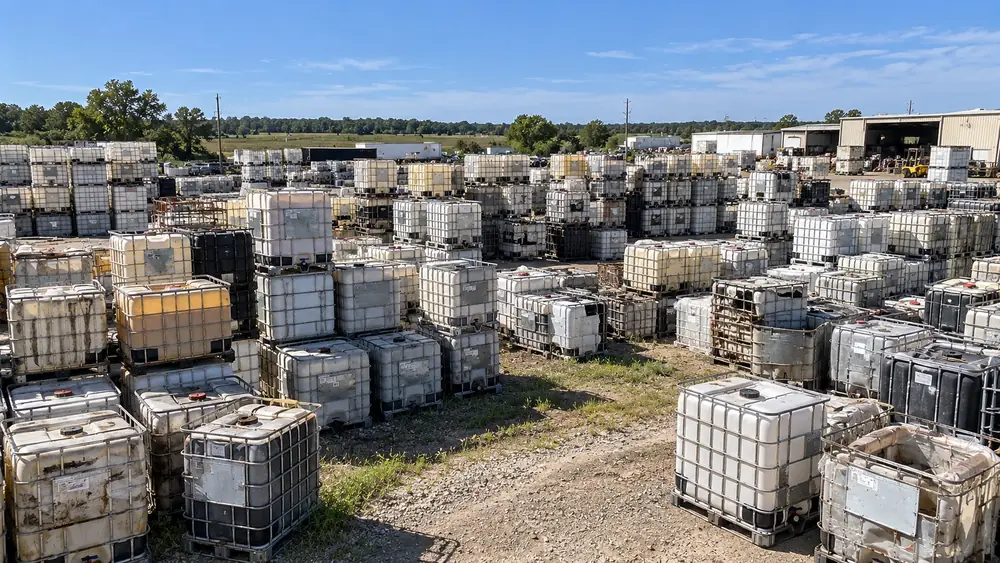
Where used totes actually come from
If liquid arrives at your plant in bulk and leaves in smaller packages, you are structurally a net generator of containers.
Sep 21, 2026 · The yard office · 7 min read
Read it34 longer pieces on buying, washing, grading, hauling and recycling bulk containers. Process detail, market notes and the occasional argument — all of it written by people who handle these containers every day.
Most of these pieces started as a customer question that took more than an email to answer. Send yours.
Buying, selling, washing, hauling or recycling — one form covers all of it. Replies come from a specialist in York, PA, by email, inside one business day.
Prefer plain email? Write to info@ibctotesreco.com — include your ZIP, quantity and what the totes last held.
New to buying used containers? Read what actually sets the price and how to buy a lot you cannot visit. Running a fleet? Start with three years of leak data and six ways a bottle dies. Interested in the environmental argument? Reuse beats recycling and what a 97% diversion rate hides.
If liquid arrives at your plant in bulk and leaves in smaller packages, you are structurally a net generator of containers.
Sep 21, 2026 · The yard office · 7 min read
Read itA container is a record of its own handling. Chalky on one side means it lived outdoors facing south, and so does everything behind it on the trailer.
Sep 7, 2026 · 7 min
ProcessA grade is a contractual promise or it is an adjective. Ours have been the former since the first time somebody returned nine totes.
Aug 24, 2026 · 7 min
Buying guideA 275-gallon tote of 50% caustic weighs 3,497 lb. The same tote of water weighs 2,347. Nothing about the container warns you.
Aug 3, 2026 · 7 min
LogisticsThe worst outcome in freight is a truck that arrives and cannot deliver. It is almost always preventable with one honest answer.
Jul 6, 2026 · 6 min
Market notesA poly bottle outdoors is a five-year asset. A stainless vessel indoors is a thirty-year one that can be re-certified repeatedly.
Jun 8, 2026 · 7 min
ProcessBay 1 has never run a caustic programme on an industrial container. That rule is enforced by where forklifts are allowed to go.
May 11, 2026 · 7 min
SustainabilityThe same sixty containers can serve maple in March, cider in October and a juice run in December. That is three times the work from one embodied footprint.
Apr 6, 2026 · 7 min
Buying guideA seller who sends all seven photographs without complaint is a seller who knows what they have.
Mar 9, 2026 · 7 min
TeardownA perfect container with a cracked valve boss is a rebottle. The cause is almost always a pump nobody bothered to support.
Feb 9, 2026 · 6 min
A 275-gallon tote of 50% caustic weighs 3,497 lb. The same tote of water weighs 2,347. Nothing about the container warns you.
The yard office · 7 min read
A seller who sends all seven photographs without complaint is a seller who knows what they have.
The yard office · 7 min read
Seven inches taller and 510 lb heavier when full. Equipment ratings cluster unhelpfully right across that gap.
The yard office · 7 min read
Rebottling gives you a virgin contact surface for 55–65% of new-unit cost. It loses on exactly two counts, and both are worth stating plainly.
The yard office · 8 min read
Nine times out of ten, a tote that is about to be written off has a fourteen-dollar problem.
The yard office · 6 min read
Buyers assume condition sets the price. In practice prior service and freight move it further than anything you can see.
The yard office · 8 min read
“Empty” is a defined regulatory condition, not a description. The one-inch rule is the part people remember and the P-list is the part that matters.
Priya Raval — compliance & records · 7 min read
A perfect UN plate on a container with a lapsed test interval is not an authorised packaging. We see it constantly.
Priya Raval — compliance & records · 7 min read
Most buyers never read the plate. It takes ninety seconds and it tells you what the container is legally allowed to hold.
Priya Raval — compliance & records · 7 min read
The worst outcome in freight is a truck that arrives and cannot deliver. It is almost always preventable with one honest answer.
Tom Kirkwood — dispatch · 6 min read
An empty tote weighs 137 lb and presents four feet of sail. The physics of securing it are not the physics of securing freight.
Tom Kirkwood — dispatch · 7 min read
Forty totes fill a flatbed and weigh 5,500 lb. You run out of deck long before you run out of weight, and that single fact explains every freight quote we issue.
Tom Kirkwood — dispatch · 7 min read
If liquid arrives at your plant in bulk and leaves in smaller packages, you are structurally a net generator of containers.
The yard office · 7 min read
A poly bottle outdoors is a five-year asset. A stainless vessel indoors is a thirty-year one that can be re-certified repeatedly.
The yard office · 7 min read
Brine at SG 1.38 makes a 275-gallon tote weigh 3,187 lb and quietly eats the bottom of the cage. Both are manageable if you plan for them.
Tom Kirkwood — dispatch · 7 min read
Sixty totes for eight weeks beats sixty totes for twelve months. Maple taught us more about leasing than any other customer group.
Tom Kirkwood — dispatch · 7 min read
Cider, de-icer and crop clean-out collide in a six-week window. The squeeze is predictable, which means it is avoidable.
The yard office · 6 min read
A grade is a contractual promise or it is an adjective. Ours have been the former since the first time somebody returned nine totes.
The yard office · 7 min read
Bay 1 has never run a caustic programme on an industrial container. That rule is enforced by where forklifts are allowed to go.
Marcus Ebersole — wash line supervisor · 7 min read
Recirculation is the difference between washing containers and running a water bill. Here is the train, stage by stage.
Marcus Ebersole — wash line supervisor · 7 min read
Three sensor technologies, a lab contract and seventeen years later, the final check on a washed container is still somebody breathing at the lid.
Dana Reilly — inbound inspection · 7 min read
Nothing about washing a container gets easier below freezing. Here is what actually changes, and what we do about it.
Marcus Ebersole — wash line supervisor · 7 min read
Caustic does not dissolve residue. It saponifies, swells and lifts it — and understanding the difference tells you which bottles are recoverable.
Marcus Ebersole — wash line supervisor · 8 min read
Eight percent of offered loads never come off the trailer. The reasons are almost always the same four, and all four come down to one document.
Dana Reilly — inbound inspection · 7 min read
A bottle too stained to hold product will hold rainwater for fifteen years. That is the whole argument for a fabrication corner.
Marcus Ebersole — wash line supervisor · 8 min read
One tote fills and overflows in a moderate storm. Four, properly manifolded, behave as one vessel — and the plumbing is easier than people expect.
Marcus Ebersole — wash line supervisor · 9 min read
The same sixty containers can serve maple in March, cider in October and a juice run in December. That is three times the work from one embodied footprint.
The yard office · 7 min read
One in five pallets on inbound containers gets replaced. Almost all of them are timber, and almost all of them lived outdoors.
Dana Reilly — inbound inspection · 7 min read
A yard claiming 100% diversion is either not counting its residue sludge or not telling you about it.
Priya Raval — compliance & records · 7 min read
Recycling is the tier of the waste hierarchy that gets reported because it is easy to count. Reuse is the tier that actually matters.
The yard office · 8 min read
A container is a record of its own handling. Chalky on one side means it lived outdoors facing south, and so does everything behind it on the trailer.
Dana Reilly — inbound inspection · 7 min read
A perfect container with a cracked valve boss is a rebottle. The cause is almost always a pump nobody bothered to support.
Dana Reilly — inbound inspection · 6 min read
The cage is the part that should outlive everything else. Half an inch of diagonal difference is where that stops being true.
Dana Reilly — inbound inspection · 8 min read
Thirty thousand containers a year cross our bench. They fail in six distinguishable ways, and five of them are preventable.
Dana Reilly — inbound inspection · 9 min read
Every figure quoted in the journal comes from one of these. Open the one you need rather than hunting through an article for it.
| Format | Nominal | Usable | L × W × H | Tare (steel base) | Gross, water | Outlet | Stack filled | Availability |
|---|---|---|---|---|---|---|---|---|
| 275 gal standard | 275 gal / 1,041 L | 265 gal | 48 × 40 × 46" | 137 lb | 2,347 lb | 2" S60x6 | 2 high | Ex-stock |
| 275 gal tall | 275 gal / 1,041 L | 264 gal | 48 × 40 × 53" | 141 lb | 2,342 lb | 2" S60x6 | 2 high | Regular |
| 330 gal standard | 330 gal / 1,249 L | 320 gal | 48 × 40 × 53" | 165 lb | 2,834 lb | 2" S60x6 | 2 high | Ex-stock |
| 350 gal | 350 gal / 1,325 L | 338 gal | 48 × 40 × 58" | 172 lb | 2,991 lb | 2" or 3" | 2 high | Occasional |
| 400 gal | 400 gal / 1,514 L | 386 gal | 48 × 46 × 60" | 198 lb | 3,417 lb | 3" buttress | 1 high | Order |
| 550 gal | 550 gal / 2,082 L | 532 gal | 48 × 48 × 72" | 251 lb | 4,688 lb | 3" buttress | 1 high | Occasional |
| 120 gal mini | 120 gal / 454 L | 115 gal | 32 × 32 × 36" | 71 lb | 1,030 lb | 2" S60x6 | 2 high | Occasional |
| 180 gal | 180 gal / 681 L | 174 gal | 40 × 40 × 42" | 98 lb | 1,549 lb | 2" S60x6 | 2 high | Order |
| Stainless 265 gal | 265 gal / 1,003 L | 258 gal | 48 × 40 × 50" | 285 lb | 2,436 lb | 2" tri-clamp | 2 high | Occasional |
| Stainless 330 gal | 330 gal / 1,249 L | 322 gal | 48 × 40 × 56" | 330 lb | 3,015 lb | 2" tri-clamp | 2 high | Occasional |
| Stainless 400 gal | 400 gal / 1,514 L | 390 gal | 48 × 46 × 62" | 385 lb | 3,637 lb | 3" tri-clamp | 1 high | Order |
| Stainless 500 gal | 500 gal / 1,893 L | 488 gal | 48 × 48 × 68" | 430 lb | 4,600 lb | 3" tri-clamp | 1 high | Order |
| Grade A | Grade B | Grade C | Cage / pallet only | |
|---|---|---|---|---|
| Bottle clarity | Clear / near-clear | Haze & staining permitted | Ghosting permitted | n/a |
| Prior service | Documented edible, signed at source | Industrial, declared | Industrial, declared | Any declared |
| Wash programme | Food line, recorded | Programme to residue, recorded | Ambient rinse | Cage rinse only |
| Hydrostatic test | 100% of units | Sampled | Sampled | n/a |
| New valve & gaskets | Yes, FDA-compliant | Yes | Sound or new | n/a |
| New lid | Yes | Yes | Sound or new | n/a |
| Re-marked | Yes | Yes | Where the plate survives | No |
| Stackable when filled | 2 high | 2 high | No | n/a |
| 30-day leak warranty | Yes | Yes | No — watertight at loading | No warranty |
| Food / potable | Yes, with records | No | No | n/a |
| Cost vs new | ≈ 35–45% | ≈ 25–32% | ≈ 18–24% | ≈ 5–10% |
| Lead time | Ex-stock to 5 days | Ex-stock | Ex-stock | Ex-stock |
| Loop score (lives left) | 5–6 | 4–5 | 2–3 | 3–4 bottles |
| Prior product | Family | SG | Programme | Best grade | Food? | Seal | What to watch |
|---|---|---|---|---|---|---|---|
| Apple juice concentrate (70 Bx) | Food & beverage | 1.35 | PF | A | Yes | FDA EPDM | Best inbound stock we see; sugars rinse clean |
| Orange juice concentrate | Food & beverage | 1.33 | PF | A | Yes | FDA Viton | Citrus oil fraction can scent the bottle |
| Grape juice concentrate | Food & beverage | 1.34 | PF | A | Yes | FDA EPDM | Watch for tartrate scale at the outlet |
| Liquid sugar / sucrose syrup | Food & beverage | 1.33 | PF | A | Yes | FDA EPDM | Hot rinse only, no caustic needed |
| High-fructose corn syrup | Food & beverage | 1.38 | PF | A | Yes | FDA EPDM | Viscous; 3" outlet helps decanting |
| Molasses | Food & beverage | 1.42 | PF | A | Yes | FDA EPDM | Heated rinse; heavy heel |
| Honey | Food & beverage | 1.42 | PF | A | Yes | FDA EPDM | Crystallises; heater jacket recommended |
| Maple sap | Food & beverage | 1.02 | PF | A | Yes | FDA EPDM | Benign but sugars feed biofilm fast |
| Maple syrup | Food & beverage | 1.33 | PF | A | Yes | FDA EPDM | Hot rinse; inspect lid seat |
| Apple cider | Food & beverage | 1.05 | PF | A | Yes | FDA EPDM | Vented lid essential — ferments |
| Wine / must | Food & beverage | 1.08 | PF | A | Yes | FDA EPDM | Tartrate scale; usually leased |
| Beer / wort | Food & beverage | 1.05 | PF | A | Yes | FDA EPDM | Stainless preferred for repeat service |
| Brine (pickling liquor) | Food & beverage | 1.20 | PF | A | Yes | FDA Viton | Check cage for chloride attack |
| Vinegar, 10% | Food & beverage | 1.01 | PF | A | Yes | FDA EPDM | Easy; acid-resistant seal needed |
| Soy sauce | Food & beverage | 1.20 | PF | A | Yes | FDA Viton | Salt plus colour; monitor ghosting |
| Edible soybean oil | Food & beverage | 0.92 | P2 | A | Yes | FDA Viton | 140°F minimum or fat re-deposits |
| Edible canola oil | Food & beverage | 0.91 | P2 | A | Yes | FDA Viton | As above |
| Olive oil | Food & beverage | 0.92 | P2 | A | Yes | FDA Viton | Polyphenols can tint the wall |
| Glycerine, USP | Food & beverage | 1.26 | PF | A | Yes | FDA EPDM | Often effectively first-use stock |
| Propylene glycol, food grade | Food & beverage | 1.04 | PF | A | Yes | FDA EPDM | Frequently single-product filler stock |
| Liquid egg | Food & beverage | 1.04 | PF | A | Case by case | FDA EPDM | Protein film needs verification |
| Milk / dairy intermediate | Food & beverage | 1.03 | PF | A | Case by case | FDA EPDM | Allergen changeover record required |
| Whey concentrate | Food & beverage | 1.06 | PF | A | Case by case | FDA EPDM | Protein scale; hot detergent |
| Tomato paste | Food & beverage | 1.10 | PF | A | Yes | FDA Viton | Acidic; stains but rinses |
| Fruit purée | Food & beverage | 1.12 | PF | A | Yes | FDA EPDM | Pulp load; coarse settling matters |
| Flavour concentrate / essence | Food & beverage | 0.95 | Refused | Rebottle | No | PTFE | Permeates HDPE permanently — use stainless |
| Citrus terpene oil | Food & beverage | 0.84 | Refused | Recycle | Never | PTFE | One batch ends a poly bottle's usefulness |
| Spent grain slurry | Food & beverage | 1.05 | P2 | B | No | EPDM | By-product duty; 3" outlet strongly advised |
| Yeast slurry | Food & beverage | 1.08 | P2 | B | Case by case | EPDM | Vent — active fermentation |
| UAN 32 liquid nitrogen | Agricultural | 1.32 | P1 | B | Never | EPDM | Rinses readily; dense — check ratings |
| UAN 28 | Agricultural | 1.28 | P1 | B | Never | EPDM | As above |
| Liquid starter 10-34-0 | Agricultural | 1.38 | P1 | B | Never | EPDM | Polyphosphate scale at the outlet |
| Ammonium thiosulphate | Agricultural | 1.33 | P1 | B | Never | EPDM | Sulphur odour persists faintly |
| Potassium thiosulphate | Agricultural | 1.47 | P1 | B | Never | EPDM | Very dense; 275 format only |
| Calcium nitrate solution | Agricultural | 1.43 | P1 | B | Never | EPDM | Crystallises when cold |
| Humic / fulvic acid | Agricultural | 1.10 | P2 | B | Never | EPDM | Dark staining, usually washes out |
| Fish hydrolysate fertiliser | Agricultural | 1.12 | P3 | C | Never | Viton | Odour frequently permanent |
| Foliar micronutrient blend | Agricultural | 1.25 | P1 | B | Never | EPDM | Metal salts can tint the wall |
| Glyphosate concentrate | Agricultural | 1.17 | P3 | C | Never | Viton | Labelled rinse programme governs |
| 2,4-D amine concentrate | Agricultural | 1.19 | Refused | Per label | Never | Viton | Label prescribes rinse-and-destroy |
| Crop oil adjuvant | Agricultural | 0.88 | P3 | C | Never | Viton | Attacks EPDM; permeates slowly |
| Surfactant adjuvant (NIS) | Agricultural | 1.03 | P1 | B | Never | EPDM | Foams heavily on transfer |
| Molluscicide suspension | Agricultural | 1.22 | Refused | Per label | Never | Viton | Refused — labelled destruction |
| Livestock drinking water | Water & inert | 1.00 | P1 | A | Yes | EPDM | Effectively first-use |
| Irrigation water | Water & inert | 1.00 | P1 | A | Yes | EPDM | May carry silt; coarse settling |
| Sodium hydroxide 50% | Industrial chemistry | 1.52 | P1 | B | Never | EPDM | 3,497 lb filled — check every rating |
| Sodium hydroxide 25% | Industrial chemistry | 1.27 | P1 | B | Never | EPDM | Easy wash; dilute and drain |
| Potassium hydroxide 45% | Industrial chemistry | 1.46 | P1 | B | Never | EPDM | As NaOH; dense |
| Sulphuric acid 93% | Industrial chemistry | 1.83 | Refused | Dedicated | Never | PTFE | 4,182 lb filled; dedicated service only |
| Sulphuric acid 35% | Industrial chemistry | 1.26 | P1 | C | Never | PTFE | Fume attack on cage galvanising |
| Hydrochloric acid 31% | Industrial chemistry | 1.16 | P1 | C | Never | PTFE | Cage usually the limiting factor |
| Phosphoric acid 75% | Industrial chemistry | 1.58 | P1 | B | Never | PTFE | Dense; viscous at low temperature |
| Nitric acid 42% | Industrial chemistry | 1.26 | Refused | Dedicated | Never | PTFE | Oxidiser — embrittles HDPE |
| Hydrogen peroxide 35% | Industrial chemistry | 1.13 | P1 | B | Case by case | PTFE | Vent; absolutely no contaminants |
| Sodium hypochlorite 12% | Industrial chemistry | 1.21 | P1 | B | Never | EPDM | Degasses; vent and shield from UV |
| Ferric chloride 40% | Industrial chemistry | 1.42 | P2 | C | Never | Viton | Heavy orange staining is permanent |
| Aluminium sulphate | Industrial chemistry | 1.33 | P1 | B | Never | EPDM | Scale at the outlet boss |
| Polyaluminium chloride | Industrial chemistry | 1.35 | P1 | B | Never | EPDM | Gels if allowed to dry out |
| Propylene glycol coolant | Industrial chemistry | 1.04 | P1 | B | Never | EPDM | Ideal duty; nothing to watch |
| Ethylene glycol | Industrial chemistry | 1.11 | P1 | B | Never | EPDM | Toxic — never re-grade for potable |
| Calcium chloride brine 32% | Industrial chemistry | 1.38 | P1 | B | Never | Viton | Chloride attack on lower cage |
| Magnesium chloride de-icer | Industrial chemistry | 1.32 | P1 | B | Never | Viton | As above; rinse frames each spring |
| Potassium acetate de-icer | Industrial chemistry | 1.28 | P1 | B | Never | EPDM | Benign; airport runway chemistry |
| Urea solution (DEF) | Industrial chemistry | 1.09 | P1 | B | Never | EPDM | Purity-critical next fill; usually dedicated |
| Nickel plating solution | Industrial chemistry | 1.25 | Refused | Recycle | Never | Viton | Metal-bearing; never re-used |
| Chromic acid solution | Refused | 1.30 | Refused | Refused | Never | PTFE | Not accepted at the gate |
| Cyanide plating bath | Refused | 1.15 | Refused | Refused | Never | PTFE | Acutely hazardous — licensed facility only |
| Phosphate conversion coating | Industrial chemistry | 1.22 | P2 | C | Never | Viton | Scale and staining |
| Amine corrosion inhibitor | Industrial chemistry | 0.98 | P2 | B | Never | Viton | Fish-like odour can persist |
| Sodium silicate | Industrial chemistry | 1.39 | P3 | C | Never | EPDM | Sets hard if dried; wash promptly |
| Polymer flocculant emulsion | Industrial chemistry | 1.02 | P3 | C | Never | EPDM | Extremely slippery; gels with water |
| Sodium bisulphite | Industrial chemistry | 1.33 | P1 | B | Never | EPDM | Sulphur odour; vent |
| Antifoam silicone emulsion | Industrial chemistry | 1.00 | P3 | C | Never | Viton | Film is very hard to remove |
| Latex paint, white | Coatings & inks | 1.30 | P3 | C | Never | EPDM | Heavy ghosting; often rebottle |
| Latex paint, tinted | Coatings & inks | 1.32 | P3 | C | Never | EPDM | Pigment ghosting permanent |
| Water-based pigment dispersion | Coatings & inks | 1.25 | P3 | C | Never | EPDM | Strong colour transfer into the wall |
| Flexographic ink | Coatings & inks | 1.08 | P3 | Rebottle | Never | Viton | Resin binder plasticises the surface |
| UV-curable coating | Coatings & inks | 1.10 | Refused | Recycle | Never | PTFE | Cures in the bottle; not washable |
| Acrylic adhesive emulsion | Coatings & inks | 1.08 | P3 | Rebottle | Never | EPDM | Caustic at 180°F, often still ghosts |
| PVA wood adhesive | Coatings & inks | 1.09 | P3 | C | Never | EPDM | Wash before it skins over |
| Polyurethane resin, 2-part | Coatings & inks | 1.12 | Refused | Recycle | Never | PTFE | Cross-linked; nothing shifts it |
| Asphalt emulsion | Coatings & inks | 1.01 | P3 | C | Never | Viton | Hot caustic plus long dwell |
| Concrete release agent | Coatings & inks | 0.89 | P2 | C | Never | Viton | Oily film; 140°F detergent |
| Mineral oil, hydraulic | Oils & fuels | 0.88 | P3 | B | Never | Viton | Permeation; faint odour often remains |
| Cutting fluid, soluble | Oils & fuels | 0.92 | P3 | B | Never | Viton | Bacterial odour is the real problem |
| Gear oil | Oils & fuels | 0.90 | P3 | C | Never | Viton | Heavy film; two cycles common |
| Used motor oil | Refused | 0.89 | Refused | Recycle | Never | Viton | Waste stream — not accepted for reuse |
| Diesel fuel | Oils & fuels | 0.85 | Refused | Recycle | Never | Viton | Permanent odour; bottle compromised |
| Kerosene | Oils & fuels | 0.81 | Refused | Recycle | Never | Viton | As diesel |
| Biodiesel B100 | Oils & fuels | 0.88 | P3 | C | Never | Viton | Solvency attacks some HDPE grades |
| Vegetable-based lubricant | Oils & fuels | 0.92 | P2 | B | Never | Viton | Oxidises to a varnish if left |
| Anionic surfactant concentrate | Cleaning & sanitation | 1.05 | P1 | B | Never | EPDM | It is soap — rinses, but foams |
| Non-ionic surfactant | Cleaning & sanitation | 1.03 | P1 | B | Never | EPDM | Easy wash |
| Alkaline degreaser | Cleaning & sanitation | 1.10 | P1 | B | Never | EPDM | Compatible with our own loop |
| Acid descaler | Cleaning & sanitation | 1.14 | P1 | B | Never | PTFE | Segregate heel from caustic tanks |
| Quaternary ammonium sanitiser | Cleaning & sanitation | 1.01 | P1 | B | Case by case | EPDM | Residual actives need verification |
| Peracetic acid sanitiser | Cleaning & sanitation | 1.12 | P1 | B | Case by case | PTFE | Oxidiser; vent and shield |
| Hand sanitiser (ethanol 70%) | Cleaning & sanitation | 0.87 | P1 | B | Case by case | Viton | Alcohol flashes off; little residue |
| Laundry detergent, liquid | Cleaning & sanitation | 1.06 | P1 | B | Never | EPDM | Optical brighteners can tint |
| Car wash soap concentrate | Cleaning & sanitation | 1.04 | P1 | B | Never | EPDM | Very common inbound stock |
| Floor finish / wax emulsion | Cleaning & sanitation | 1.02 | P3 | C | Never | EPDM | Films hard; wash before it dries |
| Potable water | Water & inert | 1.00 | P1 | A | Yes | FDA EPDM | Frequently first-use stock |
| Deionised water | Water & inert | 1.00 | P1 | A | Yes | FDA EPDM | Best-value first-use source |
| Distilled water | Water & inert | 1.00 | P1 | A | Yes | FDA EPDM | As above |
| Glycerine, technical | Water & inert | 1.26 | P1 | B | No | EPDM | Technical grade is not food grade |
| Saline solution, industrial | Water & inert | 1.07 | P1 | B | Never | Viton | Chloride; inspect cage |
| Unknown or mixed residue | Refused | — | Refused | Refused | Never | — | Safety assessment, not a grading question |
| RCRA P-listed residue | Refused | — | Refused | Refused | Never | — | Licensed treatment facility only |
| Radiological material | Refused | — | Refused | Refused | Never | — | No testing, no discussion |
| Pesticide, labelled destruction | Refused | — | Refused | Refused | Never | — | Service life ended by regulation |
| Code | Programme | Temperature | Chemistry | Cycle | Relative cost | Suits |
|---|---|---|---|---|---|---|
| P1 | Ambient flood rinse | Ambient | Process water, occasional mild alkaline | 90 sec | 1.0× | Water-miscible residues |
| P2 | Hot detergent | 140°F | Alkaline detergent 1.5–2.5% | 3 min | 2.2× | Oils, fats, filming products |
| P3 | Caustic clean-in-place | 160–180°F | NaOH 2–4% + surfactant | 6–9 min | 4.5× | Pigments, latex, resins, heavy concentrates |
| PF | Food line (Bay 1) | 140°F | Alkaline detergent 2% + 100% hydrostatic | 3 min + test | 3.1× | Documented edible prior service |
| Refused | Not accepted | — | — | — | — | Unknown, acute, labelled-destruction, radiological |
| Medium | EPDM | Viton (FKM) | Silicone | PTFE | We would fit |
|---|---|---|---|---|---|
| Water, potable & process | Excellent | Excellent | Excellent | Excellent | EPDM |
| Dilute acids (<10%) | Good | Excellent | Fair | Excellent | EPDM |
| Concentrated acids | Poor | Good | Poor | Excellent | PTFE |
| Caustic soda, alkalis | Excellent | Fair | Fair | Excellent | EPDM |
| Liquid fertiliser, UAN | Excellent | Good | Fair | Excellent | EPDM |
| Glycols, coolants, de-icer | Excellent | Good | Good | Excellent | EPDM |
| Surfactants, detergents | Excellent | Good | Good | Excellent | EPDM |
| Edible oils, fats | Poor | Excellent | Poor | Excellent | Viton |
| Mineral oils | Poor | Excellent | Poor | Excellent | Viton |
| Aromatic solvents | Poor | Excellent | Poor | Excellent | Viton |
| Chlorinated solvents | Poor | Good | Poor | Excellent | Viton / PTFE |
| Ketones (acetone, MEK) | Fair | Poor | Poor | Excellent | PTFE |
| Alcohols | Good | Good | Good | Excellent | EPDM |
| Fuels, diesel, kerosene | Poor | Excellent | Poor | Excellent | Viton |
| Juice & syrup concentrate | Excellent | Excellent | Excellent | Excellent | FDA EPDM |
| Brine, pickling liquor | Good | Excellent | Fair | Excellent | Viton |
| Hot fill 140–180°F | Fair | Excellent | Excellent | Excellent | Viton / silicone |
| Hydrogen peroxide (dilute) | Good | Fair | Fair | Excellent | EPDM / PTFE |
| Sodium hypochlorite | Good | Good | Fair | Excellent | EPDM |
| Steam / CIP chemistry | Excellent | Fair | Good | Excellent | EPDM |
| Outdoor weathering & ozone | Excellent | Good | Excellent | Excellent | EPDM |
| Product | SG | 275 gal filled | 330 gal filled | 550 gal filled |
|---|---|---|---|---|
| Acetone | 0.79 | 1,883 lb | 2,273 lb | 3,756 lb |
| Ethanol | 0.79 | 1,883 lb | 2,273 lb | 3,756 lb |
| Kerosene | 0.81 | 1,927 lb | 2,327 lb | 3,845 lb |
| Citrus terpene oil | 0.84 | 1,993 lb | 2,407 lb | 3,978 lb |
| Diesel fuel | 0.85 | 2,016 lb | 2,433 lb | 4,022 lb |
| Mineral oil, hydraulic | 0.88 | 2,082 lb | 2,514 lb | 4,155 lb |
| Biodiesel B100 | 0.88 | 2,082 lb | 2,514 lb | 4,155 lb |
| Concrete release agent | 0.89 | 2,104 lb | 2,540 lb | 4,200 lb |
| Gear oil | 0.90 | 2,126 lb | 2,567 lb | 4,244 lb |
| Canola oil | 0.91 | 2,148 lb | 2,594 lb | 4,289 lb |
| Soybean / olive oil | 0.92 | 2,170 lb | 2,620 lb | 4,333 lb |
| Flavour concentrate | 0.95 | 2,237 lb | 2,700 lb | 4,466 lb |
| Amine corrosion inhibitor | 0.98 | 2,303 lb | 2,780 lb | 4,599 lb |
| Water | 1.00 | 2,347 lb | 2,834 lb | 4,688 lb |
| Antifoam emulsion | 1.00 | 2,347 lb | 2,834 lb | 4,688 lb |
| Quaternary sanitiser | 1.01 | 2,369 lb | 2,860 lb | 4,732 lb |
| Asphalt emulsion | 1.01 | 2,369 lb | 2,860 lb | 4,732 lb |
| Maple sap | 1.02 | 2,391 lb | 2,887 lb | 4,777 lb |
| Non-ionic surfactant | 1.03 | 2,413 lb | 2,914 lb | 4,821 lb |
| Milk / dairy intermediate | 1.03 | 2,413 lb | 2,914 lb | 4,821 lb |
| Car wash soap concentrate | 1.04 | 2,436 lb | 2,941 lb | 4,865 lb |
| Propylene glycol | 1.04 | 2,436 lb | 2,941 lb | 4,865 lb |
| Anionic surfactant | 1.05 | 2,458 lb | 2,967 lb | 4,910 lb |
| Apple cider | 1.05 | 2,458 lb | 2,967 lb | 4,910 lb |
| Spent grain slurry | 1.05 | 2,458 lb | 2,967 lb | 4,910 lb |
| Laundry detergent | 1.06 | 2,480 lb | 2,994 lb | 4,954 lb |
| Flexographic ink | 1.08 | 2,524 lb | 3,047 lb | 5,043 lb |
| Wine / must | 1.08 | 2,524 lb | 3,047 lb | 5,043 lb |
| Acrylic adhesive emulsion | 1.08 | 2,524 lb | 3,047 lb | 5,043 lb |
| Urea solution (DEF) | 1.09 | 2,546 lb | 3,074 lb | 5,087 lb |
| Alkaline degreaser | 1.10 | 2,568 lb | 3,101 lb | 5,132 lb |
| Humic acid | 1.10 | 2,568 lb | 3,101 lb | 5,132 lb |
| Tomato paste | 1.10 | 2,568 lb | 3,101 lb | 5,132 lb |
| Ethylene glycol | 1.11 | 2,590 lb | 3,127 lb | 5,176 lb |
| Peracetic acid sanitiser | 1.12 | 2,612 lb | 3,154 lb | 5,220 lb |
| Fruit purée | 1.12 | 2,612 lb | 3,154 lb | 5,220 lb |
| Hydrogen peroxide 35% | 1.13 | 2,634 lb | 3,181 lb | 5,265 lb |
| Acid descaler | 1.14 | 2,657 lb | 3,207 lb | 5,309 lb |
| Hydrochloric acid 31% | 1.16 | 2,701 lb | 3,261 lb | 5,398 lb |
| Glyphosate concentrate | 1.17 | 2,723 lb | 3,287 lb | 5,442 lb |
| Brine 23% / soy sauce | 1.20 | 2,789 lb | 3,368 lb | 5,575 lb |
| Sodium hypochlorite 12% | 1.21 | 2,811 lb | 3,394 lb | 5,620 lb |
| Phosphate coating | 1.22 | 2,833 lb | 3,421 lb | 5,664 lb |
| Pigment dispersion | 1.25 | 2,900 lb | 3,501 lb | 5,797 lb |
| Nickel plating solution | 1.25 | 2,900 lb | 3,501 lb | 5,797 lb |
| Foliar micronutrient | 1.25 | 2,900 lb | 3,501 lb | 5,797 lb |
| Glycerine | 1.26 | 2,922 lb | 3,528 lb | 5,841 lb |
| Sulphuric acid 35% | 1.26 | 2,922 lb | 3,528 lb | 5,841 lb |
| Sodium hydroxide 25% | 1.27 | 2,944 lb | 3,554 lb | 5,886 lb |
| UAN 28 | 1.28 | 2,966 lb | 3,581 lb | 5,930 lb |
| Potassium acetate de-icer | 1.28 | 2,966 lb | 3,581 lb | 5,930 lb |
| Latex paint | 1.30 | 3,010 lb | 3,634 lb | 6,019 lb |
| UAN 32 fertiliser | 1.32 | 3,054 lb | 3,688 lb | 6,108 lb |
| Magnesium chloride de-icer | 1.32 | 3,054 lb | 3,688 lb | 6,108 lb |
| Liquid sugar / maple syrup | 1.33 | 3,076 lb | 3,715 lb | 6,152 lb |
| Ammonium thiosulphate | 1.33 | 3,076 lb | 3,715 lb | 6,152 lb |
| Aluminium sulphate | 1.33 | 3,076 lb | 3,715 lb | 6,152 lb |
| Juice concentrate (70 Bx) | 1.35 | 3,121 lb | 3,768 lb | 6,241 lb |
| Polyaluminium chloride | 1.35 | 3,121 lb | 3,768 lb | 6,241 lb |
| Liquid starter 10-34-0 | 1.38 | 3,187 lb | 3,848 lb | 6,374 lb |
| High-fructose corn syrup | 1.38 | 3,187 lb | 3,848 lb | 6,374 lb |
| Calcium chloride brine | 1.38 | 3,187 lb | 3,848 lb | 6,374 lb |
| Sodium silicate | 1.39 | 3,209 lb | 3,875 lb | 6,418 lb |
| Molasses / honey | 1.42 | 3,275 lb | 3,955 lb | 6,551 lb |
| Ferric chloride 40% | 1.42 | 3,275 lb | 3,955 lb | 6,551 lb |
| Calcium nitrate solution | 1.43 | 3,297 lb | 3,981 lb | 6,596 lb |
| Potassium hydroxide 45% | 1.46 | 3,364 lb | 4,061 lb | 6,729 lb |
| Potassium thiosulphate | 1.47 | 3,386 lb | 4,088 lb | 6,773 lb |
| Sodium hydroxide 50% | 1.52 | 3,496 lb | 4,222 lb | 6,995 lb |
| Phosphoric acid 75% | 1.58 | 3,629 lb | 4,382 lb | 7,261 lb |
| Sulphuric acid 93% | 1.83 | 4,181 lb | 5,049 lb | 8,370 lb |
| Mode | Cause | What it looks like | Recoverable? | Prevention | Frequency |
|---|---|---|---|---|---|
| UV embrittlement | Unshaded outdoor storage | Chalky, boardy, higher-pitched tap | No | Cover or shade it | Most common |
| Stress whitening at the radius | Over-fill, freeze, uneven ground | White crackled lower corners | No | Level pad, respect max gross mass | Common |
| Plasticisation & ghosting | Pigment, resin, solvent absorption | Permanent shadow when backlit | Rebottle | Match chemistry to material | Common |
| Freeze damage | Left full and sealed | Bulged panel, split seam, blown boss | Sometimes fittings only | Drain or 2/3 fill, vented lid | Seasonal spike |
| Valve boss cracking | Unsupported pump or rigid pipe | Star crazing at the boss root | No — rebottle | Support the pump separately | Avoidable |
| Impact puncture | Forklift tine, drop, collision | Hole or deep gouge | No | Handling discipline | Rare |
| Cage racking | Soft ground, foot impact, over-fill | Diagonals differ by > 1/2" | Jig if under 1/2" | Level load-bearing pad | Common |
| Weld node cracking | Fatigue, previous field weld | Rust bloom then crack | No | Never field-weld a cage | Occasional |
| Pallet rot / delamination | Timber base outdoors | Soft bearers, split deck | Replace base | Specify steel or composite | Very common |
| Seal failure | Compression set, wrong elastomer, reuse | Weeping at the boss or lid | Yes — new seal | Replace at every product change | 71% of reports |
| Destination | Distance | Transit | Mode | Equipment | Backhaul pricing |
|---|---|---|---|---|---|
| Harrisburg / Lancaster, PA | 35 mi | Same day | Flatbed / van | Own | Frequent |
| York / Hanover, PA | 12 mi | Same day | Flatbed | Own | Daily |
| Philadelphia, PA | 95 mi | Same day | Flatbed / van | Own | Daily |
| Allentown / Reading, PA | 80 mi | Same day | Flatbed | Own | Frequent |
| Pittsburgh, PA | 200 mi | Next day | Flatbed | Own | Twice weekly |
| Baltimore, MD | 60 mi | Same day | Flatbed / van | Own | Daily |
| Washington, DC | 95 mi | Same day | Van | Own | Frequent |
| Northern NJ / NYC | 175 mi | Next day | Van | Own | Frequent |
| Wilmington, DE | 75 mi | Same day | Flatbed | Own | Weekly |
| Richmond, VA | 230 mi | Next day | Flatbed | Own | Weekly |
| Norfolk, VA | 300 mi | 1–2 days | Flatbed | Own | Occasional |
| Buffalo / Rochester, NY | 300 mi | 1–2 days | Flatbed | Own | Weekly |
| Columbus, OH | 390 mi | 1–2 days | Flatbed | Own | Common |
| Cleveland, OH | 350 mi | 1–2 days | Flatbed | Own | Occasional |
| Charlotte, NC | 450 mi | 2 days | Flatbed | Partner | Occasional |
| Atlanta, GA | 700 mi | 2–3 days | Flatbed | Partner | Rare |
| Chicago, IL | 650 mi | 2 days | Flatbed | Partner | Occasional |
| Detroit, MI | 450 mi | 2 days | Flatbed | Partner | Occasional |
| Boston / New England | 400 mi | 2 days | Van | Partner | Occasional |
| Nashville, TN | 700 mi | 2–3 days | Flatbed | Partner | Rare |
| Dallas / Houston, TX | 1,450 mi | 3–4 days | Flatbed | Partner | Rare |
| Denver, CO | 1,700 mi | 4 days | Flatbed | Partner | No |
| Phoenix, AZ | 2,200 mi | 5 days | Flatbed | Partner | No |
| California | 2,700 mi | 5–6 days | Flatbed | Partner | No |
| Pacific Northwest | 2,700 mi | 5–6 days | Flatbed | Partner | No |
| Vehicle | Single tier | Two tier | Weight, single tier | Note |
|---|---|---|---|---|
| 48 ft flatbed | 40 | 80 | 5,480 lb | Default for 20 units and up |
| 53 ft trailer | 45 | 90 | 6,165 lb | Needs a dock or lift gate |
| 26 ft straight truck | 12 | 24 | 1,644 lb | Lift gate rating governs |
| 16 ft box trailer | 9 | 18 | 1,233 lb | Ground-level loading |
| 20 ft shipping container | 16 | 32 | 2,192 lb | Door height suits 46" formats |
| 40 ft shipping container | 36 | 72 | 4,932 lb | Floor-loaded, blocked and braced |
| Pickup bed, tailgate down | 3 | — | 411 lb | Strap to the bed, not the cage top |
| Transit / cargo van | 2 | — | 274 lb | Check interior height |
| Year | Units in | Diversion | Manifested | Notable change |
|---|---|---|---|---|
| 2019 | 19,400 | 88.2% | 11.8% | Closed-loop water train commissioned |
| 2020 | 26,800 | 90.6% | 9.4% | Food line run six days a week |
| 2021 | 24,100 | 92.4% | 7.6% | Upcycled builds workshop opened |
| 2022 | 27,300 | 94.1% | 5.9% | Lease pool launched |
| 2023 | 29,600 | 96.1% | 3.9% | Diversion certificates formalised |
| 2024 | 31,200 | 96.8% | 3.2% | Stainless stream added |
| 2025 | 33,900 | 97.4% | 2.6% | Sludge dewatering upgraded |
| Route | CO₂e | Fresh water | Virgin resin | Virgin steel |
|---|---|---|---|---|
| New unit | ≈ 410 lb | ≈ 290 gal | 118 lb | 62 lb |
| Rebottled | ≈ 182 lb | ≈ 120 gal | 47 lb | 0 lb |
| Reconditioned | ≈ 34 lb | ≈ 31 gal | 0 lb | 0 lb |
| Repurposed Grade C | ≈ 11 lb | ≈ 14 gal | 0 lb | 0 lb |
| Reference | Title | What it covers | Who it binds |
|---|---|---|---|
| 49 CFR 172.101 | Hazardous materials table | Classification and authorised packaging reference | Shippers |
| 49 CFR 172 Subpart H | Training | Who must be trained, in what, how often, with records | Any hazmat employer |
| 49 CFR 173 | Shippers — general requirements by class | Whether an IBC is authorised for your entry | Shippers |
| 49 CFR 178 Subpart N | IBC design types, testing and marking | What the plate means and how it was earned | Makers, reconditioners |
| 49 CFR 180.352 | Periodic inspection, testing, repair & remanufacture | 2.5-year visual, 5-year leakproofness + full inspection | Owners, shippers |
| 40 CFR 261.7 | RCRA empty containers | When a container counts as empty; P-list triple rinse | Generators |
| 40 CFR 262 | Generator standards | Waste determination, manifesting, accumulation | Generators |
| 21 CFR 177.1520 | Olefin polymers | HDPE compliance for food contact | Food users |
| 21 CFR 177.2600 | Rubber articles for repeated use | Gasket and seal compliance for food contact | Food users |
| 21 CFR 110 / 117 | Good manufacturing practice | Handling, storage, sanitation programmes | Food users |
| NSF/ANSI 61 | Drinking water system components | Potable-contact material evaluation | Water utilities |
| 29 CFR 1910.1200 | Hazard communication | Workplace labelling and safety data sheets | Everyone |
| 29 CFR 1910.146 | Permit-required confined spaces | Entry into tanks and vessels | Anyone cleaning containers |
| 29 CFR 1910.178 | Powered industrial trucks | Forklift operation and certification | Yards and docks |
| ANSI/ITSDF B56.1 | Low-lift and high-lift trucks | Capacity ratings and load centres | Yards and docks |
| ANSI MH16.1 | Steel storage racking | Beam capacity, deflection, inspection | Warehouses |
| PA Title 25 Ch. 95 | Wastewater treatment requirements | Industrial discharge standards in Pennsylvania | Wash lines |
| ISPM-15 | Wood packaging in international trade | Heat treatment and marking of timber pallets | Exporters |
| Month | Food-grade demand | Industrial demand | Inbound supply | What it means for you |
|---|---|---|---|---|
| January | Low | High (de-icer) | Average | Winter emergencies; frozen heels slow the gate |
| February | High (maple starts) | High | Average | Sugaring floats go out; access often difficult |
| March | Highest (maple peak) | Moderate | Low | Freeze-damage crop arrives from last autumn |
| April | High | High (fertiliser) | Average | Maple returns, spring inputs ship |
| May | Average | Highest (fertiliser) | High | Biggest Grade B volume window |
| June | Average | High | High | Best month to sell us empties |
| July | Low | Average | Highest | Deepest stock; cheapest buying |
| August | Low | Average | Highest | Book autumn food-grade now |
| September | Highest (cider, crush) | High (de-icer fill) | Low | The squeeze begins |
| October | Highest | High | Lowest | Food-grade lead times stretch to 2–3 weeks |
| November | Average | Highest | Low | Winter chemistry fills; order covers and jackets |
| December | Average (juice runs) | High | Low | Holiday-week bookings close early |
| Document | What it contains | When you get it |
|---|---|---|
| Written quotation | Unit price by grade, freight as its own line, validity, and the conditions that would change it | Before you order |
| Grade certificate | Assigned grade against our published definitions, per unit serial | With the order |
| Leak & pressure test record | Test pressure, hold time, outcome, per serial | With the order |
| Hydrostatic test certificate | 100% of food-line units, recorded against serial | Food-grade orders |
| Prior-contents declaration | Named last product, generating site, signature | Anything we collected |
| Wash programme record | Bay, programme, temperature, chemistry, cycle time | Reconditioned & contract work |
| Rinse verification | Final-rinse pH and conductivity | Reconditioned & contract work |
| Component specification | Valve, gasket, lid materials with compliance references | Food-grade orders |
| Photograph set | The actual units on the rack before loading | Every order |
| Weight ticket | Certified-scale gross weight and count | Collections and cleanouts |
| Diversion certificate | Unit counts, weights by stream, destination routes, dates | End-of-life batches |
| Certificate of insurance | GL, auto, cargo, workers' comp; additional insured | Before a crew arrives |
| Reconditioner marking detail | Code, date, design type | Re-marked units |
| Lease schedule | Count, grade, dates, weekly rate, return condition, replacement charge | Leases |
Thirty thousand containers a year cross the inspection bench, 180 a day go through the wash line, and a few hundred emails a month ask something that takes more than a paragraph to answer. The third of those is where most of this journal started.
None of it is written by a marketing department, and the figures quoted are the ones we actually use — which is why the reference datasets sit at the bottom of every article rather than in a brochure.