The line, station by station
This page is not linked from the main menu. It exists for the engineers, quality managers and auditors who want to know what temperature, what concentration, what residence time.
Send us a residue we should be worried about
Describe the prior product and we will tell you honestly whether it washes, rebottles or recycles.
Tell us what you have.
We will tell you what it is worth.
Buying, selling, washing, hauling or recycling — one form covers all of it. Replies come from a specialist in York, PA, by email, inside one business day.
Prefer plain email? Write to info@ibctotesreco.com — include your ZIP, quantity and what the totes last held.
Every container is drained and classified by prior-product family, then routed to one of three programmes: a three-stage ambient rinse for benign water-miscible residues, a hot-detergent cycle for oils and fats, or a hot caustic clean-in-place at 160–180°F with a 360° rotating lance for the stubborn and the polymerising. Everything that comes out of a bay is leak-tested at pressure, re-valved, re-gasketed and re-marked. Containers that fail a wash twice are rebottled or granulated — never re-graded upward to clear them.
Pre-drain and residue classification
Heel is drained to one of four segregated tanks — aqueous neutral, aqueous caustic-compatible, oil/fat, and quarantine. Classification comes from the signed prior-contents declaration, confirmed on the sniff bench. Anything that cannot be classified goes to quarantine and the unit is routed to rebottling or scrap.
Stage 1 — ambient flood rinse
70–90 gallons of recirculated process water through a fixed spray ball at 45 psi for 90 seconds, drained to coarse settling. This alone clears the majority of water-miscible residues: liquid fertiliser, glycols, surfactant dilutions, most food concentrates.
Stage 2 — hot detergent, 140°F
Alkaline detergent at 1.5–2.5% through the rotating lance for 3 minutes at 160 psi. This is the programme for oils, fats, waxes and anything that films. Temperature matters more than pressure here; below about 130°F animal fats simply re-deposit on cooling.
Stage 3 — hot caustic clean-in-place, 160–180°F
Sodium hydroxide at 2–4% with a surfactant package, 360° rotating lance, 6–9 minutes depending on prior-product family, followed by two fresh-water rinses and a pH verification on the final rinse. Reserved for pigments, resins, adhesives, heavy agricultural concentrates and anything that has begun to plasticise into the bottle wall.
Dry, inspect, backlight
Forced-air dry, then a second backlight inspection looking for ghosting, crazing, stress whitening at the lower radius and any residual haze. A unit that still ghosts after Stage 3 is not washed again — it is rebottled or granulated.
Leak and pressure test
Air test to 3 psi held for 5 minutes with a soap-film check on the valve boss, the lid seat and the lower seam; hydrostatic verification on a sampled basis and on 100% of food-line units.
Re-valve, re-gasket, re-lid
New 2" butterfly or ball valve to order, new EPDM or Viton gaskets selected for the customer's product, new lid with a fresh foam or EPDM seal, and a tamper-evident dust cap. The old valve is harvested for parts, never refitted.
Re-mark and photograph
Reconditioner mark applied under 49 CFR 178 with our code and the month and year of reconditioning, grade stencilled on the cage, unit photographed on the rack. The photo set is what travels with the quote.
Programme matrix
Which prior-product families route to which programme, and what comes out the other end.
| Prior product family | Programme | Temp | Chemistry | Best achievable grade |
|---|---|---|---|---|
| Food syrups, brines, juice concentrate | Food line, Stage 1+2 | 140°F | Alkaline detergent 2% | A — food-grade eligible |
| Potable water, glycerine, vinegar | Food line, Stage 1 | Ambient | Process water only | A — food-grade eligible |
| Liquid fertiliser, UAN, humic acid | Stage 1+2 | 140°F | Alkaline detergent 1.5% | B — washed industrial |
| Surfactants, detergents, soaps | Stage 1+2 | 140°F | Alkaline detergent 1.5% | B — washed industrial |
| Glycols, coolants, de-icer | Stage 1+2 | 140°F | Alkaline detergent 2% | B — washed industrial |
| Latex paint, water-based pigment | Stage 3 CIP | 170°F | NaOH 3% + surfactant | B or C, by ghosting |
| Adhesives, resins, polymer emulsions | Stage 3 CIP | 180°F | NaOH 4% + surfactant | C, often rebottle |
| Mineral oils, cutting fluids | Stage 3 CIP | 170°F | NaOH 2% + degreaser | B or C |
| Agricultural concentrates (labelled rinse) | Stage 3 CIP | 180°F | NaOH 4% | C, non-contact only |
| Acutely hazardous, unknown mixed | Refused | — | — | Not accepted |
This matrix is a summary of an internal list covering about 140 named prior products. If yours is not obviously in one of these families, send it on the form and we will tell you which row it lands in — including when the answer is “we will not take it”.
Four things we will not wash
- Unknown mixed residue. Two chemistries we cannot identify in one bottle is a safety problem for the operator on the lance, not a commercial judgement call.
- Acutely hazardous waste residues. RCRA P-list and similar. These belong with a licensed treatment facility, not a container reconditioner.
- Pesticide concentrates outside the labelled rinse programme. If the label prescribes triple-rinse-and-puncture, the container's service life is over by regulation, whatever its condition.
- Anything radiological. No exceptions, no testing, no discussion.
Refusing roughly one inbound load in twelve is a feature of the model. The 2015 entry in our history explains the load that taught us to do it.
One hundred products, five programmes, every parameter
The matrix on this page is a summary of the internal list. Here is the list itself.
| Code | Programme | Temperature | Chemistry | Cycle | Relative cost | Suits |
|---|---|---|---|---|---|---|
| P1 | Ambient flood rinse | Ambient | Process water, occasional mild alkaline | 90 sec | 1.0× | Water-miscible residues |
| P2 | Hot detergent | 140°F | Alkaline detergent 1.5–2.5% | 3 min | 2.2× | Oils, fats, filming products |
| P3 | Caustic clean-in-place | 160–180°F | NaOH 2–4% + surfactant | 6–9 min | 4.5× | Pigments, latex, resins, heavy concentrates |
| PF | Food line (Bay 1) | 140°F | Alkaline detergent 2% + 100% hydrostatic | 3 min + test | 3.1× | Documented edible prior service |
| Refused | Not accepted | — | — | — | — | Unknown, acute, labelled-destruction, radiological |
| Prior product | Family | SG | Programme | Best grade | Food? | Seal | What to watch |
|---|---|---|---|---|---|---|---|
| Apple juice concentrate (70 Bx) | Food & beverage | 1.35 | PF | A | Yes | FDA EPDM | Best inbound stock we see; sugars rinse clean |
| Orange juice concentrate | Food & beverage | 1.33 | PF | A | Yes | FDA Viton | Citrus oil fraction can scent the bottle |
| Grape juice concentrate | Food & beverage | 1.34 | PF | A | Yes | FDA EPDM | Watch for tartrate scale at the outlet |
| Liquid sugar / sucrose syrup | Food & beverage | 1.33 | PF | A | Yes | FDA EPDM | Hot rinse only, no caustic needed |
| High-fructose corn syrup | Food & beverage | 1.38 | PF | A | Yes | FDA EPDM | Viscous; 3" outlet helps decanting |
| Molasses | Food & beverage | 1.42 | PF | A | Yes | FDA EPDM | Heated rinse; heavy heel |
| Honey | Food & beverage | 1.42 | PF | A | Yes | FDA EPDM | Crystallises; heater jacket recommended |
| Maple sap | Food & beverage | 1.02 | PF | A | Yes | FDA EPDM | Benign but sugars feed biofilm fast |
| Maple syrup | Food & beverage | 1.33 | PF | A | Yes | FDA EPDM | Hot rinse; inspect lid seat |
| Apple cider | Food & beverage | 1.05 | PF | A | Yes | FDA EPDM | Vented lid essential — ferments |
| Wine / must | Food & beverage | 1.08 | PF | A | Yes | FDA EPDM | Tartrate scale; usually leased |
| Beer / wort | Food & beverage | 1.05 | PF | A | Yes | FDA EPDM | Stainless preferred for repeat service |
| Brine (pickling liquor) | Food & beverage | 1.20 | PF | A | Yes | FDA Viton | Check cage for chloride attack |
| Vinegar, 10% | Food & beverage | 1.01 | PF | A | Yes | FDA EPDM | Easy; acid-resistant seal needed |
| Soy sauce | Food & beverage | 1.20 | PF | A | Yes | FDA Viton | Salt plus colour; monitor ghosting |
| Edible soybean oil | Food & beverage | 0.92 | P2 | A | Yes | FDA Viton | 140°F minimum or fat re-deposits |
| Edible canola oil | Food & beverage | 0.91 | P2 | A | Yes | FDA Viton | As above |
| Olive oil | Food & beverage | 0.92 | P2 | A | Yes | FDA Viton | Polyphenols can tint the wall |
| Glycerine, USP | Food & beverage | 1.26 | PF | A | Yes | FDA EPDM | Often effectively first-use stock |
| Propylene glycol, food grade | Food & beverage | 1.04 | PF | A | Yes | FDA EPDM | Frequently single-product filler stock |
| Liquid egg | Food & beverage | 1.04 | PF | A | Case by case | FDA EPDM | Protein film needs verification |
| Milk / dairy intermediate | Food & beverage | 1.03 | PF | A | Case by case | FDA EPDM | Allergen changeover record required |
| Whey concentrate | Food & beverage | 1.06 | PF | A | Case by case | FDA EPDM | Protein scale; hot detergent |
| Tomato paste | Food & beverage | 1.10 | PF | A | Yes | FDA Viton | Acidic; stains but rinses |
| Fruit purée | Food & beverage | 1.12 | PF | A | Yes | FDA EPDM | Pulp load; coarse settling matters |
| Flavour concentrate / essence | Food & beverage | 0.95 | Refused | Rebottle | No | PTFE | Permeates HDPE permanently — use stainless |
| Citrus terpene oil | Food & beverage | 0.84 | Refused | Recycle | Never | PTFE | One batch ends a poly bottle's usefulness |
| Spent grain slurry | Food & beverage | 1.05 | P2 | B | No | EPDM | By-product duty; 3" outlet strongly advised |
| Yeast slurry | Food & beverage | 1.08 | P2 | B | Case by case | EPDM | Vent — active fermentation |
| UAN 32 liquid nitrogen | Agricultural | 1.32 | P1 | B | Never | EPDM | Rinses readily; dense — check ratings |
| UAN 28 | Agricultural | 1.28 | P1 | B | Never | EPDM | As above |
| Liquid starter 10-34-0 | Agricultural | 1.38 | P1 | B | Never | EPDM | Polyphosphate scale at the outlet |
| Ammonium thiosulphate | Agricultural | 1.33 | P1 | B | Never | EPDM | Sulphur odour persists faintly |
| Potassium thiosulphate | Agricultural | 1.47 | P1 | B | Never | EPDM | Very dense; 275 format only |
| Calcium nitrate solution | Agricultural | 1.43 | P1 | B | Never | EPDM | Crystallises when cold |
| Humic / fulvic acid | Agricultural | 1.10 | P2 | B | Never | EPDM | Dark staining, usually washes out |
| Fish hydrolysate fertiliser | Agricultural | 1.12 | P3 | C | Never | Viton | Odour frequently permanent |
| Foliar micronutrient blend | Agricultural | 1.25 | P1 | B | Never | EPDM | Metal salts can tint the wall |
| Glyphosate concentrate | Agricultural | 1.17 | P3 | C | Never | Viton | Labelled rinse programme governs |
| 2,4-D amine concentrate | Agricultural | 1.19 | Refused | Per label | Never | Viton | Label prescribes rinse-and-destroy |
| Crop oil adjuvant | Agricultural | 0.88 | P3 | C | Never | Viton | Attacks EPDM; permeates slowly |
| Surfactant adjuvant (NIS) | Agricultural | 1.03 | P1 | B | Never | EPDM | Foams heavily on transfer |
| Molluscicide suspension | Agricultural | 1.22 | Refused | Per label | Never | Viton | Refused — labelled destruction |
| Livestock drinking water | Water & inert | 1.00 | P1 | A | Yes | EPDM | Effectively first-use |
| Irrigation water | Water & inert | 1.00 | P1 | A | Yes | EPDM | May carry silt; coarse settling |
| Sodium hydroxide 50% | Industrial chemistry | 1.52 | P1 | B | Never | EPDM | 3,497 lb filled — check every rating |
| Sodium hydroxide 25% | Industrial chemistry | 1.27 | P1 | B | Never | EPDM | Easy wash; dilute and drain |
| Potassium hydroxide 45% | Industrial chemistry | 1.46 | P1 | B | Never | EPDM | As NaOH; dense |
| Sulphuric acid 93% | Industrial chemistry | 1.83 | Refused | Dedicated | Never | PTFE | 4,182 lb filled; dedicated service only |
| Sulphuric acid 35% | Industrial chemistry | 1.26 | P1 | C | Never | PTFE | Fume attack on cage galvanising |
| Hydrochloric acid 31% | Industrial chemistry | 1.16 | P1 | C | Never | PTFE | Cage usually the limiting factor |
| Phosphoric acid 75% | Industrial chemistry | 1.58 | P1 | B | Never | PTFE | Dense; viscous at low temperature |
| Nitric acid 42% | Industrial chemistry | 1.26 | Refused | Dedicated | Never | PTFE | Oxidiser — embrittles HDPE |
| Hydrogen peroxide 35% | Industrial chemistry | 1.13 | P1 | B | Case by case | PTFE | Vent; absolutely no contaminants |
| Sodium hypochlorite 12% | Industrial chemistry | 1.21 | P1 | B | Never | EPDM | Degasses; vent and shield from UV |
| Ferric chloride 40% | Industrial chemistry | 1.42 | P2 | C | Never | Viton | Heavy orange staining is permanent |
| Aluminium sulphate | Industrial chemistry | 1.33 | P1 | B | Never | EPDM | Scale at the outlet boss |
| Polyaluminium chloride | Industrial chemistry | 1.35 | P1 | B | Never | EPDM | Gels if allowed to dry out |
| Propylene glycol coolant | Industrial chemistry | 1.04 | P1 | B | Never | EPDM | Ideal duty; nothing to watch |
| Ethylene glycol | Industrial chemistry | 1.11 | P1 | B | Never | EPDM | Toxic — never re-grade for potable |
| Calcium chloride brine 32% | Industrial chemistry | 1.38 | P1 | B | Never | Viton | Chloride attack on lower cage |
| Magnesium chloride de-icer | Industrial chemistry | 1.32 | P1 | B | Never | Viton | As above; rinse frames each spring |
| Potassium acetate de-icer | Industrial chemistry | 1.28 | P1 | B | Never | EPDM | Benign; airport runway chemistry |
| Urea solution (DEF) | Industrial chemistry | 1.09 | P1 | B | Never | EPDM | Purity-critical next fill; usually dedicated |
| Nickel plating solution | Industrial chemistry | 1.25 | Refused | Recycle | Never | Viton | Metal-bearing; never re-used |
| Chromic acid solution | Refused | 1.30 | Refused | Refused | Never | PTFE | Not accepted at the gate |
| Cyanide plating bath | Refused | 1.15 | Refused | Refused | Never | PTFE | Acutely hazardous — licensed facility only |
| Phosphate conversion coating | Industrial chemistry | 1.22 | P2 | C | Never | Viton | Scale and staining |
| Amine corrosion inhibitor | Industrial chemistry | 0.98 | P2 | B | Never | Viton | Fish-like odour can persist |
| Sodium silicate | Industrial chemistry | 1.39 | P3 | C | Never | EPDM | Sets hard if dried; wash promptly |
| Polymer flocculant emulsion | Industrial chemistry | 1.02 | P3 | C | Never | EPDM | Extremely slippery; gels with water |
| Sodium bisulphite | Industrial chemistry | 1.33 | P1 | B | Never | EPDM | Sulphur odour; vent |
| Antifoam silicone emulsion | Industrial chemistry | 1.00 | P3 | C | Never | Viton | Film is very hard to remove |
| Latex paint, white | Coatings & inks | 1.30 | P3 | C | Never | EPDM | Heavy ghosting; often rebottle |
| Latex paint, tinted | Coatings & inks | 1.32 | P3 | C | Never | EPDM | Pigment ghosting permanent |
| Water-based pigment dispersion | Coatings & inks | 1.25 | P3 | C | Never | EPDM | Strong colour transfer into the wall |
| Flexographic ink | Coatings & inks | 1.08 | P3 | Rebottle | Never | Viton | Resin binder plasticises the surface |
| UV-curable coating | Coatings & inks | 1.10 | Refused | Recycle | Never | PTFE | Cures in the bottle; not washable |
| Acrylic adhesive emulsion | Coatings & inks | 1.08 | P3 | Rebottle | Never | EPDM | Caustic at 180°F, often still ghosts |
| PVA wood adhesive | Coatings & inks | 1.09 | P3 | C | Never | EPDM | Wash before it skins over |
| Polyurethane resin, 2-part | Coatings & inks | 1.12 | Refused | Recycle | Never | PTFE | Cross-linked; nothing shifts it |
| Asphalt emulsion | Coatings & inks | 1.01 | P3 | C | Never | Viton | Hot caustic plus long dwell |
| Concrete release agent | Coatings & inks | 0.89 | P2 | C | Never | Viton | Oily film; 140°F detergent |
| Mineral oil, hydraulic | Oils & fuels | 0.88 | P3 | B | Never | Viton | Permeation; faint odour often remains |
| Cutting fluid, soluble | Oils & fuels | 0.92 | P3 | B | Never | Viton | Bacterial odour is the real problem |
| Gear oil | Oils & fuels | 0.90 | P3 | C | Never | Viton | Heavy film; two cycles common |
| Used motor oil | Refused | 0.89 | Refused | Recycle | Never | Viton | Waste stream — not accepted for reuse |
| Diesel fuel | Oils & fuels | 0.85 | Refused | Recycle | Never | Viton | Permanent odour; bottle compromised |
| Kerosene | Oils & fuels | 0.81 | Refused | Recycle | Never | Viton | As diesel |
| Biodiesel B100 | Oils & fuels | 0.88 | P3 | C | Never | Viton | Solvency attacks some HDPE grades |
| Vegetable-based lubricant | Oils & fuels | 0.92 | P2 | B | Never | Viton | Oxidises to a varnish if left |
| Anionic surfactant concentrate | Cleaning & sanitation | 1.05 | P1 | B | Never | EPDM | It is soap — rinses, but foams |
| Non-ionic surfactant | Cleaning & sanitation | 1.03 | P1 | B | Never | EPDM | Easy wash |
| Alkaline degreaser | Cleaning & sanitation | 1.10 | P1 | B | Never | EPDM | Compatible with our own loop |
| Acid descaler | Cleaning & sanitation | 1.14 | P1 | B | Never | PTFE | Segregate heel from caustic tanks |
| Quaternary ammonium sanitiser | Cleaning & sanitation | 1.01 | P1 | B | Case by case | EPDM | Residual actives need verification |
| Peracetic acid sanitiser | Cleaning & sanitation | 1.12 | P1 | B | Case by case | PTFE | Oxidiser; vent and shield |
| Hand sanitiser (ethanol 70%) | Cleaning & sanitation | 0.87 | P1 | B | Case by case | Viton | Alcohol flashes off; little residue |
| Laundry detergent, liquid | Cleaning & sanitation | 1.06 | P1 | B | Never | EPDM | Optical brighteners can tint |
| Car wash soap concentrate | Cleaning & sanitation | 1.04 | P1 | B | Never | EPDM | Very common inbound stock |
| Floor finish / wax emulsion | Cleaning & sanitation | 1.02 | P3 | C | Never | EPDM | Films hard; wash before it dries |
| Potable water | Water & inert | 1.00 | P1 | A | Yes | FDA EPDM | Frequently first-use stock |
| Deionised water | Water & inert | 1.00 | P1 | A | Yes | FDA EPDM | Best-value first-use source |
| Distilled water | Water & inert | 1.00 | P1 | A | Yes | FDA EPDM | As above |
| Glycerine, technical | Water & inert | 1.26 | P1 | B | No | EPDM | Technical grade is not food grade |
| Saline solution, industrial | Water & inert | 1.07 | P1 | B | Never | Viton | Chloride; inspect cage |
| Unknown or mixed residue | Refused | — | Refused | Refused | Never | — | Safety assessment, not a grading question |
| RCRA P-listed residue | Refused | — | Refused | Refused | Never | — | Licensed treatment facility only |
| Radiological material | Refused | — | Refused | Refused | Never | — | No testing, no discussion |
| Pesticide, labelled destruction | Refused | — | Refused | Refused | Never | — | Service life ended by regulation |
Five stages, and the sludge nobody talks about
A wash cycle moves roughly 90 gallons; fresh make-up is about 31. The difference is the train below.
| Stage | What it removes | Mechanism | Residence / detail |
|---|---|---|---|
| 0 — Pre-drain and segregation | The concentrated heel | Gravity into four classified tanks | By prior-product family |
| 1 — Coarse settling | Solids, fibre, heavy emulsified fraction | Gravity, three baffled chambers | ≈ 40 min combined |
| 2 — Dissolved air flotation | Fine suspended solids and oils | Micro-bubble lift, surface skim | Temperature-sensitive |
| 3 — Cartridge polish and re-dose | Residual fines; restores concentration | 25 µm filtration, pH correction, titrated dosing | Returns to the lance header |
| 4 — Heat recovery | n/a — recovers energy | Plate exchanger off outgoing rinse | 62% recovered, feed ≈ 110°F |
| 5 — Sludge dewatering | Water from the residue stream | Mechanical dewatering | Characterised and manifested |
Grades achievable after each programme
| Grade A | Grade B | Grade C | Cage / pallet only | |
|---|---|---|---|---|
| Bottle clarity | Clear / near-clear | Haze & staining permitted | Ghosting permitted | n/a |
| Prior service | Documented edible, signed at source | Industrial, declared | Industrial, declared | Any declared |
| Wash programme | Food line, recorded | Programme to residue, recorded | Ambient rinse | Cage rinse only |
| Hydrostatic test | 100% of units | Sampled | Sampled | n/a |
| New valve & gaskets | Yes, FDA-compliant | Yes | Sound or new | n/a |
| New lid | Yes | Yes | Sound or new | n/a |
| Re-marked | Yes | Yes | Where the plate survives | No |
| Stackable when filled | 2 high | 2 high | No | n/a |
| 30-day leak warranty | Yes | Yes | No — watertight at loading | No warranty |
| Food / potable | Yes, with records | No | No | n/a |
| Cost vs new | ≈ 35–45% | ≈ 25–32% | ≈ 18–24% | ≈ 5–10% |
| Lead time | Ex-stock to 5 days | Ex-stock | Ex-stock | Ex-stock |
| Loop score (lives left) | 5–6 | 4–5 | 2–3 | 3–4 bottles |
Seal and closure fit-out at station 7
| Medium | EPDM | Viton (FKM) | Silicone | PTFE | We would fit |
|---|---|---|---|---|---|
| Water, potable & process | Excellent | Excellent | Excellent | Excellent | EPDM |
| Dilute acids (<10%) | Good | Excellent | Fair | Excellent | EPDM |
| Concentrated acids | Poor | Good | Poor | Excellent | PTFE |
| Caustic soda, alkalis | Excellent | Fair | Fair | Excellent | EPDM |
| Liquid fertiliser, UAN | Excellent | Good | Fair | Excellent | EPDM |
| Glycols, coolants, de-icer | Excellent | Good | Good | Excellent | EPDM |
| Surfactants, detergents | Excellent | Good | Good | Excellent | EPDM |
| Edible oils, fats | Poor | Excellent | Poor | Excellent | Viton |
| Mineral oils | Poor | Excellent | Poor | Excellent | Viton |
| Aromatic solvents | Poor | Excellent | Poor | Excellent | Viton |
| Chlorinated solvents | Poor | Good | Poor | Excellent | Viton / PTFE |
| Ketones (acetone, MEK) | Fair | Poor | Poor | Excellent | PTFE |
| Alcohols | Good | Good | Good | Excellent | EPDM |
| Fuels, diesel, kerosene | Poor | Excellent | Poor | Excellent | Viton |
| Juice & syrup concentrate | Excellent | Excellent | Excellent | Excellent | FDA EPDM |
| Brine, pickling liquor | Good | Excellent | Fair | Excellent | Viton |
| Hot fill 140–180°F | Fair | Excellent | Excellent | Excellent | Viton / silicone |
| Hydrogen peroxide (dilute) | Good | Fair | Fair | Excellent | EPDM / PTFE |
| Sodium hypochlorite | Good | Good | Fair | Excellent | EPDM |
| Steam / CIP chemistry | Excellent | Fair | Good | Excellent | EPDM |
| Outdoor weathering & ozone | Excellent | Good | Excellent | Excellent | EPDM |
| Part | Group | Options | Materials | Typical use | Availability |
|---|---|---|---|---|---|
| 2" butterfly valve | Valves | EPDM, Viton, silicone seat | PP body | Standard composite IBC outlet | Stocked |
| 3" butterfly valve | Valves | EPDM, Viton seat | PP body | 330 gal+ and viscous product | Stocked |
| 2" ball valve, full bore | Valves | EPDM, Viton seat | PP / PE body | Slurries, pastes, abrasives | Stocked |
| 3" ball valve | Valves | EPDM, Viton seat | PP body | High-viscosity decanting | 1–3 days |
| Stainless ball valve | Valves | 2", 3"; PTFE seat | 304 / 316L | Hot fill, solvents, CIP service | 1–3 days |
| Fine-control ball valve | Valves | 2", lever or handwheel | PP | Controlled pail filling | Stocked |
| Tri-clamp butterfly valve | Valves | 2", 3" | 316L, EPDM / PTFE | Sanitary stainless vessels | To order |
| Gate valve | Valves | 2", 3" | Cast iron, PTFE seat | Legacy steel vessels only | To order |
Failure modes that end a wash attempt
| Mode | Cause | What it looks like | Recoverable? | Prevention | Frequency |
|---|---|---|---|---|---|
| UV embrittlement | Unshaded outdoor storage | Chalky, boardy, higher-pitched tap | No | Cover or shade it | Most common |
| Stress whitening at the radius | Over-fill, freeze, uneven ground | White crackled lower corners | No | Level pad, respect max gross mass | Common |
| Plasticisation & ghosting | Pigment, resin, solvent absorption | Permanent shadow when backlit | Rebottle | Match chemistry to material | Common |
| Freeze damage | Left full and sealed | Bulged panel, split seam, blown boss | Sometimes fittings only | Drain or 2/3 fill, vented lid | Seasonal spike |
| Valve boss cracking | Unsupported pump or rigid pipe | Star crazing at the boss root | No — rebottle | Support the pump separately | Avoidable |
| Impact puncture | Forklift tine, drop, collision | Hole or deep gouge | No | Handling discipline | Rare |
| Cage racking | Soft ground, foot impact, over-fill | Diagonals differ by > 1/2" | Jig if under 1/2" | Level load-bearing pad | Common |
| Weld node cracking | Fatigue, previous field weld | Rust bloom then crack | No | Never field-weld a cage | Occasional |
| Pallet rot / delamination | Timber base outdoors | Soft bearers, split deck | Replace base | Specify steel or composite | Very common |
| Seal failure | Compression set, wrong elastomer, reuse | Weeping at the boss or lid | Yes — new seal | Replace at every product change | 71% of reports |
Standards behind marking and testing
| Reference | Title | What it covers | Who it binds |
|---|---|---|---|
| 49 CFR 172.101 | Hazardous materials table | Classification and authorised packaging reference | Shippers |
| 49 CFR 172 Subpart H | Training | Who must be trained, in what, how often, with records | Any hazmat employer |
| 49 CFR 173 | Shippers — general requirements by class | Whether an IBC is authorised for your entry | Shippers |
| 49 CFR 178 Subpart N | IBC design types, testing and marking | What the plate means and how it was earned | Makers, reconditioners |
| 49 CFR 180.352 | Periodic inspection, testing, repair & remanufacture | 2.5-year visual, 5-year leakproofness + full inspection | Owners, shippers |
| 40 CFR 261.7 | RCRA empty containers | When a container counts as empty; P-list triple rinse | Generators |
| 40 CFR 262 | Generator standards | Waste determination, manifesting, accumulation | Generators |
| 21 CFR 177.1520 | Olefin polymers | HDPE compliance for food contact | Food users |
| 21 CFR 177.2600 | Rubber articles for repeated use | Gasket and seal compliance for food contact | Food users |
| 21 CFR 110 / 117 | Good manufacturing practice | Handling, storage, sanitation programmes | Food users |
| NSF/ANSI 61 | Drinking water system components | Potable-contact material evaluation | Water utilities |
| 29 CFR 1910.1200 | Hazard communication | Workplace labelling and safety data sheets | Everyone |
| 29 CFR 1910.146 | Permit-required confined spaces | Entry into tanks and vessels | Anyone cleaning containers |
| 29 CFR 1910.178 | Powered industrial trucks | Forklift operation and certification | Yards and docks |
| ANSI/ITSDF B56.1 | Low-lift and high-lift trucks | Capacity ratings and load centres | Yards and docks |
| ANSI MH16.1 | Steel storage racking | Beam capacity, deflection, inspection | Warehouses |
| PA Title 25 Ch. 95 | Wastewater treatment requirements | Industrial discharge standards in Pennsylvania | Wash lines |
| ISPM-15 | Wood packaging in international trade | Heat treatment and marking of timber pallets | Exporters |
Diversion and carbon outcome
| Year | Units in | Diversion | Manifested | Notable change |
|---|---|---|---|---|
| 2019 | 19,400 | 88.2% | 11.8% | Closed-loop water train commissioned |
| 2020 | 26,800 | 90.6% | 9.4% | Food line run six days a week |
| 2021 | 24,100 | 92.4% | 7.6% | Upcycled builds workshop opened |
| 2022 | 27,300 | 94.1% | 5.9% | Lease pool launched |
| 2023 | 29,600 | 96.1% | 3.9% | Diversion certificates formalised |
| 2024 | 31,200 | 96.8% | 3.2% | Stainless stream added |
| 2025 | 33,900 | 97.4% | 2.6% | Sludge dewatering upgraded |
| Route | CO₂e | Fresh water | Virgin resin | Virgin steel |
|---|---|---|---|---|
| New unit | ≈ 410 lb | ≈ 290 gal | 118 lb | 62 lb |
| Rebottled | ≈ 182 lb | ≈ 120 gal | 47 lb | 0 lb |
| Reconditioned | ≈ 34 lb | ≈ 31 gal | 0 lb | 0 lb |
| Repurposed Grade C | ≈ 11 lb | ≈ 14 gal | 0 lb | 0 lb |
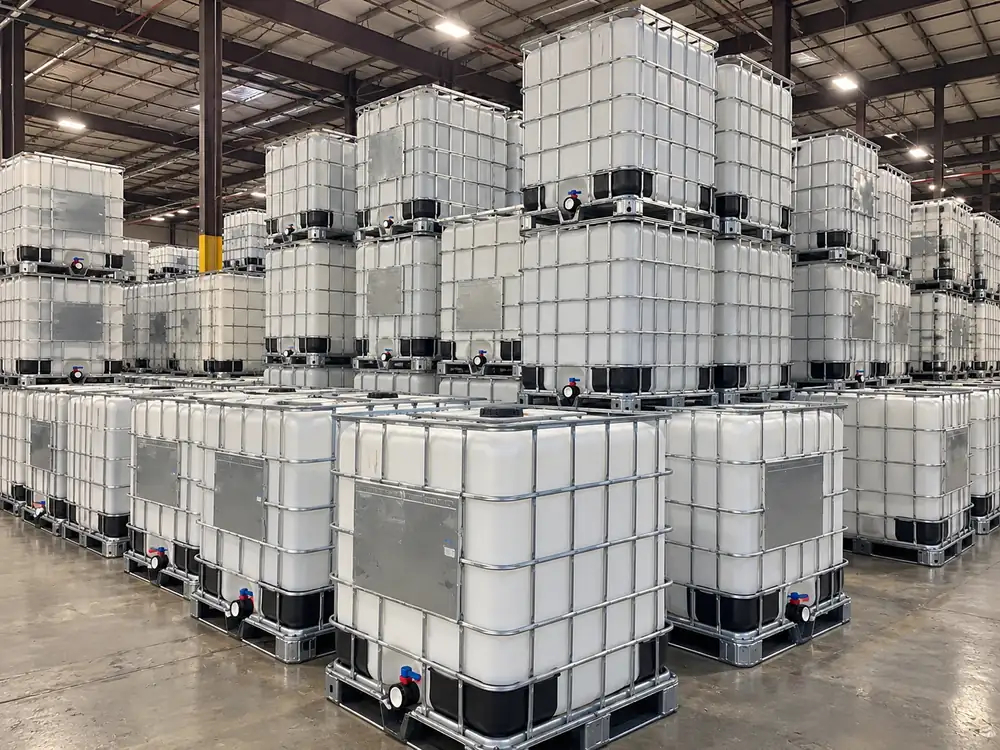
What a finished batch looks like
Uniform clarity across a row is the visible sign of a programme that ran correctly. Where you see variation — a hazier unit beside a clear one — it is almost always a prior-product difference rather than a wash difference, which is why the routing matrix above matters more than the pressure on the lance.
Each of these carries a wash record indexed to its serial: bay, programme, temperature, chemistry concentration, cycle time, final-rinse pH and conductivity, backlight result, leak test outcome, components fitted and marking date.