New totes, and
when to say no to them
We stock and supply new composite IBCs. We also think most people who buy them did not need to — so this page is as much about the four cases where virgin is genuinely required as it is a product listing.
Quote new or first-use totes
Send the specification if you have one. If a rebottled unit would satisfy it, we will say so before quoting.
Tell us what you have.
We will tell you what it is worth.
Buying, selling, washing, hauling or recycling — one form covers all of it. Replies come from a specialist in York, PA, by email, inside one business day.
Prefer plain email? Write to info@ibctotesreco.com — include your ZIP, quantity and what the totes last held.
Buy new when a written specification requires a new cage, when the UN design type you need cannot be built by remanufacture, when your chemistry requires a resin or wall thickness the used population does not contain, or when fleet uniformity has commercial value. In every other case a rebottled unit gives an identical virgin contact surface for roughly 40% less and a fraction of the embodied carbon.
What we supply
Standard 275 and 330 gallon composite IBCs: virgin natural HDPE bottle, hot-dip galvanised tubular cage, and your choice of steel, composite or timber pallet. Valve, gasket material and lid style are specified to your liquid rather than shipped to a default. UN design types quoted on request with the corresponding test documentation.
First-use stock — the best value in the yard
A first-use tote has held one product, once. The classic sources are single-product fillers: distilled and deionised water, USP glycerine, food-grade propylene glycol, liquid sugar. The bottle is visually and functionally indistinguishable from new; the price is closer to Grade A reconditioned. Supply is erratic by nature — it depends entirely on who is emptying what this month — so if you want it, tell us and we will flag you when a lot lands.
The four honest reasons to buy new
- A specification says so. Some audited supply chains require a new cage as well as a new bottle. There is no argument to be had; buy new and move on.
- Design type availability. If you need a particular UN design type and test certificate that cannot be achieved by remanufacturing an available cage, new is the only route.
- Resin or wall requirements. Specific wall thickness, UV-stabilised or pigmented bottles, or resin grades absent from the used population.
- Fleet uniformity. A 200-unit rollout where every tote must be dimensionally and cosmetically identical for automated handling or brand reasons.
And the reasons that are not reasons
“Used totes are dirty” — a Grade A unit is washed, tested and documented; a new unit arrives with mould release and warehouse dust. “We cannot prove provenance” — a rebottled unit has no prior contents to prove. “Insurance requires it” — in seventeen years we have been shown exactly two policies that genuinely did. Ask us to look at yours; we read them for free.
Does your case actually require new?
Find your row. If it is not one of the top four, there is a cheaper honest answer.
| Your situation | Honest recommendation | Why |
|---|---|---|
| Contract specifies new cage | New | No remanufactured unit can satisfy it |
| Need a design type we cannot remanufacture | New | Marking and test certificate availability |
| Specific resin, wall or UV-stabilised bottle | New | Not present in used population |
| 200-unit uniform fleet rollout | New | Dimensional and cosmetic consistency |
| Food or beverage, no cage requirement | Rebottled | Virgin surface, 40% less cost |
| Potable water | Rebottled | No prior-contents question to answer |
| General industrial chemistry | Reconditioned Grade B | Best value container in the trade |
| Water storage, site use, projects | Reconditioned Grade C | Cheapest sound container available |
| Seasonal campaign, 6–14 weeks | Lease | You do not want to own the asset |
| Solvents, hot fill, CIP in place | Stainless | Poly is the wrong material entirely |
New tote FAQ
Do I actually need a new IBC tote?
Usually not. There are four honest reasons to buy new: a purchasing specification or customer contract that explicitly requires a new cage as well as a new bottle; a design type and UN marking combination we cannot build by remanufacture; a product whose chemistry requires a specific bottle resin or wall thickness not available in the used population; or a fleet rollout where absolute dimensional and cosmetic uniformity has commercial value. Outside those, a rebottled unit gives you the same virgin contact surface for roughly 40% less.
What is a 'first-use' tote?
A container that has held exactly one product, once, and come back. The bottle is effectively unused but the unit is legally and commercially a used tote. First-use stock out of a single-product filler — distilled water, glycerine, food-grade glycol — is the best value in the entire catalogue when we can get it, and it sells within days.
What lead time should I expect on new units?
One to two weeks for standard 275 and 330 gallon composite formats, longer for non-standard pallet types, specific resin grades, or UN design types requiring a particular test certificate. Truckload quantities are built and shipped together.
Will you try to talk me out of buying new?
We will tell you plainly if we think a rebottled or Grade A unit does the same job, and why. If you have a specification in front of you that says new, we will quote new without argument — that is a commercial reality, not a sustainability failure on your part.
Do you take the new totes back at end of life?
Yes, on the same terms as anything else: we buy empties, we recondition, and we recycle with documentation at true end of life. Buying new from us means the unit is already inside a loop that will not throw it away.
Related pages
The four honest reasons, and the cost of the other ones
New units are 100% of the price baseline and roughly 410 lb CO₂e. Everything below is the arithmetic of whether you need that.
What buying new actually spends
| Route | CO₂e | Fresh water | Virgin resin | Virgin steel |
|---|---|---|---|---|
| New unit | ≈ 410 lb | ≈ 290 gal | 118 lb | 62 lb |
| Rebottled | ≈ 182 lb | ≈ 120 gal | 47 lb | 0 lb |
| Reconditioned | ≈ 34 lb | ≈ 31 gal | 0 lb | 0 lb |
| Repurposed Grade C | ≈ 11 lb | ≈ 14 gal | 0 lb | 0 lb |
| Input | Quantity | Factor or source |
|---|---|---|
| Virgin HDPE resin | 118 lb / 53.5 kg | 1.8 kg CO₂e/kg |
| Blow moulding energy | 53.5 kg part | 0.4 kg CO₂e/kg |
| Hot-dip galvanised steel | 106 lb / 48 kg | 2.5 kg CO₂e/kg |
| Cage fabrication & assembly | 48 kg | 0.3 kg CO₂e/kg |
| Mechanical HDPE recycling | per kg processed | 0.5 kg CO₂e/kg |
| Fresh water per wash | 31 gal / unit | Metered |
| Natural gas, water heating | per programme | Metered per bay per shift |
| Electricity | per unit | Renewable tariff + 48 kW array |
| New valve, gaskets, lid | ≈ 3 lb | ≈ 8 lb CO₂e |
Available new, with full specification
| Format | Nominal | Usable | L × W × H | Tare (steel base) | Gross, water | Outlet | Stack filled | Availability |
|---|---|---|---|---|---|---|---|---|
| 275 gal standard | 275 gal / 1,041 L | 265 gal | 48 × 40 × 46" | 137 lb | 2,347 lb | 2" S60x6 | 2 high | Ex-stock |
| 275 gal tall | 275 gal / 1,041 L | 264 gal | 48 × 40 × 53" | 141 lb | 2,342 lb | 2" S60x6 | 2 high | Regular |
| 330 gal standard | 330 gal / 1,249 L | 320 gal | 48 × 40 × 53" | 165 lb | 2,834 lb | 2" S60x6 | 2 high | Ex-stock |
| 350 gal | 350 gal / 1,325 L | 338 gal | 48 × 40 × 58" | 172 lb | 2,991 lb | 2" or 3" | 2 high | Occasional |
| 400 gal | 400 gal / 1,514 L | 386 gal | 48 × 46 × 60" | 198 lb | 3,417 lb | 3" buttress | 1 high | Order |
| 550 gal | 550 gal / 2,082 L | 532 gal | 48 × 48 × 72" | 251 lb | 4,688 lb | 3" buttress | 1 high | Occasional |
| 120 gal mini | 120 gal / 454 L | 115 gal | 32 × 32 × 36" | 71 lb | 1,030 lb | 2" S60x6 | 2 high | Occasional |
| 180 gal | 180 gal / 681 L | 174 gal | 40 × 40 × 42" | 98 lb | 1,549 lb | 2" S60x6 | 2 high | Order |
| Stainless 265 gal | 265 gal / 1,003 L | 258 gal | 48 × 40 × 50" | 285 lb | 2,436 lb | 2" tri-clamp | 2 high | Occasional |
| Stainless 330 gal | 330 gal / 1,249 L | 322 gal | 48 × 40 × 56" | 330 lb | 3,015 lb | 2" tri-clamp | 2 high | Occasional |
| Stainless 400 gal | 400 gal / 1,514 L | 390 gal | 48 × 46 × 62" | 385 lb | 3,637 lb | 3" tri-clamp | 1 high | Order |
| Stainless 500 gal | 500 gal / 1,893 L | 488 gal | 48 × 48 × 68" | 430 lb | 4,600 lb | 3" tri-clamp | 1 high | Order |
What you can specify on a new build that you cannot on used stock
This is the real argument for new, and it is narrower than most buyers expect.
| Option | New | Rebottled | Reconditioned |
|---|---|---|---|
| Virgin contact surface | Yes | Yes | No |
| New cage | Yes | No | No |
| New pallet, type of your choice | Yes | Yes | Sometimes |
| Specific wall thickness (60–100 mil) | Yes | Limited | No |
| UV-stabilised or pigmented bottle | Yes | No | No |
| Specific resin grade | Yes | No | No |
| Particular UN design type + test certificate | Yes | Where achievable | Where plate survives |
| Dimensional and cosmetic uniformity across 200 units | Yes | Close | No |
| Valve and elastomer to order | Yes | Yes | Yes |
| Lead time | 1–2 weeks | 3–7 days | Ex-stock |
| Cost | 100% | 55–65% | 18–45% |
Seal selection — the one thing that matters as much on a new unit as a used one
| Medium | EPDM | Viton (FKM) | Silicone | PTFE | We would fit |
|---|---|---|---|---|---|
| Water, potable & process | Excellent | Excellent | Excellent | Excellent | EPDM |
| Dilute acids (<10%) | Good | Excellent | Fair | Excellent | EPDM |
| Concentrated acids | Poor | Good | Poor | Excellent | PTFE |
| Caustic soda, alkalis | Excellent | Fair | Fair | Excellent | EPDM |
| Liquid fertiliser, UAN | Excellent | Good | Fair | Excellent | EPDM |
| Glycols, coolants, de-icer | Excellent | Good | Good | Excellent | EPDM |
| Surfactants, detergents | Excellent | Good | Good | Excellent | EPDM |
| Edible oils, fats | Poor | Excellent | Poor | Excellent | Viton |
| Mineral oils | Poor | Excellent | Poor | Excellent | Viton |
| Aromatic solvents | Poor | Excellent | Poor | Excellent | Viton |
| Chlorinated solvents | Poor | Good | Poor | Excellent | Viton / PTFE |
| Ketones (acetone, MEK) | Fair | Poor | Poor | Excellent | PTFE |
| Alcohols | Good | Good | Good | Excellent | EPDM |
| Fuels, diesel, kerosene | Poor | Excellent | Poor | Excellent | Viton |
| Juice & syrup concentrate | Excellent | Excellent | Excellent | Excellent | FDA EPDM |
| Brine, pickling liquor | Good | Excellent | Fair | Excellent | Viton |
| Hot fill 140–180°F | Fair | Excellent | Excellent | Excellent | Viton / silicone |
| Hydrogen peroxide (dilute) | Good | Fair | Fair | Excellent | EPDM / PTFE |
| Sodium hypochlorite | Good | Good | Fair | Excellent | EPDM |
| Steam / CIP chemistry | Excellent | Fair | Good | Excellent | EPDM |
| Outdoor weathering & ozone | Excellent | Good | Excellent | Excellent | EPDM |
Specific gravity and filled weight — check before you fix the format
| Product | SG | 275 gal filled | 330 gal filled | 550 gal filled |
|---|---|---|---|---|
| Acetone | 0.79 | 1,883 lb | 2,273 lb | 3,756 lb |
| Ethanol | 0.79 | 1,883 lb | 2,273 lb | 3,756 lb |
| Kerosene | 0.81 | 1,927 lb | 2,327 lb | 3,845 lb |
| Citrus terpene oil | 0.84 | 1,993 lb | 2,407 lb | 3,978 lb |
| Diesel fuel | 0.85 | 2,016 lb | 2,433 lb | 4,022 lb |
| Mineral oil, hydraulic | 0.88 | 2,082 lb | 2,514 lb | 4,155 lb |
| Biodiesel B100 | 0.88 | 2,082 lb | 2,514 lb | 4,155 lb |
| Concrete release agent | 0.89 | 2,104 lb | 2,540 lb | 4,200 lb |
| Gear oil | 0.90 | 2,126 lb | 2,567 lb | 4,244 lb |
| Canola oil | 0.91 | 2,148 lb | 2,594 lb | 4,289 lb |
| Soybean / olive oil | 0.92 | 2,170 lb | 2,620 lb | 4,333 lb |
| Flavour concentrate | 0.95 | 2,237 lb | 2,700 lb | 4,466 lb |
| Amine corrosion inhibitor | 0.98 | 2,303 lb | 2,780 lb | 4,599 lb |
| Water | 1.00 | 2,347 lb | 2,834 lb | 4,688 lb |
| Antifoam emulsion | 1.00 | 2,347 lb | 2,834 lb | 4,688 lb |
| Quaternary sanitiser | 1.01 | 2,369 lb | 2,860 lb | 4,732 lb |
| Asphalt emulsion | 1.01 | 2,369 lb | 2,860 lb | 4,732 lb |
| Maple sap | 1.02 | 2,391 lb | 2,887 lb | 4,777 lb |
| Non-ionic surfactant | 1.03 | 2,413 lb | 2,914 lb | 4,821 lb |
| Milk / dairy intermediate | 1.03 | 2,413 lb | 2,914 lb | 4,821 lb |
| Car wash soap concentrate | 1.04 | 2,436 lb | 2,941 lb | 4,865 lb |
| Propylene glycol | 1.04 | 2,436 lb | 2,941 lb | 4,865 lb |
| Anionic surfactant | 1.05 | 2,458 lb | 2,967 lb | 4,910 lb |
| Apple cider | 1.05 | 2,458 lb | 2,967 lb | 4,910 lb |
| Spent grain slurry | 1.05 | 2,458 lb | 2,967 lb | 4,910 lb |
| Laundry detergent | 1.06 | 2,480 lb | 2,994 lb | 4,954 lb |
| Flexographic ink | 1.08 | 2,524 lb | 3,047 lb | 5,043 lb |
| Wine / must | 1.08 | 2,524 lb | 3,047 lb | 5,043 lb |
| Acrylic adhesive emulsion | 1.08 | 2,524 lb | 3,047 lb | 5,043 lb |
| Urea solution (DEF) | 1.09 | 2,546 lb | 3,074 lb | 5,087 lb |
| Alkaline degreaser | 1.10 | 2,568 lb | 3,101 lb | 5,132 lb |
| Humic acid | 1.10 | 2,568 lb | 3,101 lb | 5,132 lb |
| Tomato paste | 1.10 | 2,568 lb | 3,101 lb | 5,132 lb |
| Ethylene glycol | 1.11 | 2,590 lb | 3,127 lb | 5,176 lb |
| Peracetic acid sanitiser | 1.12 | 2,612 lb | 3,154 lb | 5,220 lb |
| Fruit purée | 1.12 | 2,612 lb | 3,154 lb | 5,220 lb |
| Hydrogen peroxide 35% | 1.13 | 2,634 lb | 3,181 lb | 5,265 lb |
| Acid descaler | 1.14 | 2,657 lb | 3,207 lb | 5,309 lb |
| Hydrochloric acid 31% | 1.16 | 2,701 lb | 3,261 lb | 5,398 lb |
| Glyphosate concentrate | 1.17 | 2,723 lb | 3,287 lb | 5,442 lb |
| Brine 23% / soy sauce | 1.20 | 2,789 lb | 3,368 lb | 5,575 lb |
| Sodium hypochlorite 12% | 1.21 | 2,811 lb | 3,394 lb | 5,620 lb |
| Phosphate coating | 1.22 | 2,833 lb | 3,421 lb | 5,664 lb |
| Pigment dispersion | 1.25 | 2,900 lb | 3,501 lb | 5,797 lb |
| Nickel plating solution | 1.25 | 2,900 lb | 3,501 lb | 5,797 lb |
| Foliar micronutrient | 1.25 | 2,900 lb | 3,501 lb | 5,797 lb |
| Glycerine | 1.26 | 2,922 lb | 3,528 lb | 5,841 lb |
| Sulphuric acid 35% | 1.26 | 2,922 lb | 3,528 lb | 5,841 lb |
| Sodium hydroxide 25% | 1.27 | 2,944 lb | 3,554 lb | 5,886 lb |
| UAN 28 | 1.28 | 2,966 lb | 3,581 lb | 5,930 lb |
| Potassium acetate de-icer | 1.28 | 2,966 lb | 3,581 lb | 5,930 lb |
| Latex paint | 1.30 | 3,010 lb | 3,634 lb | 6,019 lb |
| UAN 32 fertiliser | 1.32 | 3,054 lb | 3,688 lb | 6,108 lb |
| Magnesium chloride de-icer | 1.32 | 3,054 lb | 3,688 lb | 6,108 lb |
| Liquid sugar / maple syrup | 1.33 | 3,076 lb | 3,715 lb | 6,152 lb |
| Ammonium thiosulphate | 1.33 | 3,076 lb | 3,715 lb | 6,152 lb |
| Aluminium sulphate | 1.33 | 3,076 lb | 3,715 lb | 6,152 lb |
| Juice concentrate (70 Bx) | 1.35 | 3,121 lb | 3,768 lb | 6,241 lb |
| Polyaluminium chloride | 1.35 | 3,121 lb | 3,768 lb | 6,241 lb |
| Liquid starter 10-34-0 | 1.38 | 3,187 lb | 3,848 lb | 6,374 lb |
| High-fructose corn syrup | 1.38 | 3,187 lb | 3,848 lb | 6,374 lb |
| Calcium chloride brine | 1.38 | 3,187 lb | 3,848 lb | 6,374 lb |
| Sodium silicate | 1.39 | 3,209 lb | 3,875 lb | 6,418 lb |
| Molasses / honey | 1.42 | 3,275 lb | 3,955 lb | 6,551 lb |
| Ferric chloride 40% | 1.42 | 3,275 lb | 3,955 lb | 6,551 lb |
| Calcium nitrate solution | 1.43 | 3,297 lb | 3,981 lb | 6,596 lb |
| Potassium hydroxide 45% | 1.46 | 3,364 lb | 4,061 lb | 6,729 lb |
| Potassium thiosulphate | 1.47 | 3,386 lb | 4,088 lb | 6,773 lb |
| Sodium hydroxide 50% | 1.52 | 3,496 lb | 4,222 lb | 6,995 lb |
| Phosphoric acid 75% | 1.58 | 3,629 lb | 4,382 lb | 7,261 lb |
| Sulphuric acid 93% | 1.83 | 4,181 lb | 5,049 lb | 8,370 lb |
Service life by exposure — a new bottle in full sun is still a five-year asset
| Exposure | Realistic life | Note |
|---|---|---|
| Indoors, dry, no direct sun | 10–15 years | The bottle outlives most process changes |
| Indoors, skylights / direct sun | 8–12 years | Rotate the containers occasionally |
| Outdoors, fully covered | 9–14 years | A cover is the highest-return intervention there is |
| Outdoors, shaded north side | 7–10 years | Orientation matters as much as cover |
| Outdoors, partial sun | 5–7 years | One face chalks before the other |
| Outdoors, full sun | 3–5 years | Chalky, boardy wall; sudden failures |
| Outdoors, full sun + freeze cycles | 2–4 years | The worst combination we see |
Standards and regulations behind design-type selection
| Reference | Title | What it covers | Who it binds |
|---|---|---|---|
| 49 CFR 172.101 | Hazardous materials table | Classification and authorised packaging reference | Shippers |
| 49 CFR 172 Subpart H | Training | Who must be trained, in what, how often, with records | Any hazmat employer |
| 49 CFR 173 | Shippers — general requirements by class | Whether an IBC is authorised for your entry | Shippers |
| 49 CFR 178 Subpart N | IBC design types, testing and marking | What the plate means and how it was earned | Makers, reconditioners |
| 49 CFR 180.352 | Periodic inspection, testing, repair & remanufacture | 2.5-year visual, 5-year leakproofness + full inspection | Owners, shippers |
| 40 CFR 261.7 | RCRA empty containers | When a container counts as empty; P-list triple rinse | Generators |
| 40 CFR 262 | Generator standards | Waste determination, manifesting, accumulation | Generators |
| 21 CFR 177.1520 | Olefin polymers | HDPE compliance for food contact | Food users |
| 21 CFR 177.2600 | Rubber articles for repeated use | Gasket and seal compliance for food contact | Food users |
| 21 CFR 110 / 117 | Good manufacturing practice | Handling, storage, sanitation programmes | Food users |
| NSF/ANSI 61 | Drinking water system components | Potable-contact material evaluation | Water utilities |
| 29 CFR 1910.1200 | Hazard communication | Workplace labelling and safety data sheets | Everyone |
| 29 CFR 1910.146 | Permit-required confined spaces | Entry into tanks and vessels | Anyone cleaning containers |
| 29 CFR 1910.178 | Powered industrial trucks | Forklift operation and certification | Yards and docks |
| ANSI/ITSDF B56.1 | Low-lift and high-lift trucks | Capacity ratings and load centres | Yards and docks |
| ANSI MH16.1 | Steel storage racking | Beam capacity, deflection, inspection | Warehouses |
| PA Title 25 Ch. 95 | Wastewater treatment requirements | Industrial discharge standards in Pennsylvania | Wash lines |
| ISPM-15 | Wood packaging in international trade | Heat treatment and marking of timber pallets | Exporters |
Five reasons people buy new that are not reasons
“Used totes are dirty”
A Grade A unit is washed to a recorded programme, hydrostatically tested and documented. A new unit arrives with mould release and warehouse dust.
“We cannot prove provenance”
A rebottled unit has no prior contents to prove. The contact surface is virgin and the question does not arise.
“Insurance requires it”
In seventeen years we have been shown two policies that genuinely did. Send us yours and we will read it for free.
“New will be quicker”
New is one to two weeks. Reconditioned stock is ex-stock and rebottling is three to seven days.
“We want it to look professional”
Free stencilling to your wording is available on any grade. Cosmetic uniformity across a large fleet is a real reason; appearance on its own is not.
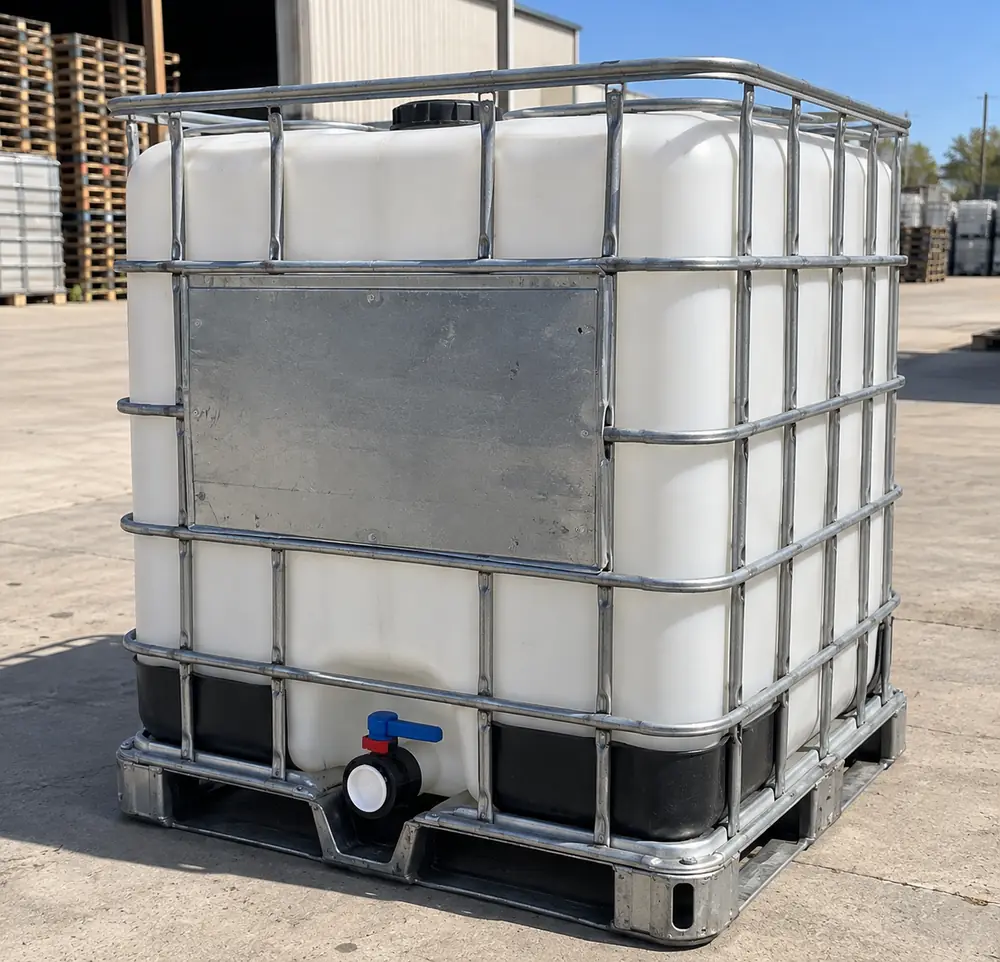
The photograph that makes the argument
This is what a virgin HDPE contact surface looks like. It is also what a rebottled unit looks like, because in both cases the bottle has never held anything — the difference is a cage that has carried a bottle before, straightened on a press jig and zinc repaired.
If your specification demands a new cage, buy new and move on. If it does not, you are paying roughly 40% more for a component that nobody downstream will ever ask about.