Reconditioned
IBC totes
The original bottle, washed back to a defined programme, pressure tested, re-valved and re-marked. This is the best-value bulk container in North America and the backbone of our yard.
Quote reconditioned totes
Name the liquid and the quantity. You will get a grade recommendation, photographs of the actual units and a delivered price.
Tell us what you have.
We will tell you what it is worth.
Buying, selling, washing, hauling or recycling — one form covers all of it. Replies come from a specialist in York, PA, by email, inside one business day.
Prefer plain email? Write to info@ibctotesreco.com — include your ZIP, quantity and what the totes last held.
A reconditioned IBC tote is a used container whose original HDPE bottle has been washed to a recorded programme, leak tested at pressure, fitted with a new valve, gaskets and lid, and re-marked by a registered reconditioner. It typically costs 20–35% of a new unit, carries zero virgin resin, and in our yard moves from inbound gate to shippable in an average of 72 hours.
The three grades, defined
These are contractual definitions printed on the back of every invoice, not adjectives. The inspector assigns the grade and nobody in sales can overturn it.
Grade A — food-grade eligible
Clear to near-clear bottle. Documented edible prior service from the generating site. Washed on the dedicated food line, 100% hydrostatically tested, new valve, new FDA-compliant gaskets, new lid, re-marked. Suitable for food, beverage and potable applications. See food-grade totes.
Grade B — washed industrial
Sound bottle with staining or haze permitted; square cage; sound or new pallet; new valve and gaskets; leak tested; re-marked. The right answer for fertiliser, surfactants, glycols, coolants, de-icer, industrial cleaners and the broad middle of chemical blending. Roughly three quarters of what leaves our yard.
Grade C — rinsed, as-is
Watertight and structurally sound, cosmetically marked, may show ghosting from a previous pigment or resin. Sold for non-contact storage, water, site use, ballast and upcycling. Not sold as a stacking base and not warranted beyond being watertight at loading.
What a reconditioned tote is not
It is not a rinsed container with a new sticker. The distinction matters because the trade is full of both. If a seller cannot tell you the wash programme, the test pressure and the prior product, you are buying the second thing. Our full line sequence — temperatures, concentrations, residence times — is published on the reconditioning line page, which is unusual, and deliberate.
What you get, and what you give up
Pick the cheapest row that still satisfies your liquid and your auditor.
| Grade A | Grade B | Grade C | |
|---|---|---|---|
| Bottle clarity | Clear / near-clear | Haze & staining OK | Ghosting permitted |
| Prior service | Documented edible | Industrial, declared | Industrial, declared |
| Wash programme | Food line, Stage 1–2 | Stage 1–3 as needed | Stage 1 rinse |
| Hydrostatic test | 100% | Sampled | Sampled |
| New valve & gaskets | Yes, FDA-compliant | Yes | Sound or new |
| New lid | Yes | Yes | Sound or new |
| Re-marked | Yes | Yes | Where plate survives |
| Stackable filled | 2 high | 2 high | No |
| 30-day leak warranty | Yes | Yes | No — watertight at loading |
| Typical use | Food, potable, audited | Industrial liquids | Water, storage, projects |
| Cost vs new | ≈ 35–45% | ≈ 25–32% | ≈ 18–24% |
What happens between your order and your dock
Five steps, all of them recorded against the unit serial.
Grade recommendation
You tell us the liquid; we tell you the lowest grade that is honest for it, and say so if the answer is rebottled rather than reconditioned.
Stock pull and photographs
The actual units are pulled from the rack, photographed and attached to the quote. No stock imagery for used stock, ever.
Fit-out to your spec
Valve type and elastomer, lid style, dust cap and pallet type are fitted to order rather than to whatever was on the unit when it arrived.
Final leak test and marking
Re-tested after fit-out, because a new valve is a new potential leak path. Marked, stencilled, serial recorded.
Load and document
Loaded on our own flatbed or van where the lane allows, with the grade certificate, test record and photo set travelling with the paperwork.
We buy these back when you are finished with them.
Reconditioned tote FAQ
What exactly is done to a reconditioned IBC tote?
Drain and classify the heel, assign an inbound grade at the inspection bench, route to the right wash programme (three-stage rinse, hot detergent, or hot caustic clean-in-place at 160–180°F), force-dry, backlight inspect for ghosting, air leak test at 3 psi for five minutes, fit a new valve, gaskets and lid, apply a reconditioner mark with our code and date, stencil the grade on the cage, photograph on the rack.
How long does a reconditioned tote last?
A composite IBC bottle has a practical service life of roughly five years of outdoor UV exposure or ten to fifteen years indoors, and the cage outlasts three or four bottles. A Grade B unit bought today will typically give you several more service cycles; if it is going outdoors permanently, budget on UV rather than on the wash as the limiting factor.
Can I specify the valve and gasket material?
Yes, and you should. Standard is a 2-inch polypropylene butterfly valve with an EPDM seat; we stock Viton for aromatic and chlorinated service, stainless ball valves for high-viscosity and hot product, and S60x6 or camlock outlet adapters. Tell us the liquid and we will spec the elastomer rather than guess.
Will the tote still carry a valid UN marking?
Where the original design-type marking survives and the unit passes the required inspection and leak test, yes — and we add a reconditioner mark showing our registration code and the month and year of reconditioning. If the original plate is destroyed or illegible the unit is sold as non-UN, for non-regulated service only, and we say so on the quote.
Are reconditioned totes stackable?
Composite IBCs are typically rated for two-high stacking when filled, provided the cage is square, the welds are sound and the pallet is undamaged — which is precisely what the inspection bench checks. We will not sell a Grade C unit as a stacking base. Stack ratings by format are on the weights and footprints page.
What is the minimum order?
One, collected from the yard. Delivered orders normally start at four units because freight for a single tote often exceeds the tote; 40–45 units fills a flatbed and is where pricing improves sharply.
Related pages
Everything a reconditioned unit commits us to
Thirteen graded attributes, twelve formats, a hundred prior products and the wash programme each one routes to.
The grade matrix in full
| Grade A | Grade B | Grade C | Cage / pallet only | |
|---|---|---|---|---|
| Bottle clarity | Clear / near-clear | Haze & staining permitted | Ghosting permitted | n/a |
| Prior service | Documented edible, signed at source | Industrial, declared | Industrial, declared | Any declared |
| Wash programme | Food line, recorded | Programme to residue, recorded | Ambient rinse | Cage rinse only |
| Hydrostatic test | 100% of units | Sampled | Sampled | n/a |
| New valve & gaskets | Yes, FDA-compliant | Yes | Sound or new | n/a |
| New lid | Yes | Yes | Sound or new | n/a |
| Re-marked | Yes | Yes | Where the plate survives | No |
| Stackable when filled | 2 high | 2 high | No | n/a |
| 30-day leak warranty | Yes | Yes | No — watertight at loading | No warranty |
| Food / potable | Yes, with records | No | No | n/a |
| Cost vs new | ≈ 35–45% | ≈ 25–32% | ≈ 18–24% | ≈ 5–10% |
| Lead time | Ex-stock to 5 days | Ex-stock | Ex-stock | Ex-stock |
| Loop score (lives left) | 5–6 | 4–5 | 2–3 | 3–4 bottles |
Available in every composite format
| Format | Nominal | Usable | L × W × H | Tare (steel base) | Gross, water | Outlet | Stack filled | Availability |
|---|---|---|---|---|---|---|---|---|
| 275 gal standard | 275 gal / 1,041 L | 265 gal | 48 × 40 × 46" | 137 lb | 2,347 lb | 2" S60x6 | 2 high | Ex-stock |
| 275 gal tall | 275 gal / 1,041 L | 264 gal | 48 × 40 × 53" | 141 lb | 2,342 lb | 2" S60x6 | 2 high | Regular |
| 330 gal standard | 330 gal / 1,249 L | 320 gal | 48 × 40 × 53" | 165 lb | 2,834 lb | 2" S60x6 | 2 high | Ex-stock |
| 350 gal | 350 gal / 1,325 L | 338 gal | 48 × 40 × 58" | 172 lb | 2,991 lb | 2" or 3" | 2 high | Occasional |
| 400 gal | 400 gal / 1,514 L | 386 gal | 48 × 46 × 60" | 198 lb | 3,417 lb | 3" buttress | 1 high | Order |
| 550 gal | 550 gal / 2,082 L | 532 gal | 48 × 48 × 72" | 251 lb | 4,688 lb | 3" buttress | 1 high | Occasional |
| 120 gal mini | 120 gal / 454 L | 115 gal | 32 × 32 × 36" | 71 lb | 1,030 lb | 2" S60x6 | 2 high | Occasional |
| 180 gal | 180 gal / 681 L | 174 gal | 40 × 40 × 42" | 98 lb | 1,549 lb | 2" S60x6 | 2 high | Order |
Your prior product decides the achievable grade
Reconditioning removes residue. It does not remove history, and it cannot extract what a polymer has absorbed.
Prior-product list — 100 named products with programme, achievable grade and food eligibility
| Prior product | Family | SG | Programme | Best grade | Food? | Seal | What to watch |
|---|---|---|---|---|---|---|---|
| Apple juice concentrate (70 Bx) | Food & beverage | 1.35 | PF | A | Yes | FDA EPDM | Best inbound stock we see; sugars rinse clean |
| Orange juice concentrate | Food & beverage | 1.33 | PF | A | Yes | FDA Viton | Citrus oil fraction can scent the bottle |
| Grape juice concentrate | Food & beverage | 1.34 | PF | A | Yes | FDA EPDM | Watch for tartrate scale at the outlet |
| Liquid sugar / sucrose syrup | Food & beverage | 1.33 | PF | A | Yes | FDA EPDM | Hot rinse only, no caustic needed |
| High-fructose corn syrup | Food & beverage | 1.38 | PF | A | Yes | FDA EPDM | Viscous; 3" outlet helps decanting |
| Molasses | Food & beverage | 1.42 | PF | A | Yes | FDA EPDM | Heated rinse; heavy heel |
| Honey | Food & beverage | 1.42 | PF | A | Yes | FDA EPDM | Crystallises; heater jacket recommended |
| Maple sap | Food & beverage | 1.02 | PF | A | Yes | FDA EPDM | Benign but sugars feed biofilm fast |
| Maple syrup | Food & beverage | 1.33 | PF | A | Yes | FDA EPDM | Hot rinse; inspect lid seat |
| Apple cider | Food & beverage | 1.05 | PF | A | Yes | FDA EPDM | Vented lid essential — ferments |
| Wine / must | Food & beverage | 1.08 | PF | A | Yes | FDA EPDM | Tartrate scale; usually leased |
| Beer / wort | Food & beverage | 1.05 | PF | A | Yes | FDA EPDM | Stainless preferred for repeat service |
| Brine (pickling liquor) | Food & beverage | 1.20 | PF | A | Yes | FDA Viton | Check cage for chloride attack |
| Vinegar, 10% | Food & beverage | 1.01 | PF | A | Yes | FDA EPDM | Easy; acid-resistant seal needed |
| Soy sauce | Food & beverage | 1.20 | PF | A | Yes | FDA Viton | Salt plus colour; monitor ghosting |
| Edible soybean oil | Food & beverage | 0.92 | P2 | A | Yes | FDA Viton | 140°F minimum or fat re-deposits |
| Edible canola oil | Food & beverage | 0.91 | P2 | A | Yes | FDA Viton | As above |
| Olive oil | Food & beverage | 0.92 | P2 | A | Yes | FDA Viton | Polyphenols can tint the wall |
| Glycerine, USP | Food & beverage | 1.26 | PF | A | Yes | FDA EPDM | Often effectively first-use stock |
| Propylene glycol, food grade | Food & beverage | 1.04 | PF | A | Yes | FDA EPDM | Frequently single-product filler stock |
| Liquid egg | Food & beverage | 1.04 | PF | A | Case by case | FDA EPDM | Protein film needs verification |
| Milk / dairy intermediate | Food & beverage | 1.03 | PF | A | Case by case | FDA EPDM | Allergen changeover record required |
| Whey concentrate | Food & beverage | 1.06 | PF | A | Case by case | FDA EPDM | Protein scale; hot detergent |
| Tomato paste | Food & beverage | 1.10 | PF | A | Yes | FDA Viton | Acidic; stains but rinses |
| Fruit purée | Food & beverage | 1.12 | PF | A | Yes | FDA EPDM | Pulp load; coarse settling matters |
| Flavour concentrate / essence | Food & beverage | 0.95 | Refused | Rebottle | No | PTFE | Permeates HDPE permanently — use stainless |
| Citrus terpene oil | Food & beverage | 0.84 | Refused | Recycle | Never | PTFE | One batch ends a poly bottle's usefulness |
| Spent grain slurry | Food & beverage | 1.05 | P2 | B | No | EPDM | By-product duty; 3" outlet strongly advised |
| Yeast slurry | Food & beverage | 1.08 | P2 | B | Case by case | EPDM | Vent — active fermentation |
| UAN 32 liquid nitrogen | Agricultural | 1.32 | P1 | B | Never | EPDM | Rinses readily; dense — check ratings |
| UAN 28 | Agricultural | 1.28 | P1 | B | Never | EPDM | As above |
| Liquid starter 10-34-0 | Agricultural | 1.38 | P1 | B | Never | EPDM | Polyphosphate scale at the outlet |
| Ammonium thiosulphate | Agricultural | 1.33 | P1 | B | Never | EPDM | Sulphur odour persists faintly |
| Potassium thiosulphate | Agricultural | 1.47 | P1 | B | Never | EPDM | Very dense; 275 format only |
| Calcium nitrate solution | Agricultural | 1.43 | P1 | B | Never | EPDM | Crystallises when cold |
| Humic / fulvic acid | Agricultural | 1.10 | P2 | B | Never | EPDM | Dark staining, usually washes out |
| Fish hydrolysate fertiliser | Agricultural | 1.12 | P3 | C | Never | Viton | Odour frequently permanent |
| Foliar micronutrient blend | Agricultural | 1.25 | P1 | B | Never | EPDM | Metal salts can tint the wall |
| Glyphosate concentrate | Agricultural | 1.17 | P3 | C | Never | Viton | Labelled rinse programme governs |
| 2,4-D amine concentrate | Agricultural | 1.19 | Refused | Per label | Never | Viton | Label prescribes rinse-and-destroy |
| Crop oil adjuvant | Agricultural | 0.88 | P3 | C | Never | Viton | Attacks EPDM; permeates slowly |
| Surfactant adjuvant (NIS) | Agricultural | 1.03 | P1 | B | Never | EPDM | Foams heavily on transfer |
| Molluscicide suspension | Agricultural | 1.22 | Refused | Per label | Never | Viton | Refused — labelled destruction |
| Livestock drinking water | Water & inert | 1.00 | P1 | A | Yes | EPDM | Effectively first-use |
| Irrigation water | Water & inert | 1.00 | P1 | A | Yes | EPDM | May carry silt; coarse settling |
| Sodium hydroxide 50% | Industrial chemistry | 1.52 | P1 | B | Never | EPDM | 3,497 lb filled — check every rating |
| Sodium hydroxide 25% | Industrial chemistry | 1.27 | P1 | B | Never | EPDM | Easy wash; dilute and drain |
| Potassium hydroxide 45% | Industrial chemistry | 1.46 | P1 | B | Never | EPDM | As NaOH; dense |
| Sulphuric acid 93% | Industrial chemistry | 1.83 | Refused | Dedicated | Never | PTFE | 4,182 lb filled; dedicated service only |
| Sulphuric acid 35% | Industrial chemistry | 1.26 | P1 | C | Never | PTFE | Fume attack on cage galvanising |
| Hydrochloric acid 31% | Industrial chemistry | 1.16 | P1 | C | Never | PTFE | Cage usually the limiting factor |
| Phosphoric acid 75% | Industrial chemistry | 1.58 | P1 | B | Never | PTFE | Dense; viscous at low temperature |
| Nitric acid 42% | Industrial chemistry | 1.26 | Refused | Dedicated | Never | PTFE | Oxidiser — embrittles HDPE |
| Hydrogen peroxide 35% | Industrial chemistry | 1.13 | P1 | B | Case by case | PTFE | Vent; absolutely no contaminants |
| Sodium hypochlorite 12% | Industrial chemistry | 1.21 | P1 | B | Never | EPDM | Degasses; vent and shield from UV |
| Ferric chloride 40% | Industrial chemistry | 1.42 | P2 | C | Never | Viton | Heavy orange staining is permanent |
| Aluminium sulphate | Industrial chemistry | 1.33 | P1 | B | Never | EPDM | Scale at the outlet boss |
| Polyaluminium chloride | Industrial chemistry | 1.35 | P1 | B | Never | EPDM | Gels if allowed to dry out |
| Propylene glycol coolant | Industrial chemistry | 1.04 | P1 | B | Never | EPDM | Ideal duty; nothing to watch |
| Ethylene glycol | Industrial chemistry | 1.11 | P1 | B | Never | EPDM | Toxic — never re-grade for potable |
| Calcium chloride brine 32% | Industrial chemistry | 1.38 | P1 | B | Never | Viton | Chloride attack on lower cage |
| Magnesium chloride de-icer | Industrial chemistry | 1.32 | P1 | B | Never | Viton | As above; rinse frames each spring |
| Potassium acetate de-icer | Industrial chemistry | 1.28 | P1 | B | Never | EPDM | Benign; airport runway chemistry |
| Urea solution (DEF) | Industrial chemistry | 1.09 | P1 | B | Never | EPDM | Purity-critical next fill; usually dedicated |
| Nickel plating solution | Industrial chemistry | 1.25 | Refused | Recycle | Never | Viton | Metal-bearing; never re-used |
| Chromic acid solution | Refused | 1.30 | Refused | Refused | Never | PTFE | Not accepted at the gate |
| Cyanide plating bath | Refused | 1.15 | Refused | Refused | Never | PTFE | Acutely hazardous — licensed facility only |
| Phosphate conversion coating | Industrial chemistry | 1.22 | P2 | C | Never | Viton | Scale and staining |
| Amine corrosion inhibitor | Industrial chemistry | 0.98 | P2 | B | Never | Viton | Fish-like odour can persist |
| Sodium silicate | Industrial chemistry | 1.39 | P3 | C | Never | EPDM | Sets hard if dried; wash promptly |
| Polymer flocculant emulsion | Industrial chemistry | 1.02 | P3 | C | Never | EPDM | Extremely slippery; gels with water |
| Sodium bisulphite | Industrial chemistry | 1.33 | P1 | B | Never | EPDM | Sulphur odour; vent |
| Antifoam silicone emulsion | Industrial chemistry | 1.00 | P3 | C | Never | Viton | Film is very hard to remove |
| Latex paint, white | Coatings & inks | 1.30 | P3 | C | Never | EPDM | Heavy ghosting; often rebottle |
| Latex paint, tinted | Coatings & inks | 1.32 | P3 | C | Never | EPDM | Pigment ghosting permanent |
| Water-based pigment dispersion | Coatings & inks | 1.25 | P3 | C | Never | EPDM | Strong colour transfer into the wall |
| Flexographic ink | Coatings & inks | 1.08 | P3 | Rebottle | Never | Viton | Resin binder plasticises the surface |
| UV-curable coating | Coatings & inks | 1.10 | Refused | Recycle | Never | PTFE | Cures in the bottle; not washable |
| Acrylic adhesive emulsion | Coatings & inks | 1.08 | P3 | Rebottle | Never | EPDM | Caustic at 180°F, often still ghosts |
| PVA wood adhesive | Coatings & inks | 1.09 | P3 | C | Never | EPDM | Wash before it skins over |
| Polyurethane resin, 2-part | Coatings & inks | 1.12 | Refused | Recycle | Never | PTFE | Cross-linked; nothing shifts it |
| Asphalt emulsion | Coatings & inks | 1.01 | P3 | C | Never | Viton | Hot caustic plus long dwell |
| Concrete release agent | Coatings & inks | 0.89 | P2 | C | Never | Viton | Oily film; 140°F detergent |
| Mineral oil, hydraulic | Oils & fuels | 0.88 | P3 | B | Never | Viton | Permeation; faint odour often remains |
| Cutting fluid, soluble | Oils & fuels | 0.92 | P3 | B | Never | Viton | Bacterial odour is the real problem |
| Gear oil | Oils & fuels | 0.90 | P3 | C | Never | Viton | Heavy film; two cycles common |
| Used motor oil | Refused | 0.89 | Refused | Recycle | Never | Viton | Waste stream — not accepted for reuse |
| Diesel fuel | Oils & fuels | 0.85 | Refused | Recycle | Never | Viton | Permanent odour; bottle compromised |
| Kerosene | Oils & fuels | 0.81 | Refused | Recycle | Never | Viton | As diesel |
| Biodiesel B100 | Oils & fuels | 0.88 | P3 | C | Never | Viton | Solvency attacks some HDPE grades |
| Vegetable-based lubricant | Oils & fuels | 0.92 | P2 | B | Never | Viton | Oxidises to a varnish if left |
| Anionic surfactant concentrate | Cleaning & sanitation | 1.05 | P1 | B | Never | EPDM | It is soap — rinses, but foams |
| Non-ionic surfactant | Cleaning & sanitation | 1.03 | P1 | B | Never | EPDM | Easy wash |
| Alkaline degreaser | Cleaning & sanitation | 1.10 | P1 | B | Never | EPDM | Compatible with our own loop |
| Acid descaler | Cleaning & sanitation | 1.14 | P1 | B | Never | PTFE | Segregate heel from caustic tanks |
| Quaternary ammonium sanitiser | Cleaning & sanitation | 1.01 | P1 | B | Case by case | EPDM | Residual actives need verification |
| Peracetic acid sanitiser | Cleaning & sanitation | 1.12 | P1 | B | Case by case | PTFE | Oxidiser; vent and shield |
| Hand sanitiser (ethanol 70%) | Cleaning & sanitation | 0.87 | P1 | B | Case by case | Viton | Alcohol flashes off; little residue |
| Laundry detergent, liquid | Cleaning & sanitation | 1.06 | P1 | B | Never | EPDM | Optical brighteners can tint |
| Car wash soap concentrate | Cleaning & sanitation | 1.04 | P1 | B | Never | EPDM | Very common inbound stock |
| Floor finish / wax emulsion | Cleaning & sanitation | 1.02 | P3 | C | Never | EPDM | Films hard; wash before it dries |
| Potable water | Water & inert | 1.00 | P1 | A | Yes | FDA EPDM | Frequently first-use stock |
| Deionised water | Water & inert | 1.00 | P1 | A | Yes | FDA EPDM | Best-value first-use source |
| Distilled water | Water & inert | 1.00 | P1 | A | Yes | FDA EPDM | As above |
| Glycerine, technical | Water & inert | 1.26 | P1 | B | No | EPDM | Technical grade is not food grade |
| Saline solution, industrial | Water & inert | 1.07 | P1 | B | Never | Viton | Chloride; inspect cage |
| Unknown or mixed residue | Refused | — | Refused | Refused | Never | — | Safety assessment, not a grading question |
| RCRA P-listed residue | Refused | — | Refused | Refused | Never | — | Licensed treatment facility only |
| Radiological material | Refused | — | Refused | Refused | Never | — | No testing, no discussion |
| Pesticide, labelled destruction | Refused | — | Refused | Refused | Never | — | Service life ended by regulation |
Wash programmes — five routes with temperature, chemistry and cycle time
| Code | Programme | Temperature | Chemistry | Cycle | Relative cost | Suits |
|---|---|---|---|---|---|---|
| P1 | Ambient flood rinse | Ambient | Process water, occasional mild alkaline | 90 sec | 1.0× | Water-miscible residues |
| P2 | Hot detergent | 140°F | Alkaline detergent 1.5–2.5% | 3 min | 2.2× | Oils, fats, filming products |
| P3 | Caustic clean-in-place | 160–180°F | NaOH 2–4% + surfactant | 6–9 min | 4.5× | Pigments, latex, resins, heavy concentrates |
| PF | Food line (Bay 1) | 140°F | Alkaline detergent 2% + 100% hydrostatic | 3 min + test | 3.1× | Documented edible prior service |
| Refused | Not accepted | — | — | — | — | Unknown, acute, labelled-destruction, radiological |
Seal selection — 21 media against EPDM, Viton, silicone and PTFE
| Medium | EPDM | Viton (FKM) | Silicone | PTFE | We would fit |
|---|---|---|---|---|---|
| Water, potable & process | Excellent | Excellent | Excellent | Excellent | EPDM |
| Dilute acids (<10%) | Good | Excellent | Fair | Excellent | EPDM |
| Concentrated acids | Poor | Good | Poor | Excellent | PTFE |
| Caustic soda, alkalis | Excellent | Fair | Fair | Excellent | EPDM |
| Liquid fertiliser, UAN | Excellent | Good | Fair | Excellent | EPDM |
| Glycols, coolants, de-icer | Excellent | Good | Good | Excellent | EPDM |
| Surfactants, detergents | Excellent | Good | Good | Excellent | EPDM |
| Edible oils, fats | Poor | Excellent | Poor | Excellent | Viton |
| Mineral oils | Poor | Excellent | Poor | Excellent | Viton |
| Aromatic solvents | Poor | Excellent | Poor | Excellent | Viton |
| Chlorinated solvents | Poor | Good | Poor | Excellent | Viton / PTFE |
| Ketones (acetone, MEK) | Fair | Poor | Poor | Excellent | PTFE |
| Alcohols | Good | Good | Good | Excellent | EPDM |
| Fuels, diesel, kerosene | Poor | Excellent | Poor | Excellent | Viton |
| Juice & syrup concentrate | Excellent | Excellent | Excellent | Excellent | FDA EPDM |
| Brine, pickling liquor | Good | Excellent | Fair | Excellent | Viton |
| Hot fill 140–180°F | Fair | Excellent | Excellent | Excellent | Viton / silicone |
| Hydrogen peroxide (dilute) | Good | Fair | Fair | Excellent | EPDM / PTFE |
| Sodium hypochlorite | Good | Good | Fair | Excellent | EPDM |
| Steam / CIP chemistry | Excellent | Fair | Good | Excellent | EPDM |
| Outdoor weathering & ozone | Excellent | Good | Excellent | Excellent | EPDM |
Failure modes — what we reject, and why
| Mode | Cause | What it looks like | Recoverable? | Prevention | Frequency |
|---|---|---|---|---|---|
| UV embrittlement | Unshaded outdoor storage | Chalky, boardy, higher-pitched tap | No | Cover or shade it | Most common |
| Stress whitening at the radius | Over-fill, freeze, uneven ground | White crackled lower corners | No | Level pad, respect max gross mass | Common |
| Plasticisation & ghosting | Pigment, resin, solvent absorption | Permanent shadow when backlit | Rebottle | Match chemistry to material | Common |
| Freeze damage | Left full and sealed | Bulged panel, split seam, blown boss | Sometimes fittings only | Drain or 2/3 fill, vented lid | Seasonal spike |
| Valve boss cracking | Unsupported pump or rigid pipe | Star crazing at the boss root | No — rebottle | Support the pump separately | Avoidable |
| Impact puncture | Forklift tine, drop, collision | Hole or deep gouge | No | Handling discipline | Rare |
| Cage racking | Soft ground, foot impact, over-fill | Diagonals differ by > 1/2" | Jig if under 1/2" | Level load-bearing pad | Common |
| Weld node cracking | Fatigue, previous field weld | Rust bloom then crack | No | Never field-weld a cage | Occasional |
| Pallet rot / delamination | Timber base outdoors | Soft bearers, split deck | Replace base | Specify steel or composite | Very common |
| Seal failure | Compression set, wrong elastomer, reuse | Weeping at the boss or lid | Yes — new seal | Replace at every product change | 71% of reports |
Service life by exposure — the UV table
| Exposure | Realistic life | Note |
|---|---|---|
| Indoors, dry, no direct sun | 10–15 years | The bottle outlives most process changes |
| Indoors, skylights / direct sun | 8–12 years | Rotate the containers occasionally |
| Outdoors, fully covered | 9–14 years | A cover is the highest-return intervention there is |
| Outdoors, shaded north side | 7–10 years | Orientation matters as much as cover |
| Outdoors, partial sun | 5–7 years | One face chalks before the other |
| Outdoors, full sun | 3–5 years | Chalky, boardy wall; sudden failures |
| Outdoors, full sun + freeze cycles | 2–4 years | The worst combination we see |
Specified to your liquid, not to whatever arrived
Valve, seat elastomer, lid style, pallet base and stencilling are fitted to order.
| Part | Group | Options | Materials | Typical use | Availability |
|---|---|---|---|---|---|
| 2" butterfly valve | Valves | EPDM, Viton, silicone seat | PP body | Standard composite IBC outlet | Stocked |
| 3" butterfly valve | Valves | EPDM, Viton seat | PP body | 330 gal+ and viscous product | Stocked |
| 2" ball valve, full bore | Valves | EPDM, Viton seat | PP / PE body | Slurries, pastes, abrasives | Stocked |
| 3" ball valve | Valves | EPDM, Viton seat | PP body | High-viscosity decanting | 1–3 days |
| Stainless ball valve | Valves | 2", 3"; PTFE seat | 304 / 316L | Hot fill, solvents, CIP service | 1–3 days |
| Fine-control ball valve | Valves | 2", lever or handwheel | PP | Controlled pail filling | Stocked |
| Tri-clamp butterfly valve | Valves | 2", 3" | 316L, EPDM / PTFE | Sanitary stainless vessels | To order |
| Gate valve | Valves | 2", 3" | Cast iron, PTFE seat | Legacy steel vessels only | To order |
Six things to get right when buying reconditioned
Not naming the liquid
Grade is decided by what goes in and who audits it. Name the product and we will recommend the cheapest grade that is honest for it.
Keeping the default EPDM seat
EPDM is right for water-based chemistry and wrong for aromatics, fuels and fats. The elastomer costs a few dollars.
Mounting a pump on the outlet
Support pumps independently and use a flexible first connection. Star crazing at the valve boss is unrepairable.
Buying Grade C for a filled lower tier
Only square-caged Grade A and B units may form a filled stacking base. We will not sell Grade C for it.
Assuming a plate means authorised
Periodic intervals run on a calendar: 2.5-year visual, 5-year leakproofness test, with records. Ask for them before you agree a price.
Leaving them in full sun
Unshaded outdoor storage takes a bottle from ten-to-fifteen years down to three-to-five. A cover is the highest-return thing you can buy.
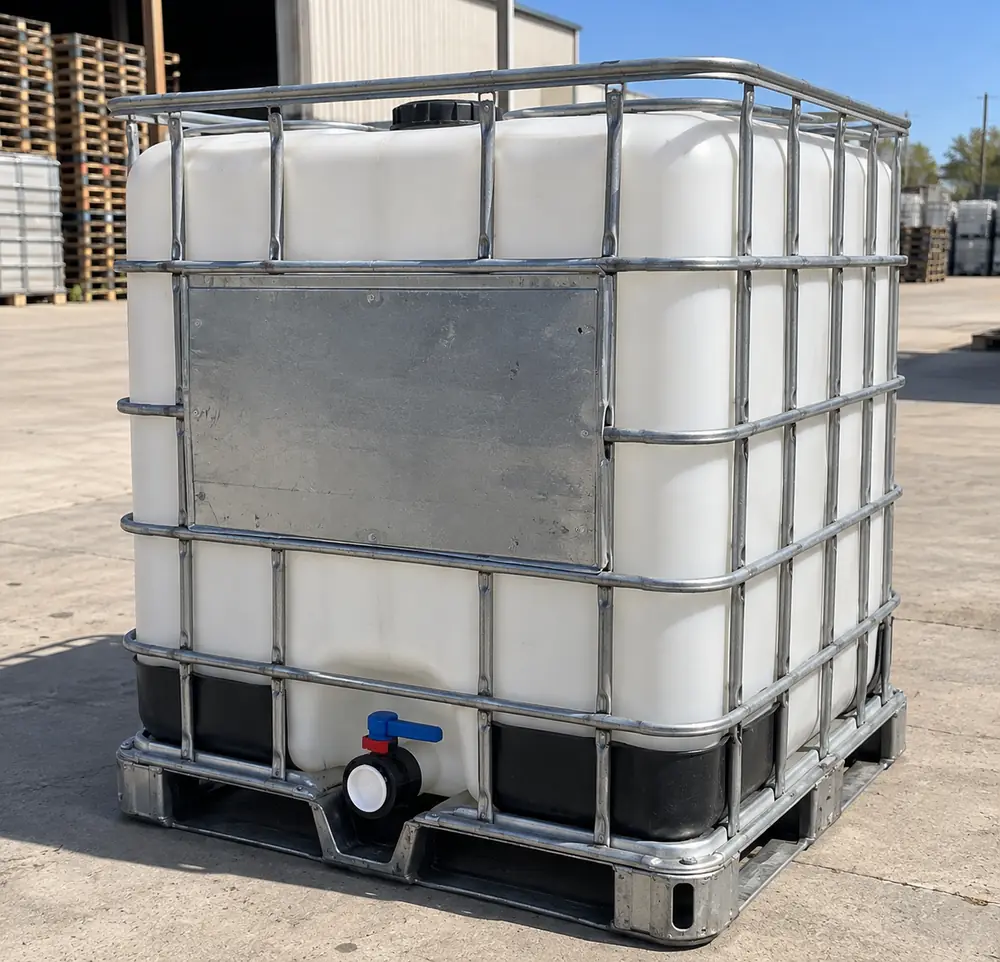
What you are actually buying
The container in that photograph crossed a certified scale, was graded in writing at the inspection bench before anybody priced it, ran a recorded wash programme, held 3 psi of air for five minutes with a soap-film check on the valve boss, lid seat and lower seam, and was then fitted out to the liquid it is going to hold.
The staining you can see on some units is cosmetic and defines the Grade A / Grade B boundary — a price difference rather than a performance one. What you cannot see, and what actually matters, is the record set behind it.