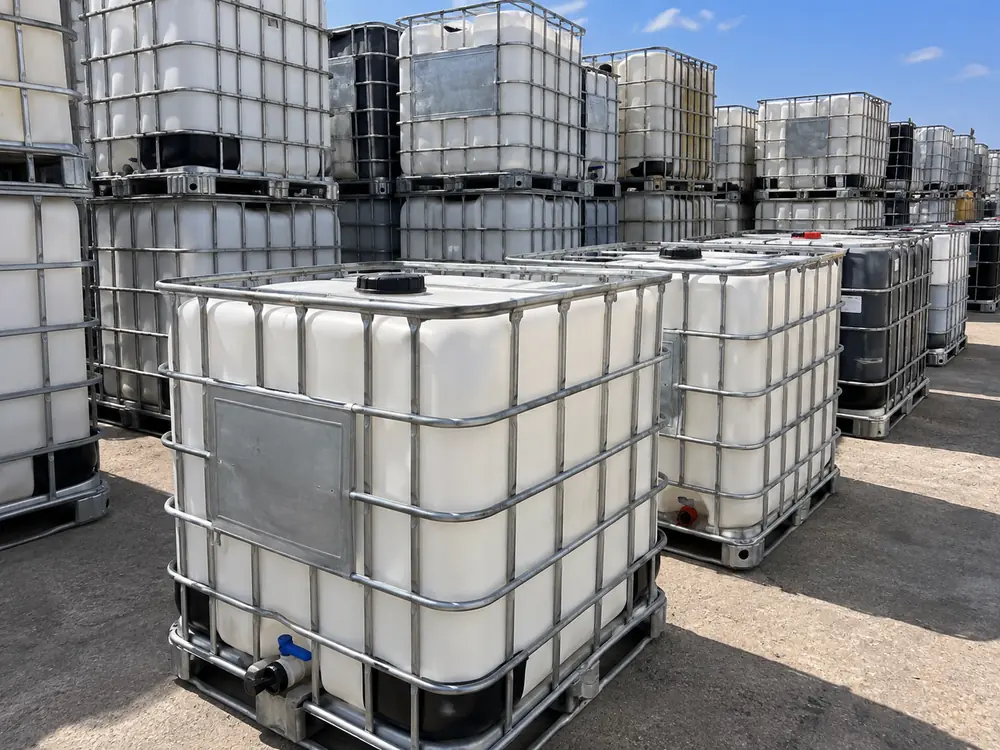
Rent the asset,
not the end-of-life problem.
Seasonal demand does not justify permanent ownership. Lease a float of graded, washed, tested totes for the weeks you actually need them, and hand them back — where they go straight into somebody else's season.
Quote a lease float
Unit count, start date, how many weeks, and the product going in. Minimum term is usually four weeks.
Tell us what you have.
We will tell you what it is worth.
Buying, selling, washing, hauling or recycling — one form covers all of it. Replies come from a specialist in York, PA, by email, inside one business day.
Prefer plain email? Write to info@ibctotesreco.com — include your ZIP, quantity and what the totes last held.
Leasing is priced per unit per week with a typical four-week minimum, plus delivery and collection freight. Units arrive graded, washed, leak tested and photographed; you return them empty and rinsed. It is the right answer for seasonal, campaign and project demand, and the highest-utilisation form of container reuse that exists — a pooled tote commonly runs three or four campaigns a year.
Who leases, and when
- Maple producers, February to April. Sap volume is brutal and brief; sixty totes for eight weeks beats sixty totes for twelve months.
- Cider, wine and craft beverage, through crush and harvest. Food- grade or rebottled floats, returned, washed, and out again to the next region.
- De-icer and winter chemistry blenders, November to March.
- Agricultural co-ops, through the spring fertiliser window.
- Construction and remediation projects, for the duration of the job, where nobody wants a hundred containers left on the books at handover.
- Anyone trialling a new product line who does not yet know whether the volume is real.
Why pooling is the best environmental answer we have
A purchased tote spends most of its life idle. A pooled tote is almost never idle: it comes back, goes through the wash line in 72 hours, and ships to the next customer whose season is starting. The embodied carbon of the container is amortised across three or four times as much useful work, which is a larger improvement than anything you can achieve by changing the container itself.
It also solves the end-of-life question structurally. We own the asset, so we are the ones who rebottle it, re-grade it and eventually recycle it with documentation. You never have a hundred weathered totes behind a building and no plan.
How the paperwork works
A lease schedule sets out the unit count, grade, start and end dates, weekly rate, freight both ways, the condition standard for return, and the replacement charge for a unit that does not come back or comes back destroyed. All of it is agreed in writing before the first delivery, and none of it changes mid-term.
The honest comparison
Leasing is not always cheaper. Here is where the line sits.
| Factor | Lease | Purchase |
|---|---|---|
| Best when | Seasonal, project or uncertain demand | Year-round, predictable demand |
| Breaks even at | Roughly 6–8 months of continuous use | Immediately, if used continuously |
| Capital | None | Full, up front |
| Storage off-season | Ours | Yours |
| Washing between products | Included at turnaround | Your cost or ours, per batch |
| End of life | Our problem | Your problem |
| Condition on arrival | Graded, tested, photographed | Graded, tested, photographed |
| Flexibility to scale | Extend or add by email | Buy more, own more |
| Carbon per unit of work | Lowest available | Good, but idle time counts |
If your float would be in use more than about eight months a year, buy — Grade B reconditioned will be cheaper and we will tell you so.
Leasing FAQ
When does leasing beat buying IBC totes?
Whenever your demand is seasonal, project-based or uncertain. A maple producer needs sixty totes for eight weeks; a cider house needs forty for a crush; a de-icer blender needs a hundred from November to March. Buying means owning idle assets for nine months, storing them, and dealing with their end of life. Leasing turns that into a line item for the weeks you actually need them.
What does a lease cost?
Priced per unit per week with a minimum term, usually four weeks, plus delivery and collection freight. Longer terms and larger floats are materially cheaper per unit-week. Food-grade and rebottled units cost more than Grade B because the wash and documentation cost more.
What condition are leased totes in?
The same graded, washed, leak-tested, re-valved and re-marked condition as anything we sell — photographed before dispatch and photographed again on return. You get the grade certificate and test record exactly as a purchaser would.
What are my obligations on return?
Return them empty, rinsed and in the condition issued, less fair wear. Fair wear means scuffing, staining from your own product and normal handling marks. It does not mean a bowed cage from double-stacking beyond the rating, a cracked bottle from freezing, or a missing valve. Replacement charges are stated on the lease schedule before the lease starts, never invented afterwards.
Can I buy the units at the end?
Yes, and lease-to-own is common with customers whose seasonal demand turns out to be permanent. The accumulated lease payments are credited against the purchase price on a declining schedule set out at the start.
What if my season runs long?
Extend by email. We would far rather extend a lease than have units come back in the middle of your busiest fortnight. Extensions bill at the same weekly rate with no re-mobilisation charge.
Related pages
Utilisation is the biggest lever in bulk packaging
A purchased tote serving a ten-week season is idle for forty-two weeks. A pooled one runs three or four campaigns a year from the same embodied footprint.
| Period | Where | Between jobs |
|---|---|---|
| Late Feb – mid Apr | Maple producer, sap collection | Wash, test, re-grade — 72 hours |
| May – June | Beverage plant, syrup transfer | Wash, test, re-grade |
| Late Sep – Nov | Cider house, crush and transfer | Wash, test, re-grade |
| Dec – Jan | Juice concentrate campaign | Wash, test, re-grade |
| Idle | Roughly 8 weeks total | Racked, photographed, ready |
When each sector needs a float
| Month | Food-grade demand | Industrial demand | Inbound supply | What it means for you |
|---|---|---|---|---|
| January | Low | High (de-icer) | Average | Winter emergencies; frozen heels slow the gate |
| February | High (maple starts) | High | Average | Sugaring floats go out; access often difficult |
| March | Highest (maple peak) | Moderate | Low | Freeze-damage crop arrives from last autumn |
| April | High | High (fertiliser) | Average | Maple returns, spring inputs ship |
| May | Average | Highest (fertiliser) | High | Biggest Grade B volume window |
| June | Average | High | High | Best month to sell us empties |
| July | Low | Average | Highest | Deepest stock; cheapest buying |
| August | Low | Average | Highest | Book autumn food-grade now |
| September | Highest (cider, crush) | High (de-icer fill) | Low | The squeeze begins |
| October | Highest | High | Lowest | Food-grade lead times stretch to 2–3 weeks |
| November | Average | Highest | Low | Winter chemistry fills; order covers and jackets |
| December | Average (juice runs) | High | Low | Holiday-week bookings close early |
Everything agreed before the first delivery
Almost every lease dispute in this industry comes from the absence of the fourth line below. With it written down, we have had three in seventeen years.
- Unit count, grade and format, with the actual serials recorded on dispatch.
- Start and end dates, and the weekly rate per unit.
- Freight both ways, quoted as its own line rather than buried in the rate.
- Return condition, defined. Empty and rinsed. Fair wear accepted: scuffing, staining from your own product, handling marks, abraded stencilling.
- Not fair wear, defined: a bowed cage from over-stacking, a cracked bottle from freezing, a missing valve, a cracked valve boss from an unsupported pump.
- Replacement charge per unit, stated up front — never invented afterwards.
- Extension terms: by email, same weekly rate, no re-mobilisation charge.
- Lease-to-own credit schedule, if you want the option.
Grades available on a float, and what each commits us to
| Grade A | Grade B | Grade C | Cage / pallet only | |
|---|---|---|---|---|
| Bottle clarity | Clear / near-clear | Haze & staining permitted | Ghosting permitted | n/a |
| Prior service | Documented edible, signed at source | Industrial, declared | Industrial, declared | Any declared |
| Wash programme | Food line, recorded | Programme to residue, recorded | Ambient rinse | Cage rinse only |
| Hydrostatic test | 100% of units | Sampled | Sampled | n/a |
| New valve & gaskets | Yes, FDA-compliant | Yes | Sound or new | n/a |
| New lid | Yes | Yes | Sound or new | n/a |
| Re-marked | Yes | Yes | Where the plate survives | No |
| Stackable when filled | 2 high | 2 high | No | n/a |
| 30-day leak warranty | Yes | Yes | No — watertight at loading | No warranty |
| Food / potable | Yes, with records | No | No | n/a |
| Cost vs new | ≈ 35–45% | ≈ 25–32% | ≈ 18–24% | ≈ 5–10% |
| Lead time | Ex-stock to 5 days | Ex-stock | Ex-stock | Ex-stock |
| Loop score (lives left) | 5–6 | 4–5 | 2–3 | 3–4 bottles |
Formats available on a float
| Format | Nominal | Usable | L × W × H | Tare (steel base) | Gross, water | Outlet | Stack filled | Availability |
|---|---|---|---|---|---|---|---|---|
| 275 gal standard | 275 gal / 1,041 L | 265 gal | 48 × 40 × 46" | 137 lb | 2,347 lb | 2" S60x6 | 2 high | Ex-stock |
| 275 gal tall | 275 gal / 1,041 L | 264 gal | 48 × 40 × 53" | 141 lb | 2,342 lb | 2" S60x6 | 2 high | Regular |
| 330 gal standard | 330 gal / 1,249 L | 320 gal | 48 × 40 × 53" | 165 lb | 2,834 lb | 2" S60x6 | 2 high | Ex-stock |
| 350 gal | 350 gal / 1,325 L | 338 gal | 48 × 40 × 58" | 172 lb | 2,991 lb | 2" or 3" | 2 high | Occasional |
| 400 gal | 400 gal / 1,514 L | 386 gal | 48 × 46 × 60" | 198 lb | 3,417 lb | 3" buttress | 1 high | Order |
| 550 gal | 550 gal / 2,082 L | 532 gal | 48 × 48 × 72" | 251 lb | 4,688 lb | 3" buttress | 1 high | Occasional |
| 120 gal mini | 120 gal / 454 L | 115 gal | 32 × 32 × 36" | 71 lb | 1,030 lb | 2" S60x6 | 2 high | Occasional |
| 180 gal | 180 gal / 681 L | 174 gal | 40 × 40 × 42" | 98 lb | 1,549 lb | 2" S60x6 | 2 high | Order |
| Stainless 265 gal | 265 gal / 1,003 L | 258 gal | 48 × 40 × 50" | 285 lb | 2,436 lb | 2" tri-clamp | 2 high | Occasional |
| Stainless 330 gal | 330 gal / 1,249 L | 322 gal | 48 × 40 × 56" | 330 lb | 3,015 lb | 2" tri-clamp | 2 high | Occasional |
| Stainless 400 gal | 400 gal / 1,514 L | 390 gal | 48 × 46 × 62" | 385 lb | 3,637 lb | 3" tri-clamp | 1 high | Order |
| Stainless 500 gal | 500 gal / 1,893 L | 488 gal | 48 × 48 × 68" | 430 lb | 4,600 lb | 3" tri-clamp | 1 high | Order |
Prior-service rules for food-grade floats
| Prior product | Family | Food-grade eligible? | Programme | Best grade | Seal | Note |
|---|---|---|---|---|---|---|
| Apple juice concentrate (70 Bx) | Food & beverage | Yes | PF | A | FDA EPDM | Best inbound stock we see; sugars rinse clean |
| Orange juice concentrate | Food & beverage | Yes | PF | A | FDA Viton | Citrus oil fraction can scent the bottle |
| Grape juice concentrate | Food & beverage | Yes | PF | A | FDA EPDM | Watch for tartrate scale at the outlet |
| Liquid sugar / sucrose syrup | Food & beverage | Yes | PF | A | FDA EPDM | Hot rinse only, no caustic needed |
| High-fructose corn syrup | Food & beverage | Yes | PF | A | FDA EPDM | Viscous; 3" outlet helps decanting |
| Molasses | Food & beverage | Yes | PF | A | FDA EPDM | Heated rinse; heavy heel |
| Honey | Food & beverage | Yes | PF | A | FDA EPDM | Crystallises; heater jacket recommended |
| Maple sap | Food & beverage | Yes | PF | A | FDA EPDM | Benign but sugars feed biofilm fast |
| Maple syrup | Food & beverage | Yes | PF | A | FDA EPDM | Hot rinse; inspect lid seat |
| Apple cider | Food & beverage | Yes | PF | A | FDA EPDM | Vented lid essential — ferments |
| Wine / must | Food & beverage | Yes | PF | A | FDA EPDM | Tartrate scale; usually leased |
| Beer / wort | Food & beverage | Yes | PF | A | FDA EPDM | Stainless preferred for repeat service |
| Brine (pickling liquor) | Food & beverage | Yes | PF | A | FDA Viton | Check cage for chloride attack |
| Vinegar, 10% | Food & beverage | Yes | PF | A | FDA EPDM | Easy; acid-resistant seal needed |
| Soy sauce | Food & beverage | Yes | PF | A | FDA Viton | Salt plus colour; monitor ghosting |
| Edible soybean oil | Food & beverage | Yes | P2 | A | FDA Viton | 140°F minimum or fat re-deposits |
| Edible canola oil | Food & beverage | Yes | P2 | A | FDA Viton | As above |
| Olive oil | Food & beverage | Yes | P2 | A | FDA Viton | Polyphenols can tint the wall |
| Glycerine, USP | Food & beverage | Yes | PF | A | FDA EPDM | Often effectively first-use stock |
| Propylene glycol, food grade | Food & beverage | Yes | PF | A | FDA EPDM | Frequently single-product filler stock |
| Liquid egg | Food & beverage | Case by case | PF | A | FDA EPDM | Protein film needs verification |
| Milk / dairy intermediate | Food & beverage | Case by case | PF | A | FDA EPDM | Allergen changeover record required |
| Whey concentrate | Food & beverage | Case by case | PF | A | FDA EPDM | Protein scale; hot detergent |
| Tomato paste | Food & beverage | Yes | PF | A | FDA Viton | Acidic; stains but rinses |
| Fruit purée | Food & beverage | Yes | PF | A | FDA EPDM | Pulp load; coarse settling matters |
| Flavour concentrate / essence | Food & beverage | No | Refused | Rebottle | PTFE | Permeates HDPE permanently — use stainless |
| Citrus terpene oil | Food & beverage | Never | Refused | Recycle | PTFE | One batch ends a poly bottle's usefulness |
| Spent grain slurry | Food & beverage | No | P2 | B | EPDM | By-product duty; 3" outlet strongly advised |
| Yeast slurry | Food & beverage | Case by case | P2 | B | EPDM | Vent — active fermentation |
| UAN 32 liquid nitrogen | Agricultural | Never | P1 | B | EPDM | Rinses readily; dense — check ratings |
| UAN 28 | Agricultural | Never | P1 | B | EPDM | As above |
| Liquid starter 10-34-0 | Agricultural | Never | P1 | B | EPDM | Polyphosphate scale at the outlet |
| Ammonium thiosulphate | Agricultural | Never | P1 | B | EPDM | Sulphur odour persists faintly |
| Potassium thiosulphate | Agricultural | Never | P1 | B | EPDM | Very dense; 275 format only |
| Calcium nitrate solution | Agricultural | Never | P1 | B | EPDM | Crystallises when cold |
| Humic / fulvic acid | Agricultural | Never | P2 | B | EPDM | Dark staining, usually washes out |
| Fish hydrolysate fertiliser | Agricultural | Never | P3 | C | Viton | Odour frequently permanent |
| Foliar micronutrient blend | Agricultural | Never | P1 | B | EPDM | Metal salts can tint the wall |
| Glyphosate concentrate | Agricultural | Never | P3 | C | Viton | Labelled rinse programme governs |
| 2,4-D amine concentrate | Agricultural | Never | Refused | Per label | Viton | Label prescribes rinse-and-destroy |
| Crop oil adjuvant | Agricultural | Never | P3 | C | Viton | Attacks EPDM; permeates slowly |
| Surfactant adjuvant (NIS) | Agricultural | Never | P1 | B | EPDM | Foams heavily on transfer |
| Molluscicide suspension | Agricultural | Never | Refused | Per label | Viton | Refused — labelled destruction |
| Livestock drinking water | Water & inert | Yes | P1 | A | EPDM | Effectively first-use |
| Irrigation water | Water & inert | Yes | P1 | A | EPDM | May carry silt; coarse settling |
| Sodium hydroxide 50% | Industrial chemistry | Never | P1 | B | EPDM | 3,497 lb filled — check every rating |
| Sodium hydroxide 25% | Industrial chemistry | Never | P1 | B | EPDM | Easy wash; dilute and drain |
| Potassium hydroxide 45% | Industrial chemistry | Never | P1 | B | EPDM | As NaOH; dense |
| Sulphuric acid 93% | Industrial chemistry | Never | Refused | Dedicated | PTFE | 4,182 lb filled; dedicated service only |
| Sulphuric acid 35% | Industrial chemistry | Never | P1 | C | PTFE | Fume attack on cage galvanising |
| Hydrochloric acid 31% | Industrial chemistry | Never | P1 | C | PTFE | Cage usually the limiting factor |
| Phosphoric acid 75% | Industrial chemistry | Never | P1 | B | PTFE | Dense; viscous at low temperature |
| Nitric acid 42% | Industrial chemistry | Never | Refused | Dedicated | PTFE | Oxidiser — embrittles HDPE |
| Hydrogen peroxide 35% | Industrial chemistry | Case by case | P1 | B | PTFE | Vent; absolutely no contaminants |
| Sodium hypochlorite 12% | Industrial chemistry | Never | P1 | B | EPDM | Degasses; vent and shield from UV |
| Ferric chloride 40% | Industrial chemistry | Never | P2 | C | Viton | Heavy orange staining is permanent |
| Aluminium sulphate | Industrial chemistry | Never | P1 | B | EPDM | Scale at the outlet boss |
| Polyaluminium chloride | Industrial chemistry | Never | P1 | B | EPDM | Gels if allowed to dry out |
| Propylene glycol coolant | Industrial chemistry | Never | P1 | B | EPDM | Ideal duty; nothing to watch |
| Ethylene glycol | Industrial chemistry | Never | P1 | B | EPDM | Toxic — never re-grade for potable |
| Calcium chloride brine 32% | Industrial chemistry | Never | P1 | B | Viton | Chloride attack on lower cage |
| Magnesium chloride de-icer | Industrial chemistry | Never | P1 | B | Viton | As above; rinse frames each spring |
| Potassium acetate de-icer | Industrial chemistry | Never | P1 | B | EPDM | Benign; airport runway chemistry |
| Urea solution (DEF) | Industrial chemistry | Never | P1 | B | EPDM | Purity-critical next fill; usually dedicated |
| Nickel plating solution | Industrial chemistry | Never | Refused | Recycle | Viton | Metal-bearing; never re-used |
| Chromic acid solution | Refused | Never | Refused | Refused | PTFE | Not accepted at the gate |
| Cyanide plating bath | Refused | Never | Refused | Refused | PTFE | Acutely hazardous — licensed facility only |
| Phosphate conversion coating | Industrial chemistry | Never | P2 | C | Viton | Scale and staining |
| Amine corrosion inhibitor | Industrial chemistry | Never | P2 | B | Viton | Fish-like odour can persist |
| Sodium silicate | Industrial chemistry | Never | P3 | C | EPDM | Sets hard if dried; wash promptly |
| Polymer flocculant emulsion | Industrial chemistry | Never | P3 | C | EPDM | Extremely slippery; gels with water |
| Sodium bisulphite | Industrial chemistry | Never | P1 | B | EPDM | Sulphur odour; vent |
| Antifoam silicone emulsion | Industrial chemistry | Never | P3 | C | Viton | Film is very hard to remove |
| Latex paint, white | Coatings & inks | Never | P3 | C | EPDM | Heavy ghosting; often rebottle |
| Latex paint, tinted | Coatings & inks | Never | P3 | C | EPDM | Pigment ghosting permanent |
| Water-based pigment dispersion | Coatings & inks | Never | P3 | C | EPDM | Strong colour transfer into the wall |
| Flexographic ink | Coatings & inks | Never | P3 | Rebottle | Viton | Resin binder plasticises the surface |
| UV-curable coating | Coatings & inks | Never | Refused | Recycle | PTFE | Cures in the bottle; not washable |
| Acrylic adhesive emulsion | Coatings & inks | Never | P3 | Rebottle | EPDM | Caustic at 180°F, often still ghosts |
| PVA wood adhesive | Coatings & inks | Never | P3 | C | EPDM | Wash before it skins over |
| Polyurethane resin, 2-part | Coatings & inks | Never | Refused | Recycle | PTFE | Cross-linked; nothing shifts it |
| Asphalt emulsion | Coatings & inks | Never | P3 | C | Viton | Hot caustic plus long dwell |
| Concrete release agent | Coatings & inks | Never | P2 | C | Viton | Oily film; 140°F detergent |
| Mineral oil, hydraulic | Oils & fuels | Never | P3 | B | Viton | Permeation; faint odour often remains |
| Cutting fluid, soluble | Oils & fuels | Never | P3 | B | Viton | Bacterial odour is the real problem |
| Gear oil | Oils & fuels | Never | P3 | C | Viton | Heavy film; two cycles common |
| Used motor oil | Refused | Never | Refused | Recycle | Viton | Waste stream — not accepted for reuse |
| Diesel fuel | Oils & fuels | Never | Refused | Recycle | Viton | Permanent odour; bottle compromised |
| Kerosene | Oils & fuels | Never | Refused | Recycle | Viton | As diesel |
| Biodiesel B100 | Oils & fuels | Never | P3 | C | Viton | Solvency attacks some HDPE grades |
| Vegetable-based lubricant | Oils & fuels | Never | P2 | B | Viton | Oxidises to a varnish if left |
| Anionic surfactant concentrate | Cleaning & sanitation | Never | P1 | B | EPDM | It is soap — rinses, but foams |
| Non-ionic surfactant | Cleaning & sanitation | Never | P1 | B | EPDM | Easy wash |
| Alkaline degreaser | Cleaning & sanitation | Never | P1 | B | EPDM | Compatible with our own loop |
| Acid descaler | Cleaning & sanitation | Never | P1 | B | PTFE | Segregate heel from caustic tanks |
| Quaternary ammonium sanitiser | Cleaning & sanitation | Case by case | P1 | B | EPDM | Residual actives need verification |
| Peracetic acid sanitiser | Cleaning & sanitation | Case by case | P1 | B | PTFE | Oxidiser; vent and shield |
| Hand sanitiser (ethanol 70%) | Cleaning & sanitation | Case by case | P1 | B | Viton | Alcohol flashes off; little residue |
| Laundry detergent, liquid | Cleaning & sanitation | Never | P1 | B | EPDM | Optical brighteners can tint |
| Car wash soap concentrate | Cleaning & sanitation | Never | P1 | B | EPDM | Very common inbound stock |
| Floor finish / wax emulsion | Cleaning & sanitation | Never | P3 | C | EPDM | Films hard; wash before it dries |
| Potable water | Water & inert | Yes | P1 | A | FDA EPDM | Frequently first-use stock |
| Deionised water | Water & inert | Yes | P1 | A | FDA EPDM | Best-value first-use source |
| Distilled water | Water & inert | Yes | P1 | A | FDA EPDM | As above |
| Glycerine, technical | Water & inert | No | P1 | B | EPDM | Technical grade is not food grade |
| Saline solution, industrial | Water & inert | Never | P1 | B | Viton | Chloride; inspect cage |
| Unknown or mixed residue | Refused | Never | Refused | Refused | — | Safety assessment, not a grading question |
| RCRA P-listed residue | Refused | Never | Refused | Refused | — | Licensed treatment facility only |
| Radiological material | Refused | Never | Refused | Refused | — | No testing, no discussion |
| Pesticide, labelled destruction | Refused | Never | Refused | Refused | — | Service life ended by regulation |
Carbon outcome of pooling versus purchase
| Route | CO₂e | Fresh water | Virgin resin | Virgin steel |
|---|---|---|---|---|
| New unit | ≈ 410 lb | ≈ 290 gal | 118 lb | 62 lb |
| Rebottled | ≈ 182 lb | ≈ 120 gal | 47 lb | 0 lb |
| Reconditioned | ≈ 34 lb | ≈ 31 gal | 0 lb | 0 lb |
| Repurposed Grade C | ≈ 11 lb | ≈ 14 gal | 0 lb | 0 lb |
Documents issued on a lease
| Document | What it contains | When you get it |
|---|---|---|
| Written quotation | Unit price by grade, freight as its own line, validity, and the conditions that would change it | Before you order |
| Grade certificate | Assigned grade against our published definitions, per unit serial | With the order |
| Leak & pressure test record | Test pressure, hold time, outcome, per serial | With the order |
| Hydrostatic test certificate | 100% of food-line units, recorded against serial | Food-grade orders |
| Prior-contents declaration | Named last product, generating site, signature | Anything we collected |
| Wash programme record | Bay, programme, temperature, chemistry, cycle time | Reconditioned & contract work |
| Rinse verification | Final-rinse pH and conductivity | Reconditioned & contract work |
| Component specification | Valve, gasket, lid materials with compliance references | Food-grade orders |
| Photograph set | The actual units on the rack before loading | Every order |
| Weight ticket | Certified-scale gross weight and count | Collections and cleanouts |
| Diversion certificate | Unit counts, weights by stream, destination routes, dates | End-of-life batches |
| Certificate of insurance | GL, auto, cargo, workers' comp; additional insured | Before a crew arrives |
| Reconditioner marking detail | Code, date, design type | Re-marked units |
| Lease schedule | Count, grade, dates, weekly rate, return condition, replacement charge | Leases |
Five cases where we will tell you to buy instead
More than about eight months of annual use
The weekly rate stops being a saving and becomes a premium on an asset you are effectively using full-time.
A dedicated single-product fleet
If your containers must never hold anything but your product — branded, or allergen-controlled — a pool is the wrong structure by definition.
Chloride brines and de-icer
Chloride shortens cage life, which pushes a float outside normal fair wear. De-icer is the one seasonal business where we usually say buy.
Sites where collection is genuinely difficult
A pool only works if containers come back. Where access is the problem, ownership is the better answer.
Volume you already know is permanent
If the seasonality turned out to be year-round demand, lease-to-own credits the payments and we will raise it rather than wait.
What arrives on a lease
Exactly what arrives on a purchase: the same grade certificate, the same leak and pressure test record, the same photograph set. The only difference is that we own the asset and therefore we own its end of life.
Between campaigns these go back through the wash line in 72 hours and out to the next producer whose season is starting. A pooled container commonly runs three or four jobs a year against one if it were bought.