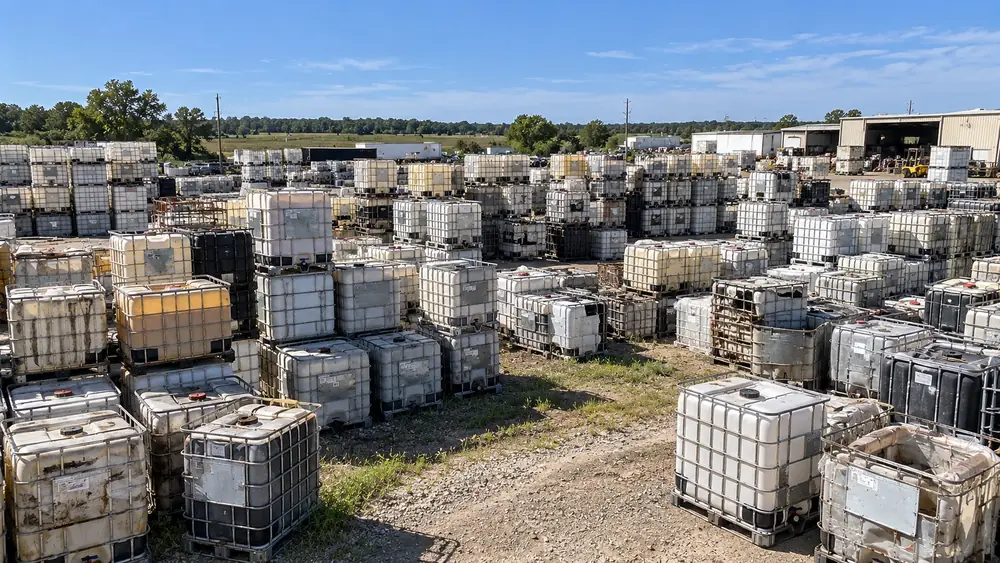
A yard with a
long memory.
Seventeen years of buying, washing, re-marking and hauling bulk containers out of York, PA. We know what was in the tote because we wrote it down when it came in.
Work with us
Supplier, customer, hauler or recycler — the same form reaches the right desk.
Tell us what you have.
We will tell you what it is worth.
Buying, selling, washing, hauling or recycling — one form covers all of it. Replies come from a specialist in York, PA, by email, inside one business day.
Prefer plain email? Write to info@ibctotesreco.com — include your ZIP, quantity and what the totes last held.
We started because nobody would give us a straight answer
In 2009 our founder was buying bulk surfactant for a small janitorial blending operation in Manchester Township. The totes arrived with mystery residue, a cage welded back together at an angle, and a seller who went quiet the moment a question was asked. Three loads in, it became obvious that the gap in the market was not supply — there were used totes everywhere — it was honesty about condition.
So the model was simple from day one: write down what was in every container, photograph every unit, grade it against a published definition, and refuse the sale when the grade does not suit the job. Seventeen years later that is still the entire competitive advantage. It is also why we run no phone line — every grade call, price and freight commitment goes in writing, where it can be checked.
What we actually are
Three things at once, and they feed each other. We are a buyer of empties, which gives us stock nobody else has priced yet. We are a reconditioner, which lets us turn that stock into graded, re-marked assets instead of reselling somebody else's problem. And we are a hauler, which means a 40-tote load does not sit waiting on a third-party lane. The recycling arm exists for the small fraction that genuinely cannot come back — about 2.6% of inbound last year.
If you want the detail, the full company history runs year by year, and the facility page walks the site bay by bay.
Four ways into the company
Each of these pages goes deeper than a typical about section, because used-container buying rewards people who read the detail.
Our story
Seventeen years in dated entries, including the two years we nearly got it wrong.
OpenSustainability & impact
The environmental argument for reuse, with the arithmetic behind every claim.
OpenFacility & logistics
Inside 310 Emig Rd: bays, wash line, water train, racking and loading.
OpenCertifications & compliance
UN reconditioner marking, RCRA posture, food-grade handling, insurance.
OpenFive house rules
These are pinned above the wash bay door. They are not aspirational; breaking one is how someone loses a job here.
- The declaration rules. If we cannot establish what a container held, it does not get washed for reuse. It gets rebottled or recycled.
- Grade before price. The grade is set by the person inspecting, not by the person selling.
- Say no out loud. If a customer asks for an industrial-prior tote for potable water, we tell them why the answer is no, in writing.
- Reuse before recycling, always. Granulating a sound bottle to hit a recycling tonnage target is vandalism with a spreadsheet.
- Everything in writing. No phone line, no ambiguity, no “you said”.
We are usually hiring yard hands and wash operators.
Seventeen years, measured
Capacity, throughput, diversion and the published datasets that come out of it.
| Year | Units in | Diversion | Manifested | Notable change |
|---|---|---|---|---|
| 2019 | 19,400 | 88.2% | 11.8% | Closed-loop water train commissioned |
| 2020 | 26,800 | 90.6% | 9.4% | Food line run six days a week |
| 2021 | 24,100 | 92.4% | 7.6% | Upcycled builds workshop opened |
| 2022 | 27,300 | 94.1% | 5.9% | Lease pool launched |
| 2023 | 29,600 | 96.1% | 3.9% | Diversion certificates formalised |
| 2024 | 31,200 | 96.8% | 3.2% | Stainless stream added |
| 2025 | 33,900 | 97.4% | 2.6% | Sludge dewatering upgraded |
The datasets, open
Unusual in this trade and deliberate. A reconditioner who will not tell you their parameters is guessing.
Wash programmes with temperature, chemistry and cycle time
| Code | Programme | Temperature | Chemistry | Cycle | Relative cost | Suits |
|---|---|---|---|---|---|---|
| P1 | Ambient flood rinse | Ambient | Process water, occasional mild alkaline | 90 sec | 1.0× | Water-miscible residues |
| P2 | Hot detergent | 140°F | Alkaline detergent 1.5–2.5% | 3 min | 2.2× | Oils, fats, filming products |
| P3 | Caustic clean-in-place | 160–180°F | NaOH 2–4% + surfactant | 6–9 min | 4.5× | Pigments, latex, resins, heavy concentrates |
| PF | Food line (Bay 1) | 140°F | Alkaline detergent 2% + 100% hydrostatic | 3 min + test | 3.1× | Documented edible prior service |
| Refused | Not accepted | — | — | — | — | Unknown, acute, labelled-destruction, radiological |
Grade matrix — thirteen attributes, four conditions
| Grade A | Grade B | Grade C | Cage / pallet only | |
|---|---|---|---|---|
| Bottle clarity | Clear / near-clear | Haze & staining permitted | Ghosting permitted | n/a |
| Prior service | Documented edible, signed at source | Industrial, declared | Industrial, declared | Any declared |
| Wash programme | Food line, recorded | Programme to residue, recorded | Ambient rinse | Cage rinse only |
| Hydrostatic test | 100% of units | Sampled | Sampled | n/a |
| New valve & gaskets | Yes, FDA-compliant | Yes | Sound or new | n/a |
| New lid | Yes | Yes | Sound or new | n/a |
| Re-marked | Yes | Yes | Where the plate survives | No |
| Stackable when filled | 2 high | 2 high | No | n/a |
| 30-day leak warranty | Yes | Yes | No — watertight at loading | No warranty |
| Food / potable | Yes, with records | No | No | n/a |
| Cost vs new | ≈ 35–45% | ≈ 25–32% | ≈ 18–24% | ≈ 5–10% |
| Lead time | Ex-stock to 5 days | Ex-stock | Ex-stock | Ex-stock |
| Loop score (lives left) | 5–6 | 4–5 | 2–3 | 3–4 bottles |
Container formats — twelve, full dimensional data
| Format | Nominal | Usable | L × W × H | Tare (steel base) | Gross, water | Outlet | Stack filled | Availability |
|---|---|---|---|---|---|---|---|---|
| 275 gal standard | 275 gal / 1,041 L | 265 gal | 48 × 40 × 46" | 137 lb | 2,347 lb | 2" S60x6 | 2 high | Ex-stock |
| 275 gal tall | 275 gal / 1,041 L | 264 gal | 48 × 40 × 53" | 141 lb | 2,342 lb | 2" S60x6 | 2 high | Regular |
| 330 gal standard | 330 gal / 1,249 L | 320 gal | 48 × 40 × 53" | 165 lb | 2,834 lb | 2" S60x6 | 2 high | Ex-stock |
| 350 gal | 350 gal / 1,325 L | 338 gal | 48 × 40 × 58" | 172 lb | 2,991 lb | 2" or 3" | 2 high | Occasional |
| 400 gal | 400 gal / 1,514 L | 386 gal | 48 × 46 × 60" | 198 lb | 3,417 lb | 3" buttress | 1 high | Order |
| 550 gal | 550 gal / 2,082 L | 532 gal | 48 × 48 × 72" | 251 lb | 4,688 lb | 3" buttress | 1 high | Occasional |
| 120 gal mini | 120 gal / 454 L | 115 gal | 32 × 32 × 36" | 71 lb | 1,030 lb | 2" S60x6 | 2 high | Occasional |
| 180 gal | 180 gal / 681 L | 174 gal | 40 × 40 × 42" | 98 lb | 1,549 lb | 2" S60x6 | 2 high | Order |
| Stainless 265 gal | 265 gal / 1,003 L | 258 gal | 48 × 40 × 50" | 285 lb | 2,436 lb | 2" tri-clamp | 2 high | Occasional |
| Stainless 330 gal | 330 gal / 1,249 L | 322 gal | 48 × 40 × 56" | 330 lb | 3,015 lb | 2" tri-clamp | 2 high | Occasional |
| Stainless 400 gal | 400 gal / 1,514 L | 390 gal | 48 × 46 × 62" | 385 lb | 3,637 lb | 3" tri-clamp | 1 high | Order |
| Stainless 500 gal | 500 gal / 1,893 L | 488 gal | 48 × 48 × 68" | 430 lb | 4,600 lb | 3" tri-clamp | 1 high | Order |
Carbon by route, with the factors used
| Route | CO₂e | Fresh water | Virgin resin | Virgin steel |
|---|---|---|---|---|
| New unit | ≈ 410 lb | ≈ 290 gal | 118 lb | 62 lb |
| Rebottled | ≈ 182 lb | ≈ 120 gal | 47 lb | 0 lb |
| Reconditioned | ≈ 34 lb | ≈ 31 gal | 0 lb | 0 lb |
| Repurposed Grade C | ≈ 11 lb | ≈ 14 gal | 0 lb | 0 lb |
| Input | Quantity | Factor or source |
|---|---|---|
| Virgin HDPE resin | 118 lb / 53.5 kg | 1.8 kg CO₂e/kg |
| Blow moulding energy | 53.5 kg part | 0.4 kg CO₂e/kg |
| Hot-dip galvanised steel | 106 lb / 48 kg | 2.5 kg CO₂e/kg |
| Cage fabrication & assembly | 48 kg | 0.3 kg CO₂e/kg |
| Mechanical HDPE recycling | per kg processed | 0.5 kg CO₂e/kg |
| Fresh water per wash | 31 gal / unit | Metered |
| Natural gas, water heating | per programme | Metered per bay per shift |
| Electricity | per unit | Renewable tariff + 48 kW array |
| New valve, gaskets, lid | ≈ 3 lb | ≈ 8 lb CO₂e |
Standards and regulations — eighteen, with who each binds
| Reference | Title | What it covers | Who it binds |
|---|---|---|---|
| 49 CFR 172.101 | Hazardous materials table | Classification and authorised packaging reference | Shippers |
| 49 CFR 172 Subpart H | Training | Who must be trained, in what, how often, with records | Any hazmat employer |
| 49 CFR 173 | Shippers — general requirements by class | Whether an IBC is authorised for your entry | Shippers |
| 49 CFR 178 Subpart N | IBC design types, testing and marking | What the plate means and how it was earned | Makers, reconditioners |
| 49 CFR 180.352 | Periodic inspection, testing, repair & remanufacture | 2.5-year visual, 5-year leakproofness + full inspection | Owners, shippers |
| 40 CFR 261.7 | RCRA empty containers | When a container counts as empty; P-list triple rinse | Generators |
| 40 CFR 262 | Generator standards | Waste determination, manifesting, accumulation | Generators |
| 21 CFR 177.1520 | Olefin polymers | HDPE compliance for food contact | Food users |
| 21 CFR 177.2600 | Rubber articles for repeated use | Gasket and seal compliance for food contact | Food users |
| 21 CFR 110 / 117 | Good manufacturing practice | Handling, storage, sanitation programmes | Food users |
| NSF/ANSI 61 | Drinking water system components | Potable-contact material evaluation | Water utilities |
| 29 CFR 1910.1200 | Hazard communication | Workplace labelling and safety data sheets | Everyone |
| 29 CFR 1910.146 | Permit-required confined spaces | Entry into tanks and vessels | Anyone cleaning containers |
| 29 CFR 1910.178 | Powered industrial trucks | Forklift operation and certification | Yards and docks |
| ANSI/ITSDF B56.1 | Low-lift and high-lift trucks | Capacity ratings and load centres | Yards and docks |
| ANSI MH16.1 | Steel storage racking | Beam capacity, deflection, inspection | Warehouses |
| PA Title 25 Ch. 95 | Wastewater treatment requirements | Industrial discharge standards in Pennsylvania | Wash lines |
| ISPM-15 | Wood packaging in international trade | Heat treatment and marking of timber pallets | Exporters |
Documents we issue — fourteen, as standard
| Document | What it contains | When you get it |
|---|---|---|
| Written quotation | Unit price by grade, freight as its own line, validity, and the conditions that would change it | Before you order |
| Grade certificate | Assigned grade against our published definitions, per unit serial | With the order |
| Leak & pressure test record | Test pressure, hold time, outcome, per serial | With the order |
| Hydrostatic test certificate | 100% of food-line units, recorded against serial | Food-grade orders |
| Prior-contents declaration | Named last product, generating site, signature | Anything we collected |
| Wash programme record | Bay, programme, temperature, chemistry, cycle time | Reconditioned & contract work |
| Rinse verification | Final-rinse pH and conductivity | Reconditioned & contract work |
| Component specification | Valve, gasket, lid materials with compliance references | Food-grade orders |
| Photograph set | The actual units on the rack before loading | Every order |
| Weight ticket | Certified-scale gross weight and count | Collections and cleanouts |
| Diversion certificate | Unit counts, weights by stream, destination routes, dates | End-of-life batches |
| Certificate of insurance | GL, auto, cargo, workers' comp; additional insured | Before a crew arrives |
| Reconditioner marking detail | Code, date, design type | Re-marked units |
| Lease schedule | Count, grade, dates, weekly rate, return condition, replacement charge | Leases |
Four activities that subsidise each other
A dealer who only sells buys other people's unknowns. A washer who only washes has idle bays. We do all four, and each absorbs the others' slack.
| Activity | What it provides | What it absorbs | Share of the operation |
|---|---|---|---|
| Buying empties | Stock nobody else has priced yet | Return legs on outbound trucks | Roughly half the business |
| Reconditioning | Graded, re-marked assets rather than resold unknowns | Bay time when contract work is thin | The core |
| Transport | Delivered pricing that makes sense | Backhaul capacity | Own lanes across six states |
| Recycling | Rack space released, documented end-of-life | Units that failed reuse twice | 2.6% of inbound weight |
| Rebottling | Virgin surfaces without new cages | Cages whose bottles failed | ≈ 900 builds to date |
| Leasing | Highest-utilisation reuse available | Seasonal demand peaks | Growing |
| Upcycled builds | A route for sound Grade C walls | 1,840 units last year | Least profitable, most protected |
Sixteen datasets, each published in full
Everything this site measures, with the row count and the page it lives on. None of it is behind a form.
Seventeen years of saying no, photographed
Somewhere in this yard are the containers we refused to re-grade upward, the lots we bought as scrap and found sound units inside, and the cages that will carry three more bottles before anybody considers scrapping them.
It is not a tidy business and it does not photograph like a brochure. What it does have is a written record for every container that has crossed the gate since 2009 — which is the only thing in this trade that actually compounds.